Have you ever wondered where goes what you put in the toilet? In most cases, it goes to a septic tank or to the local wastewater treatment plant. The former need regular emptying, the latter is expensive and is often overflowing into rivers or the sea.
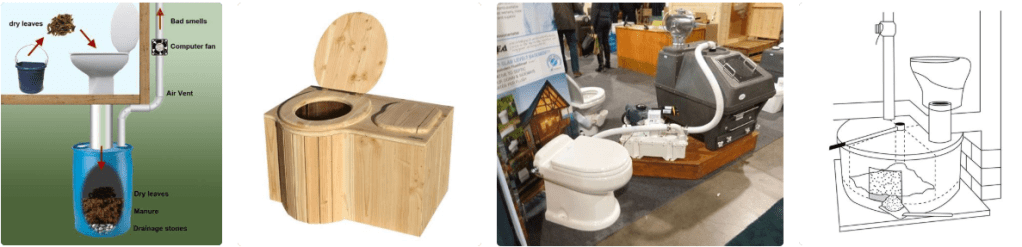
There are lots of options online for compost toilets or composting toilet or dry toilet or off-grid toilet or bio-toilet or humanure system. Some are expensive and complex, some look like “normal” toilet, most are interestingly smell free. And they save so much water! And they close the food cycle too!
Lots of system, screen capture from the first “compost toilet” Ecosia image search.
I made one.
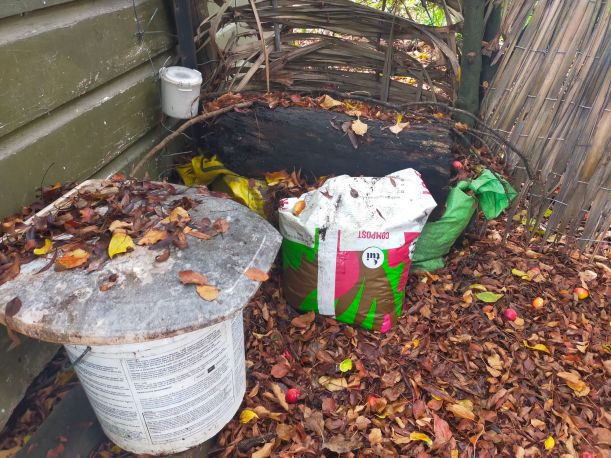
My system is simple, in a corner of the garden : a bucket, a toilet seat and lid from Wastebusters, a toilet paper roll in a water tight container, a bag of saw dust.
I love being with the birds under the trees. I use it for number 2s. I love that I don’t use water to flush. I love that my poo becomes fertilization for the garden. Not a waste.
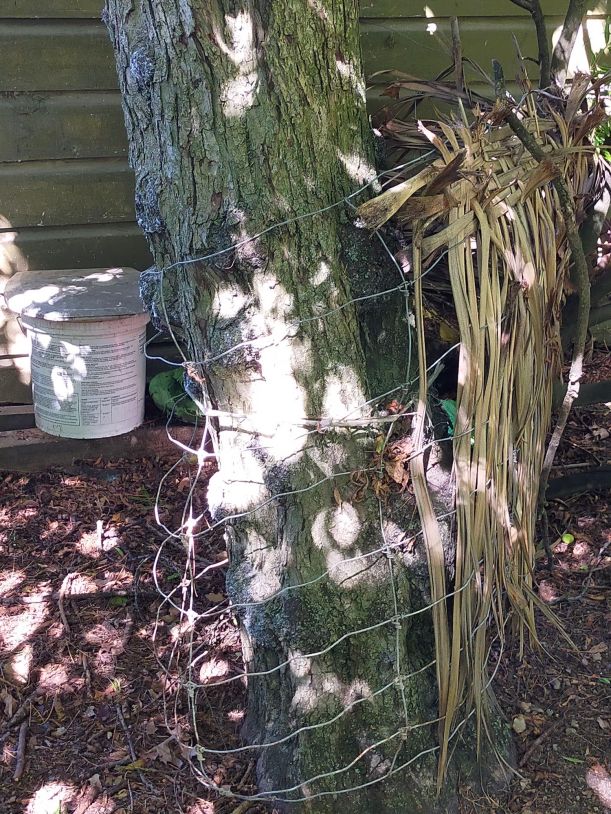
Behind a tree, hidden with a loose fence of cabbage tree leaves
Here it is, a bucket, a toilet seat with lid, a water tight box for a toilet roll and bags of saw dust. Simplissimo.
Like most people, we have toilets inside, so I only use it when I want. In nature.
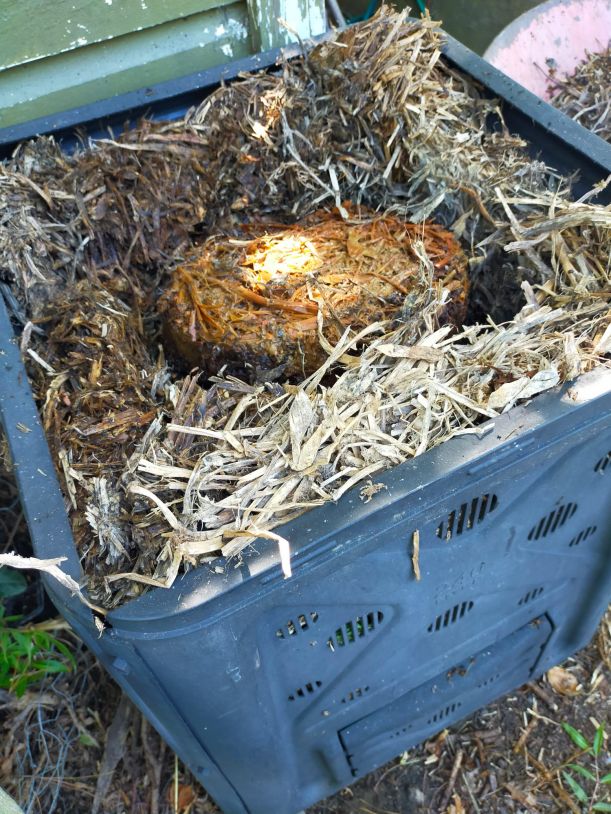
When the bucket is full, I empty it in a compost bin, nested into straw, covered with straw. It does smell but already hardly looks like what it is.
In summer, a bucket can receive about 30 uses. In winter, only 12 or 15 as it doesn’t decompose as it goes.
I can empty the full bucket in compost bins four or five times as it reduces quickly.
In autumn, I incorporate the content of the compost bin into the hot compost. At this stage, we cannot tell what it is. I make layers of leaves, mulch, a bit of biochar, our cold compost, bokashi, straw, alternating fresh (nitrogen rich) and dry (carbon rich) layers.
The layered compost is watered, often by rain this autumn season, then covered.
Temperature will reach 70 degrees C. It smokes in the morning. All baddies are transformed in goodies by wonderful nature.
In spring, the pile is 1/3 of the initial height, all nicely decomposed, used in the garden.
For commercial use in the garden, a second turn of the compost and another season are practiced, I think. Any precision on that?
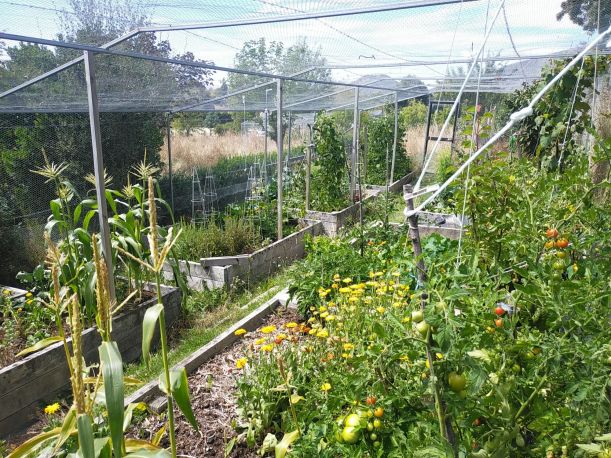
Abundant garden potager, fed yearly with our home compost
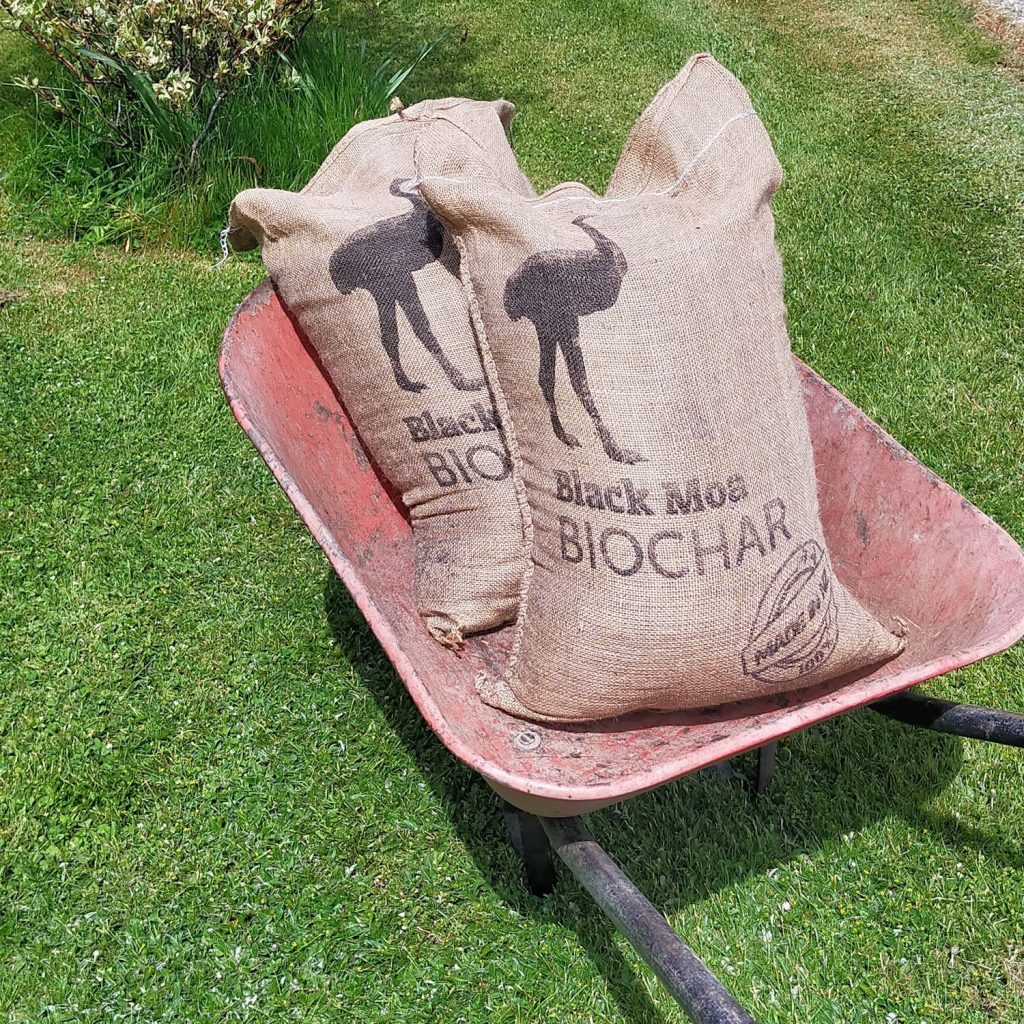
2 bags of biochar, enough for a year
Even in a small garden, it’s possible (In my previous urban garden, I had hidden it in a corner, with a few planks and a frost cloth!)
I find it rewarding to close the loop!➰🌏💧🐞💖
I hope I’ve inspired you to do your own dry toilet. Post your experience or problems in the Comments below, we may find solutions together.
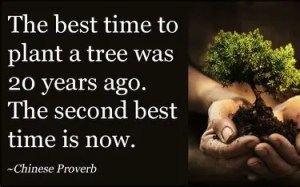
We all agree with the Chinese proverb “The best time to plant a tree was 20 years ago” and we are now well aware of all the services trees provide (biodiversity habitat and food, cleaning and regulation of air/wind, water, climate/temperature, wellbeing/esthetics etc.);
Yet in our district, established trees are cut in great numbers, from Northlake to Riverbank Road, on road sides, public and private land. It is shocking and hurting to many people, we value trees. It is an offense to the elders who have planted these conifer windbreaks and plantations, beautiful poplar rows, or mixed planting in private land for future generations, not for us to dispose off.
If we are serious about the declared climate and biodiversity crises, then we need to protect our trees.
Our Council has a tree protection policy for public land. There is no distinction in tree value whether they grow on public or private land. So rules can be extended to all trees. It is as easy as replacing “On Council land, we“, with “On all land in QLDC, we” on the current tree policy.
Even with the Tree Policy, too many trees are felled (and planned to be felled) on public land so a better protection is needed to include native and non-native trees, shelterbelts, windbreaks, hedgerows, groups of trees and stand alone trees. Clear felling, burn offs, monoculture and poisoning practices are unsustainable and must stop (read on for details).
Trees are life and they should and CAN be protected by extending the QLDC Tree policy on public land and strengthening this policy to Protecting All the trees of the land. To adapt to today’s crises, regulations must be changed to set interdictions and consent requirements before harvesting trees on the land you’ve bought.
I am opening a conversation and welcome contributions to save trees. I will revise and present the request to the Council in a full meeting asap.
Trees are beings, they are made of carbon and water like us, they have strategies to thrive in most adverse ecosystems, they live, breathe, make babies, die. At a scale so large, in a time so long that many humans do not see them.
To the Māori, trees are sacred and revered, respected and used with gratitude. Trees are taonga (treasures) with strength, resilience and interconnectedness with all living things, mirroring humans in all their diversity.
I love trees. I feel their life force, I appreciate and admire, caress and hug trees. I am like tree, carbon and water, we are the same, we are life, we are one. Trees are to me the bridge to oneness. I believe trees are unique living intelligent beings that have a right to live.
Do you remember how you felt when you planted a tree? Do you remember the love, this connection with the land and contribution to the planet? The good deed and hope for a better future? It is a good idea to think about it when planning to cut trees planted by someone else and respect them.
Just like Jane Goodall had demonstrated that chimpanzee are intelligent beings worth of protection, just like the Project Ceti deciphers whale communication, so too has Suzanne Simard demonstrated that trees are sentient beings, they cooperate to live in harmony in forests, they communicate, help each other, nurture their children… we only begin to understand their intelligence.
One day, when human society progresses, it will give civil rights to trees, and I am asking to start by protecting them now.
We need to stop killing trees just because “we’ve always done that”.
US master arborist Basil Camu has made a daring business move – refusing to cut down trees. Instead he’s turned his focus on educating people in a bid to keep their trees. He says 90% of trees don’t need to be cut, only managed. He says people can save money, time and help develop ecosystems by not cutting down their trees.
Trees are intelligent beings and have the right to live.
No money can buy an old tree
Natives and Non-natives
I feel an intense sadness at the extend to which native forests have been removed from Aotearoa over centuries and it continues today, only protected by National Parks, just.
I understand the need to “recloak” New Zealand with native forests. I love native trees and we planted many natives over the years. I understand native areas must be weeded off non-natives in National Parks which role is to conserve the authentic original canopy.
Locally, Te Kakano is doing a formidable native tree planting effort with the community since 2013.
In human settlements however, I believe ALL trees have huge value. There is an unnecessary division between native and exotic trees. All trees are beautiful carbon-loaded and valuable resources. Fast growing and resilient maples, oaks, conifers and poplars offer splendid colours along the lakes and streets, in parks and gardens, exotic trees are precious. Existing trees, old and recently planted are all invaluable as once cut, they take 20/60/100 years to grow again, if replanted, which is a loss of time and leaves a gap between now and when they will be big again.
Particularly, existing trees should not be cut to be replaced by native trees.
An ancestor has planted douglas firs? Thank you for the shade and windbreak.
A forest of pinus radiata is growing on its own? Great! Let it grow, thank you nature, thank you tough tree. It can be interplanted with natives. When it is grown, it can be selectively harvested.
I think it is great to plant lots of natives but existing trees should never be cut to make space for them. Tony Rinaudo shows that the habitual way of removing what grows naturally (ie. cutting weeds) is depleting the land; keeping them instead hold moisture and nutrients fostering more life.
Be careful what we wish for. Cutting non-native trees could result in a bare land as many established trees are willows and poplars, conifers and oaks. Where will the bird live when they are removed?
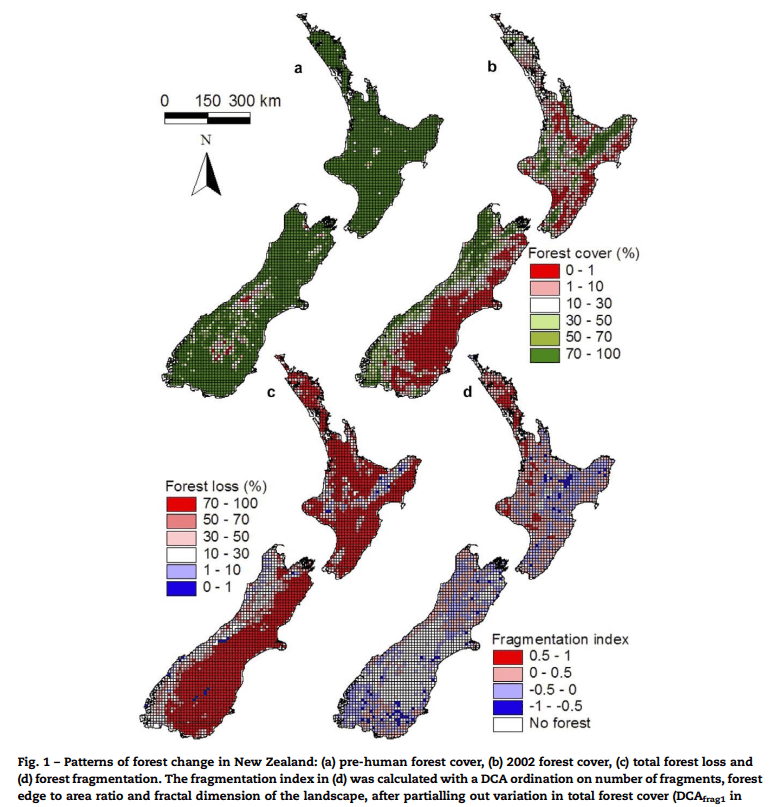
NZ forest loss Source: EPA Environmental Protection Authority (New Zealand government agency) – click on image to open the source document
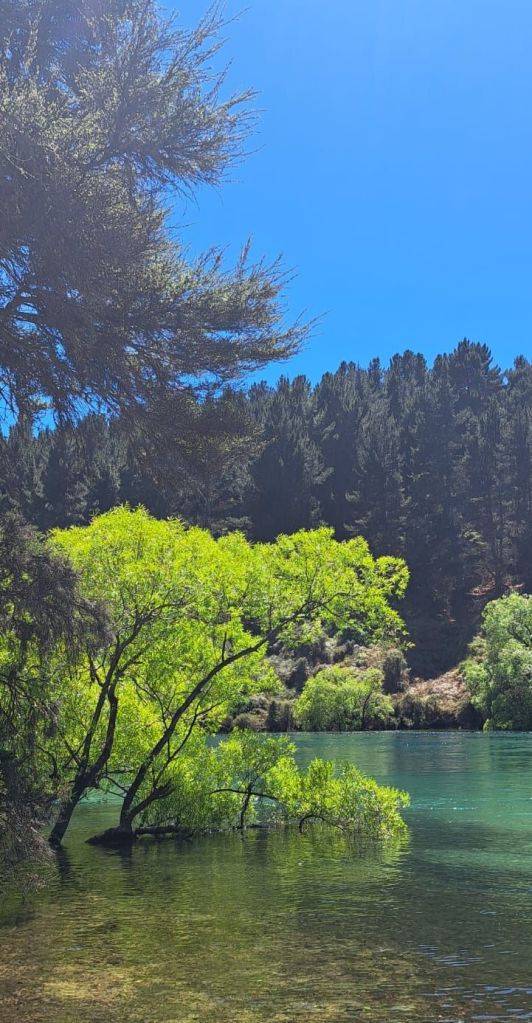
On the Fisherman track along Mata-Au, a mix of natives and non-natives grow happily together, protecting each other, feeding and protecting wildlife in complementarity. Beautiful! What’s wrong with the pine forest in the other side on Dean’s Bank? Nothing.
I will add here that non-native trees were introduced lawfully to New Zealand, they provide valuable services and are often grown in plantations. Wanting trees “here but not here” is madness, segregation. Wanting only natives is also extreme when most food in NZ is not native; pasture, sheep, kiwifruit, non native… Just like us people, most of us are not native, yet we are an asset to our chosen beloved country and we thrive to live in harmony with people who were here before. New Zealand is one country in the world where we learn to live together, enriching us all on the way. It requires effort, but it is worth it. So with the people, so with wildlife. I believe native and exotic trees can live in harmony together, in complementarity. They certainly do at our place.
“If we want a truly sustainable carbon future, we need a diversified forest portfolio — some species for quick sequestration, others for lasting stability“.
Aspen trees, cherry trees, poplar trees form clusters, clonal colonies; oaks and sycamore grow thousand of trees babies every year; all trees in forests, native trees in native forests, multiply and reproduce. Of course they reproduce, they are life. Let’s embrace this quality, not fight it.
“Ticking time bomb” I hear some say, well everything is relative… In 20 years, we have just 3 baby Pinus radiata coming from the nearby forest and we decided to keep 2 of them. I don’t call this an invasion. It is manageable.
We all like a good ground cover, don’t we? And it’s beneficial for the soil and wildlife too! So when a yellow archangel lamium, a purple ajuga, an arctostaphylos or dandelions really enjoy it and spreads, I hear people say: “Oh no! we need to remove it” and they spray.
It is similar with trees, only on a much longer time frame. Some trees enjoy an area and grow well and create a family. Great.
If a tree or a plant IS a problem, we make sure we cut it back with as much root as possible and remove all seeds before they spread. By removing 80% of it every year, we are on top of it in a few years.
When we are in harmony with nature, we welcome the vigour, manage it to keep room for other plants and ourselves. Whether a plant is a weed or welcome is political and cultural, it is a mental construct, a world view of nature.
Qualities of the so-called-invasives.
Many conifers, gorse or broom have same or better carbon values than natives.
And yes, so-called-invasive are tough! That is why they grow in the wild. Many of the so-called-invasive are ruderal, they are the first to cover the soil after scarring or poisoning. Interesting how thistles come back over and over again just on the herbicide sprayed areas, which then need spraying again.
Broom and gorse grow well on bare land and traditionally offer protection of native plant regeneration then dissolve when the natives shade them. Over the years, other plants will colonise too, native trees will pop over the protective cover and the shade they create will dim gorse which will die, nature left to her own devices usually comes back to a forest. Hinewai Nature reserve near Christchurch is a great example of this. It takes time.
The beauty is it can be greatly accelerated by inter tree planting.
Wilding pines?
The main wilding pine is Pinus radiata which is widely planted for forestry in areas previously deforested from their natives. “These trees are good here“. “These (same)trees are not good there“… This control of nature is damageable to the planet and a mindshift is required. These trees are precious long term resources and harvesting them selectively at the right time for timber and other local materials make better economic sense. Trees that grow on their own are a gift from nature and can be used as resources. We could choose to let “wilding pines” grow, then harvest them for timber and firewood, selectively like they do in Europe (no clear cut on the Swiss mountains, is there?). They are not invasive; they are growing instead of monoculture of pasture. We see many images of wilding pines colonizing bare pasture but very rarely pines growing amongst natives.
Conifers do not grow in the shade, this is why they are outcompeted worldwide by deciduous trees that grow faster when young, says conifer expert Aljos Farjon. Conifers are often seen on margins along track and roads (created by humans), in ditches and ravines where nothing else grows yet and in riverbeds where they are watered. They can be managed. In our region, I have never seen wilding pines growing in a native forest and smothering it. It is likely that with climate change, trees are now growing in places they didn’t use to. But I believe culling wilding trees is the wrong war. What needs to stop is the destruction of carbon absorbers
These trees grow on their own on our -difficult- land and they should be let to grow and harvested when grown for timber, resins and other goodies trees provide. I realize I am hurting some people with this radical view! I hope, with good intention, they will widen their views soon.
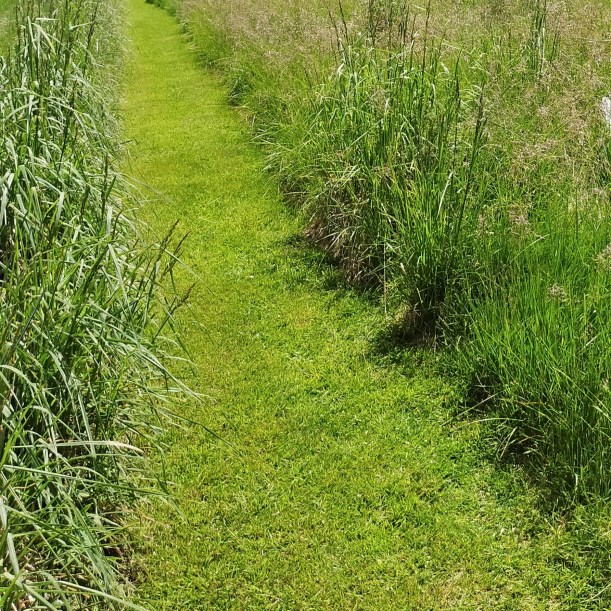
A great example of the necessary shift: the lawn! Lawns were made fashionable by rich aristocratic people showing off that they had enough to afford a useless space, at a time when all the land was forest or used for food or resource growing. Today, specially when they are kept short, watered, “weed free” or “worm-free”, lawns swallow a lot of resources: energy, water, time, poisons, they do not hold water nor carbon; in a climate, biodiversity and “cost of living” crises, they are a squander. Apart from the kids and the dog playing around, large lawns and large pastures are of little use and value. Leaving the grass to nature and mowing only footpaths is an elegant way to accommodate both nature and people.
Do we need to mow all land? Or just footpaths?
What are we doing when we cut and poison trees? We remove a free resource, use carbon heavy chemicals and pollute the planet, animals and people’s bodies. The use of chemicals brings a cancer epidemics well documented by Rachel Carson in her 1962 Silent Spring book.
Trees that grow well and fast in our climate are larches, sequoias, eucalyptus, douglas firs, walnuts, cherry and apples, all absorbing huge amounts of carbon, much more than a slow growing native. They are also providing excellent timber, firewood and food. Larches produce such a durable wood that it doesn’t need treating even used as roof tiles in European Alps.
Going deeper, I believe, the “invasive” issue is due to a mis-repartition of land. Some people have a land bigger than they can be guardians of. Meanwhile, many people can’t afford a quarter acre, which is the size of the land where you can grow some trees and some food. The iconic 1/4 acre New Zealand of the 60’s was allowing every household to live. Now, people are pushed into boundary to boundary house with no space to grow, unlivable, so as soon as they can, they move somewhere bigger, impacting the land further and creating a runaway economic growth which erodes wellbeing and is incompatible with the climate, biodiversity and inequality crisis. Adapting does require a change of culture but change we must as the crises are squeezing us.
Proposals
We are asking the Council to extend the tree protection policy for public land to all trees on private land too. We suggest replacing “On Council land, we“, with “On all land in QLDC, we” on the current tree policy.
We are asking to strengthen the tree protection policy to include native and non-native trees, shelterbelts, windbreaks, hedgerows, groups of trees and stand alone trees.
We are asking to ban clear felling, burn offs, monoculture and poisoning practices.
We are asking to protect All the trees of the land. This means for example:
Manage trees, only kill when dangerous
Manage a 20km margin around National Parks to remove self seeding trees
Welcome plants growing well naturally
Replant way before cutting, so that tree services are maintained
Practice selected harvesting
Practice coppicing
Interplant with natives as wished
Share the land -to help with the workload of managing trees
Do not poison as it pollutes the planet
What does it mean for a land owner ?
All the trees on their land are protected, even when the land is passed on or sold. It means they can plant trees knowing they will live and provide their services for perpetuity. They can manage trees as they wish as long as the tree is not critically damaged. For example, topping a tree to keep the sun on solar panels.
Trees can be removed:
if they present a risk of falling, a risk to existing building foundation
if a replacement has reached enough maturity to provide shelter, privacy and other ecosystem services of the tree cut,
when one tree out of 4? 5? 10? is removed as part of a group of trees
Trees cannot be removed around subdivisions, for any building or infrastructure construction, for power lines (power lines can go underground and lines are obsolete in a community where solar panels are providing private electricity).
Trees are recorded as part of the existing system of Land Information Memorandum report and thereby protected. Any change is recorded online in the LIM report, for example 5 years after planting trees (to make sure they are established) or if tree removing is possible along the rules 1. 2. 3. above.
Landscapers and arborists are trained to follow the rules and manage trees.
Carbon calculations can be done automatically to reward the landowners for keeping their trees and tree removing incurs a carbon tax.
These are all suggestions, ideas of how it could work and are up for discussions.
In our district, big trees are not native and they take an expensive real estate space. It has been leading to their destruction, for example Northlake, Three Parks, Orchard road etc. “They are just Douglas Firs, get rid of them” I hear. Well, they are trees. Of note here, douglas firs, along with many conifers, live for several centuries, 500 years is common. In our region, trees planted won’t be more than 150 years old so killing them is like killing a young adult with many years of good service ahead.
For many residents and visitors, Wānaka trees have huge value. There are world-known poplar and willow rows along the lake, there are still a few beautiful established trees in town, a dozen standing survivors on Orchard road, a mighty old Douglas fir across the police station, a small forest left at Eely point and Lismore park, there are patchy areas of big trees in parks, on the Golf course and on private land. They are all condemned by current rules and practices…
In Wanaka, some Wanaka Station Park trees and the start Mt Aspiring road trees are protected along with 15 others, including the three mighty McDougall sequoias.
Spectacular and much admired McDougall sequoias
In our district urban areas, most natives have been replanted recently and are still too small for wildlife habitat. We do not have tall totaras. There are established kowhais, plenty of kanuka and flaxes and small native hedges (eg. griselinia) and grasses. I observe every day that native wildlife lives and sings in tall trees, mostly non-native. Each of these existing trees are extremely valuable as they are what we (and wildlife) currently have. If we let these non native trees be cut, birds have nowhere to live, therefore disappear.
Trees need to be kept. The plan for Eely Point reserve to remove hundreds of healthy windbreak trees is inappropriate in a climate emergency; I hope the new Council and the Blue Green network step up to protect this important part of the existing (patchy and disappearing) Wānaka green belt. Natives can be planted understory, between the gaps, or on grassland further along. It is nice to read that in the Queenstown gardens (also planned to be culled), public consultation has resulted in “trial planting sites before any trees are removed, helping to demonstrate what the replacement plantings will look like ahead of future works.” Well, collections of little tree guards containing beautiful native baby trees do NOT replace mighty canopies… Not for us anyway…
Tree Protection in QLDC
QLDC has created, with public consultation, a tree policy designed to protect the trees.
It is in fact very weak as it really only protects native trees on public land. Douglas firs on public land are not protected, on the reason that they are not native. Queenstown botanic gardens, Eely point recreation area, a group of douglas firs on a public area in Peninsula bay… All cut or about to be.
This tree policy is more a process to cut trees. Not to protect them.
There are a few protected trees in Wanaka. Many trees of the Wanaka Station Park and the start of Mt Aspiring road are protected, along with less than 20 trees on private land.
I inquired in August 2024 about protected trees in QLDC. I was referred to The Upper Clutha Historic Records Society, who didn’t know much. Very little importance is given to protected trees, trees at all, I’d say!
I asked how to protect trees and was informed that the 10-year district plan is the time to apply for that.
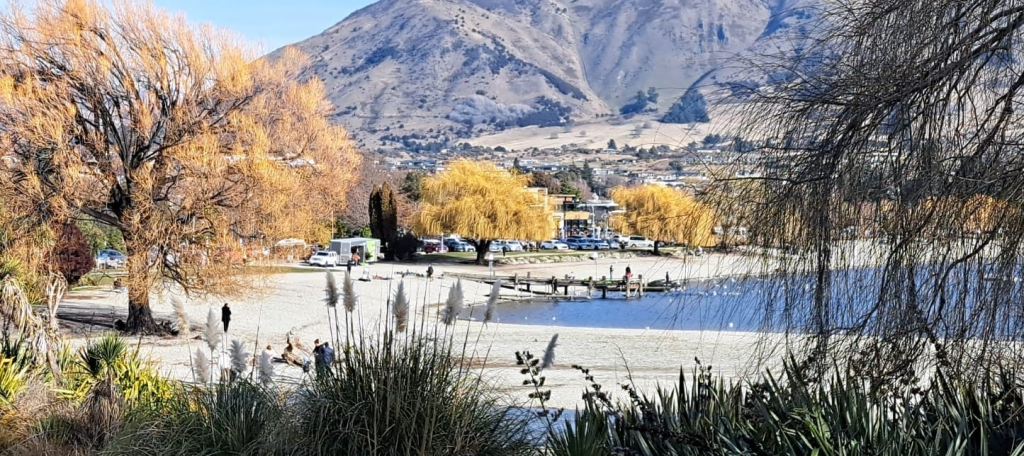
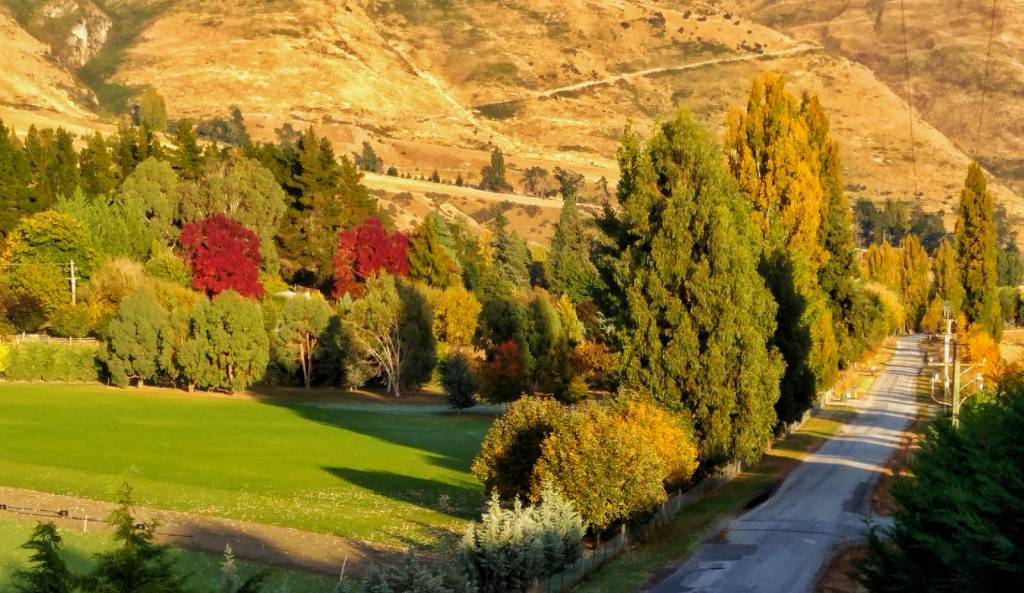
Iconic Wanaka Lake front in autumn, lighten by poplars and willows. Beautiful! That Wanaka tree itself is a willow, a post in fact.
They grow happily and protect native planting happening around them.
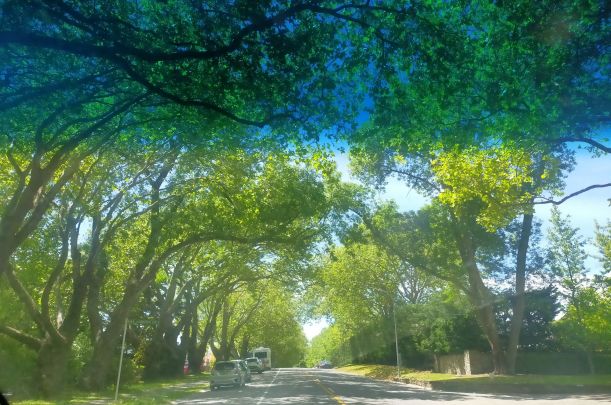
Mt Aspiring road beautiful tree tunnel, many of these trees are protected. Well managed, a beautiful avenue. We could extend this to the whole place. Little group of douglas firs on the little reserve opposite the medical centre, full of birds. These trees on public land should be protected but being non-native, they could also be on the chopping board. This screenshot of protected trees from the QLDC maps system in 2023 doesn’t seem to work anymore. It speaks volume to me.
I understand that wilderness areas deserve to keep or restore their native-only status. I don’t believe native-only is good for human settlements areas. Importantly, these established trees exist -thank you- and cannot be replaced.
Trees, native or not, have high intrinsic value, ecosystem value and wellbeing value. Biodiversity value is higher if there are natives AND non natives.
The blue-green plan could include spaces for planting these essential resources for human settlements – as the draft stands, the Blue Green plan is only about natives. How are we going to build and heat houses in a zero carbon economy or in a disaster zone? The wood is no longer going to come from over the ocean, or across highways with broken bridges. It must be grown locally and the blue green plan can include that. Always in diversity (no monoculture). Which landowner has enough space for a couple of rows and allocate a part of that wood to the community ? Are you in?
What do you think of maturely rise above the native/non-native invasive viewpoints and embrace all TREES. Click here to have your say, start a conversation to save the trees.
Beyond trees, a whole district regenerative design
Protecting trees or using and disposing of them IS cultural. It IS reflecting a different world view. Yes it IS Political and the Council has the potential to fix all these crises by capping growth and planning steady state local circular economy, by protecting trees and encouraging sharing of the land, creating commons, to grow food, for recreation access or commuting, for tree growing or biodiversity restoration… I suggest Council elected members and staff go and talk with the landowners. Ask them what would they need to be on board with sharing a part of their land as commons. It doesn’t need to be money.
Many landowners I know are creating a biodiversity asset on their land (eg. they plant trees or create ponds…) and they just want the certainty that their land is not chopped up after their death. When we plant trees, it is for us to enjoy when we are alive. It is also for future generations and the birds, and the planet. It’s generous. It needs intergenerational guardianship and the current land zonings do not allow that. It is the governance responsibility to change rules to protect what we have for now and future generations. We cannot wait and squander what we have.
Carbon sequestration is calculated over many years and at the moment, trees are planted with no guarantee that they will be kept, it is wrong. We need to create a way to protect what IS. A land zoning or any form of protection of private land is an essential part of the creation of a regenerative community.
“I don’t want to die! Because then… All this gets chopped up”
Says an old gardener with an ample movement showing extensive gardens and unusual established trees 🌲 🌸🌳
Growth is too much in our district. EVERY public meeting I have attended in the last 20 years have clearly reflected that “locals”, the community does not want this uncontrolled growth. And yet the Council continues planning for growth. Instead of planning for a sustainable urban environment. I am asking the new Council to step up and provide what the community asks.
Solutions
Create citizen assemblies to define community and the planet future best outcomes and implement them
Stop growth where it is already planned now. It is essential to keep fertile greenfields close to urban areas and stop over-building.
Keep All trees, Keep 30% for nature at all levels, on a section, in a subdivision, in the urban space, in a connected way. Use these commons for planting useful and native trees fostering wildlife, connected walk and bike ways for recreation and commute, surface water reticulation, community food growing (food forest, plots, orchards, community gardens or social entreprise growing market food…) – and to be resilient, add local energy production on all roofs, with subdivisions requirements to build battery capacity. Make it part of resource consents, it is just a political will (or not?)
Encourage landowners to regenerate 30% of their land and share and join the commons network.
This is how we create and re-create biodiversity, resilience and wellbeing.
Alternatives to current practices of clear felling, burn offs, monoculture and poisoning
Alternatives toclear felling
Since 2021, NZ Farm forestry recommends replacing clear felling with a selection system to halve (or reduce tenfold) soil erosion and to retain forest ecosystem, maintaining soil nutrients, nesting sites, food sources, cover, shade and protection from climate extremes. Read the article here. Clear felling only looks cheaper, it is externalizing actually higher costs to the public. The impacts on roads during rain events is costly and detrimental to the communities. The devastation of the cyclone Gabrielle even cost death. Clear felling is also ugly and severally impact landscapes, a detriment to wellbeing and tourism. Nelson area, Golden Bay, Coromandel etc. are no longer beautiful, they have scars, it is hurting, visitors often comment on it. We don’t see clear felling in Europe where selective forestry is generalized, nor in North America where they hide clear felling behind rows of uncut trees. Clear felling is a practice for underdeveloped countries with uncontrolled illegal logging, eg. Indonesia or Brazil. Clear felling must be banned in New Zealand, starting in our district.
In our district, subdivision developments start by removing all the trees on the land. This is unnecessary and costly. Why do passer-by have to witness yellow machines moving earth etc. for years, where they used to pass a row of singing trees? Where are the birds going? The developers soon replace the once old trees with young ones, which will take decades to provide similar services that already existed! Why?
Solutions: Move away from intensive monoculture forest management into a well-practiced closer to nature or integrative multifunctional forest management with single tree selection. In resource consent conditions, keeping trees on the boundaries and keeping 30% of all other trees and natural space. Practice coppicing: by cutting one every three trees, we keep the 30% for nature ratio, keep the visual shield provided by trees on the boundaries and trees keep growing without the need to replant.
Alternatives to burnoffs
Outdoor burning is sometimes authorised on Check It’s All Right. However, many articles show elevation of air pollution and complaints in burnoff seasons. Furthermore, burnoffs are the main reason of wildfires: “In New Zealand, about 99% of all fires are caused by people. A number of fires are started as a burn-off (farmers getting rid of excess vegetation), which then escapes, becoming a wildfire“, say Scion scientists.
Solution: ban burnoffs. It is not acceptable to continue burn offs in 2025 in a climate emergency. On hills, let it grow, let regeneration in progress. For wood debris: hire a mulcher, with the right tool, landscapers will turn it to valuable fertilizing resource for cheaper than buying mulch.
Alternatives to monoculture
It is so obvious monoculture should not exist, but it does, so it needs regulation! Monoculture is by definition unsustainable. Biodiversity is essential to hold food and shelter year around. Monoculture is the opposite of biodiversity so we need a mind shift away from monoculture, in forests, in agriculture and in lawns.
Solution: Plant a minimum of 10 different trees species for example. Row of slow growing natives with rows of fast growing timber. Plant diverse hedges, small or large, it all improves biodiversity.
Alternatives to poisoning
So much is known on pesticides and herbicides, it’s a wonder people use them still. Do they realise these chemicals require huge amounts of energy for their production, packaging and transport; they pollute the environment and bodies with long lasting chemicals with myriads of more or less known consequences on life. One is sure: by intermingling with human hormones, they create infertility and various cancers. Maybe it is time to stop and instead manage when necessary, mulching, fostering biodiversity to maintain a balance…
Solution: commit to no chemical fertilizer nor pesticide use and care for the land in harmony with nature. Share the practices that work on managing self fertile trees locally.
All these things are possible. We are doing it. We plant trees. We do not pollute. We use bokashi, worm juice or comfrey tea to feed the garden. We only mow what we need, that is less than 10% of the land. We appreciate the privilege to co-create so much beauty and abundance with nature. We trust nature. We connect with nature. We love each of our trees. The land becomes a heaven for us and wildlife. We live in a bird sanctuary! The joy and privilege have unfathomable value.
This famous quote shows the importance of protecting trees planted 20 years ago. And yet…
To All the trees planted and growing, thank you.
If we are serious about the climate, biodiversity and sickness of the world (are you?), then Tree protection is the cheapest easiest essential way on the transition to a planet and people friendly society.
What do you think about this tree protection proposal? What improvement to the statement do you suggest? Any recommendation on how to go about it?
My intention is to gather feedback and revise the text accordingly, then go to a QLDC public meeting and submit the request to the Mayor with all the support received.
I talk for the trees here, With love, with peace. Because I love trees, I want to see them around forever ♡🌳
A tree protection is free. It’s political as it means industries cannot maximize their profits. But the state of the planet calls for protecting trees and nature remnants. I am committed to it myself and it’s fun, it works well, how abundant nature is!👏 So I know it can be done. I invite you to join the conversation here
I hope many embrace a culture of creating of a beautiful low carbon resilient place and society. Thank you.
“Almost all of us long for peace and freedom” – Aldous Huxley Island, 1962
In December 2024, Syria went through a peaceful revolution and continues building peace: the interim government is committed to people and diversity, integrating all groups in the government; rebel factions are disarming. Amazing. It starts well (despite hurdles) and I wish further peace for them. It’s a fantastic example that “Peace we can”, Peace we must. If not, war, death, suffering, destruction and waste continue.
Here is a song to align with the Peace vibration while you read on: Om Shanti Shanti Shanti Om. Shanti (Peace) is said 3 times because peace is inside, between people and globally.
In the context of the NZ government increasing flirting with military and warfaring nations, I started a petition for New Zealand to Uphold its Peaceful and Nuclear-Free Status
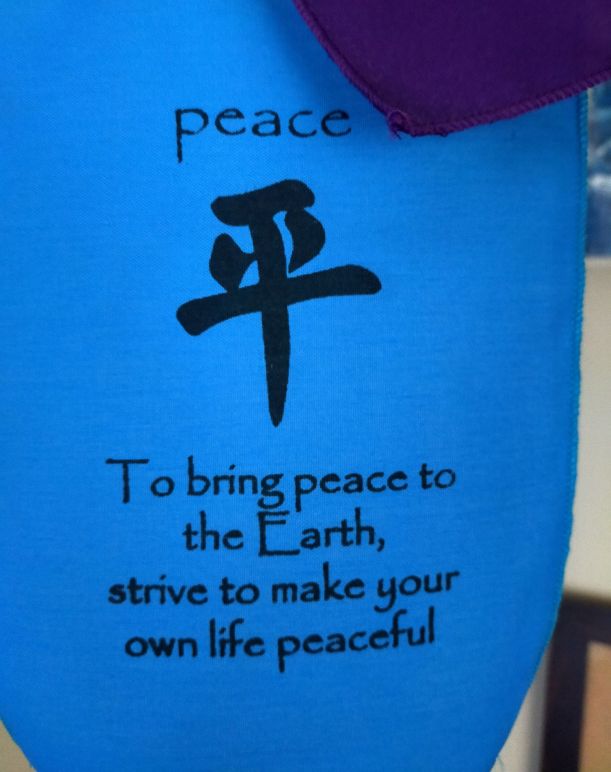
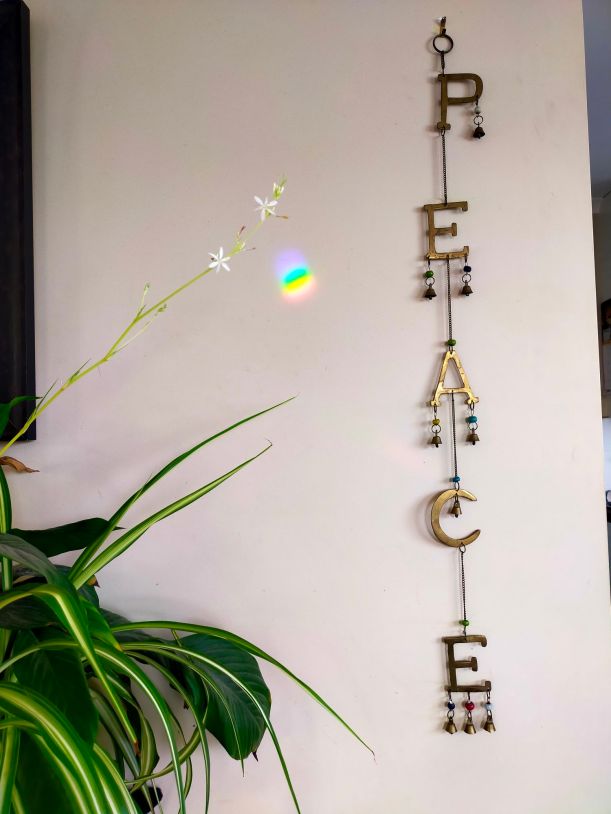
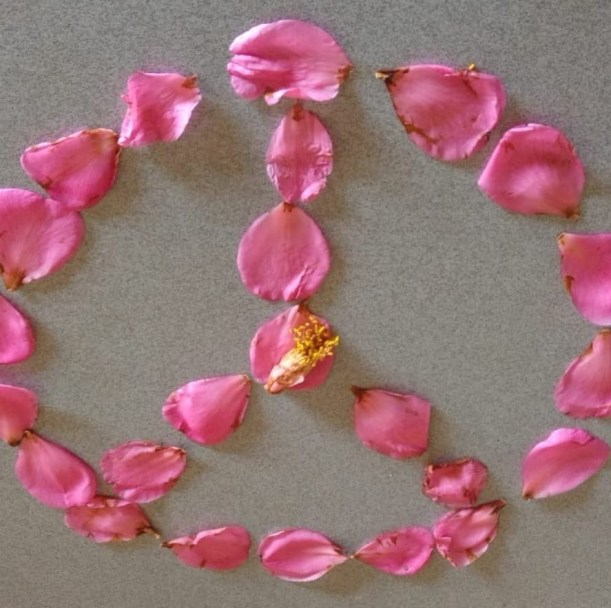
I want peace for the world. Everyday, I look at this flag that invites me to make my own life peaceful first. I realized that I indeed had internal conflicts, voices in my head, defenses and attacks, hurt.
These wars inside us create stress, sickness and project bad energies, therefore wars outside. Anxiety, negative (self) talk, addictions or bad habits, excuse, judgments, justification… Do you recognize any of these? I do!! Inside me, in society and in international conflicts!
Instead, I choose to be relaxed, present, living consciously, creating the life I want, with love always.
Becoming aware of my inner voices, fears and ego allowed me to let them go. Letting go of trauma, identifying thoughts as thoughts, quietening the mind, loving myself; all bring calm, happiness and peace.
Healthy alkaline nutrition, meditation, reiki, 3-deep-breath, time in nature and caring for the garden, sun salutations, gratitude, practicing presence and journaling are all helping me on my journey to inner peace.
Away judgement, need to justify, to defend… Welcome love, expanding love, awareness, compassion, acceptance, openness, connection, calm, beingness and nature appreciation. Peace.
I think it is a life purpose to find peace, it’s ongoing. Peace feels great. When in peace, I shine peace, share peace, pray peace. It’s personal growth. And the flag says it brings peace to the Earth!
I wish you enjoy finding peace and look forward to the peaceful snowball effect we have together. Florence
Resources that practically help me find my Peace inside:
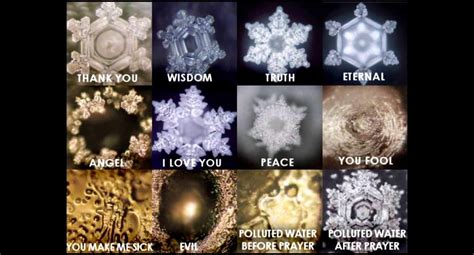
Love Water: I hold a cup of water with appreciation, love. Dr Emoto has shown that water “records” the environment so my water becomes love and gratitude and then I drink it, filling myself with love, becoming love. Crazy or not, it feels great and works with me!
The Serenity App with a dozen free 10 mn meditations creates an immediate feel good feeling. Within a few days of practice, I am am aware of my inner debates and can let go of unhelpful thoughts easily and choose beneficial loving ones.
Thank you dear Jane for the inspiration and wisdom, precious.
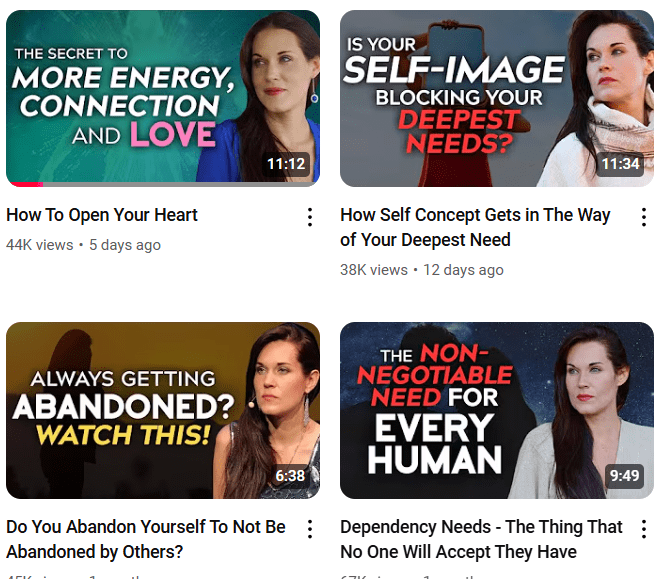
I recently did the Teal Swan Love Yourself free course and it changed my life, thank you, highly recommended.
Loving myself brings PEACE inside.
A hilarious book about finding yourself, Jane Tara introduced me to Pearl, thank you for that!
Peace between us
Relationship between people, large or small groups have the same principles. Judgment, separation, justification, comparison, blame… are all degrees of war. Instead, let’s learn to listen, acknowledge, understand, forgive, love, support. What would love do now?
Most of us are able to love our “loved-ones”. The exercise of extending this love to everyone, to every being is challenging and interesting. An enemy is a loved-one for someone else so we can open our hearts enough to love all. Consciousness and compassion are keys here. Love removes the hurt inside, love brings peace. Duh! I know it’s obvious yet worth remembering because societal norms often make us take sides and that’s counterproductive.
Whether personal, business, parenting, couples, groups, schools or states, look for the keywords “wellbeing”, “mindful”, “conscious” for all information you need. Lots of resources on the Greater Good.
I believe it’s important we build peace with nature. Everyone can do it, at their level. In our business, at work, in our household, we have reduced our footprint, by going vegetarian, choosing renewable energy, phasing out plastic packaging, divesting our money, choosing fairtrade, local or organic foods, phasing out our carbon use in travels, hobbies, tools… Everyday choices, most of them FREE or BETTER economically. It’s win-win. With the big win to avoid the climate catastrophe.
When we are in connected with nature, we feel oneness, so we love everyone on Earth too. Building peace with nature builds peace between humans.
3 minutes to understand how to be sustainable, worthwhile your time. Published 14 years ago, still relevant.
International powers
The world is not in Peace, it is over-armed and soaked in violence and huge guns on media, movies, gaming and sadly in real in many countries, cutting short real lives and devastating real landscapes.
Armament industries are financed by governments (people’s tax money) who infuse the world with fear to justify it, making the world more dangerous.
Armament industry provides jobs and huge profits to financial portfolios. Wars increase the GDP with all the business generated to make the weapons then to repair. So warfaring is an economic boost.
Yet we can realize in one instant that Growth-growth-growth is unsustainable, it is exploiting and polluting the planet, colonizing people, draining life, mental health and health. A way out is to doing / going / buying less. What we do, we do sustainably: go circular and local, low carbon, healthy, increasing resilience, aiming at having enough, within planetary boundaries. We, all of us, at our level, can foster the shift and mitigate the effects by sharing.
There is no need to continue war to keep the economy going, there is a lot to repair, from the wars and from increasing climate change disasters; There is a lot of work to relocate, innovate, plant, restore… Governments can accompany the transition into a low carbon regenerating resilient society, with subventions to foster the conversion of unsustainable industries into sustainable beneficial ventures. For example, an armaments plant starts building electric civil machinery, a farmer becomes a biodiversity steward…
Provocation, tit for tat, justification, fear culture, bullying and blackmailing, to pure cruelty… Resulting in so many death and victims.
Several leaders of the world behave like nasty kids, bullies, below-the-belt thinking. I feel compassion for all, they hold so much fear and look so hurt, by generations of wars, indoctrination and revenge.
I wish leaders soon have the realization that peace can be chosen every day, a peace that is fair, durable. Steps are taken. More effort is required.
Asking people what they need; listening; supporting; finding ways to live in harmony together… Talking to each other, sharing, realizing we are all humans who love, choosing peace over further death, creating reconciliation, this is the mission of the Israeli Palestinian Bereaved Families for Peace. It takes courage, change, vulnerability, that’s bravery. This group activities brings peace inside and between participants and hopes for wider peaceful resolutions.
I think citizens’ assemblies are great conduits for understanding and creating solutions for the highest good of all involved. They are well-suited to rise above conflicts of interest and complex issues with trade-offs and values-driven dilemmas. In New Zealand, Max Rashbrooke is fostering the practice of citizens’ jury.
So there are solutions and I continue to hope that the leaders of the world, the wealthy, the influencers, everyone really, will shift, change the way we do things and invest for the greater good, as ultimately, it benefits all.
At the occasion of the International Peace Week in September 2024, I wrote an open letter for Peace to NZ Prime Minister and Defense Minister. Then made it a petition to stay peaceful and nuclear free. (Update August 2025: The petition was sent with more than 70 signatures to Christopher Luxon, Judith Collins, Winston Peters and David Seymour on the 28th July 2025 🕊)
We are one mind shift away from peace and all it requires is love, which we all have plenty of. So I continue hoping and holding the space for peace, always. With peace, our world will be safer, better connected with one another and nature, equitable, harmonious, happier… what’s not to love?!
Does this essay on peace helps you or brings you hope? Let me know!
Love love love 🌸Shanti shanti shanti
Peace stops the destruction then regeneration begin. Divesting from military is an easy step for peace.
In New Zealand, Mindful Money helps people to direct their funds towards social and environmentally beneficial outcomes.
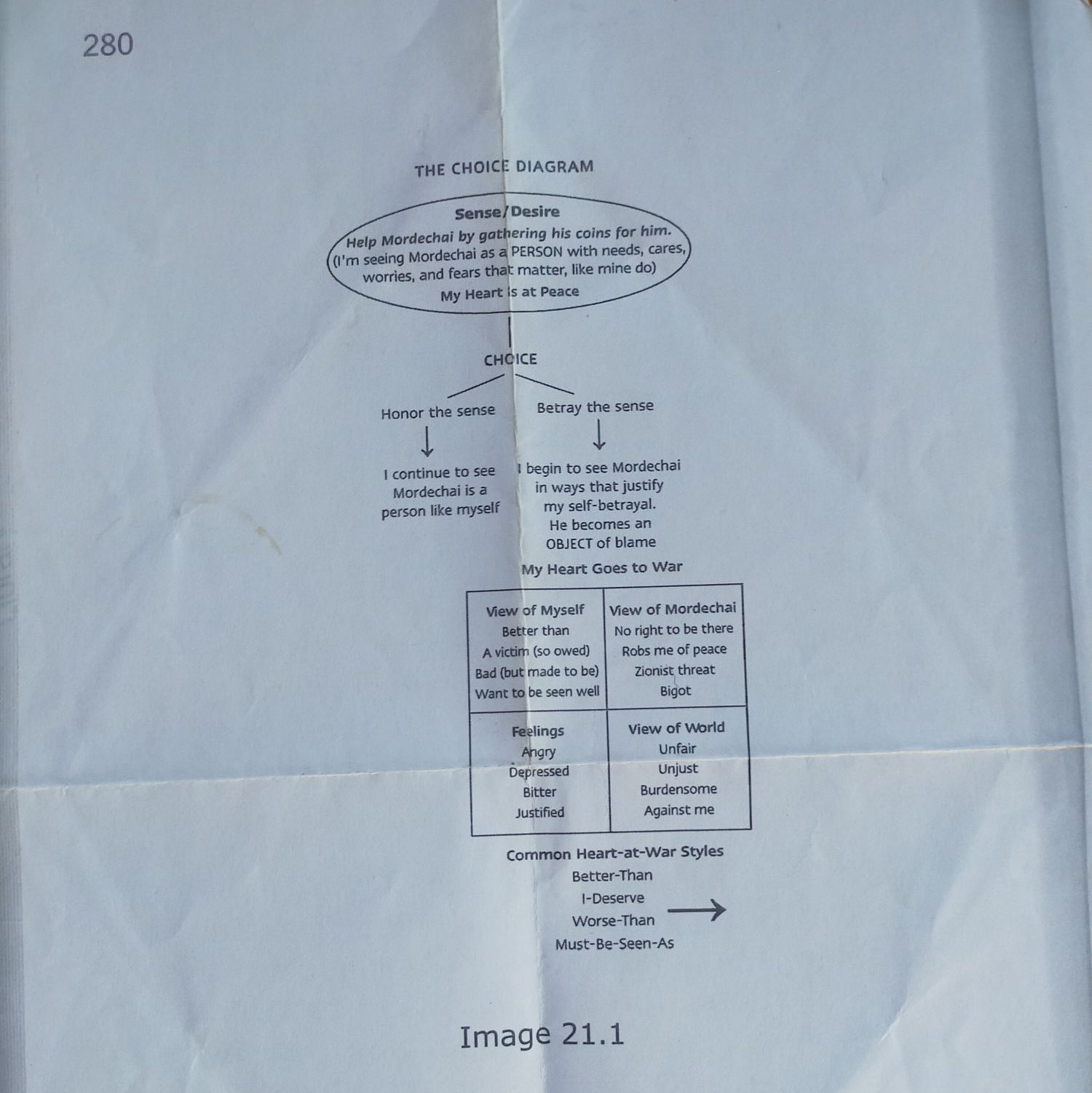
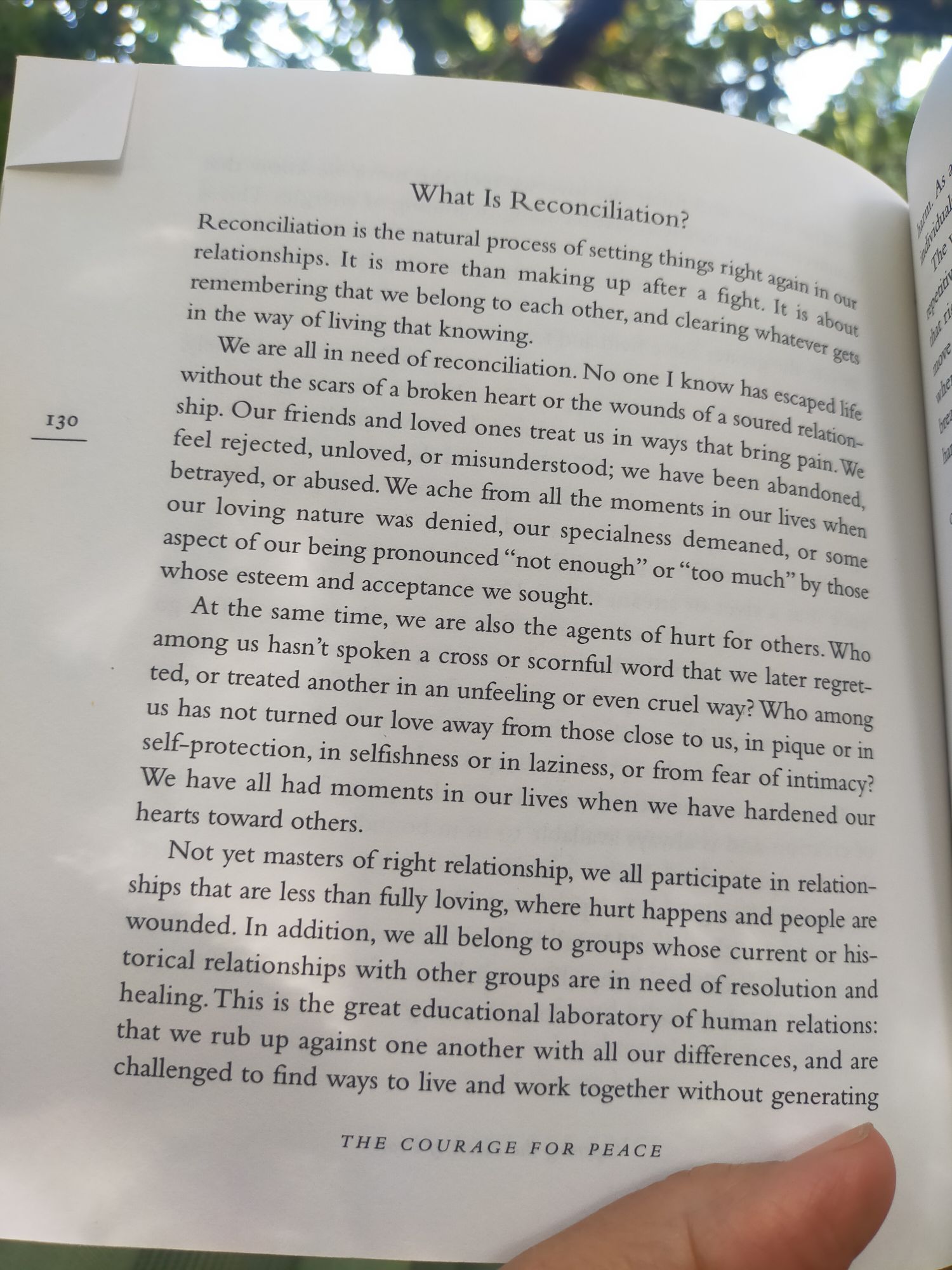
Peacemaking is reconciling people. Extracts from the Courage for Peace, by Louise Diamond.
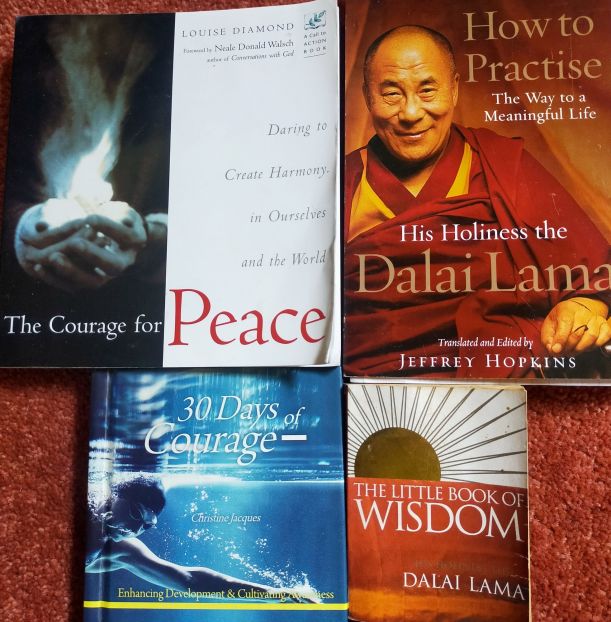
These books are great for understanding and practicing Peace.
Started in 2018 by Wānaka local Monique Kelly and a small team, WAO Summit 2024 aims again to inspire and inform, setting us on a pathway to action, helping us lead with purpose, and be part of the transformation towards a thriving future.
Saturday 2 November in the morning
Guided tour of Namaste Park and Gardens, our 2.5 hectares on the outskirts of Wānaka, featuring regenerating land with a developing 600-tree arboretum, and extensive ornamental and edible gardens maintained in harmony with nature. Our carbon-positive household is the occasion to learn about renewable energy, locally sourced food, electric equipment, wise water management, circular waste management and healthy living.
At the height of spring beauty, with dogwoods, rhododendrons and many more in full bloom, join us for practical, carbon-free living and land management insights, a Tree Healing experience, morning tea and Q&A.
When: 9-11am Where: Namaste Park and Gardens (address provided after booking). No dogs allowed. $26.05(incl. $1.05 fee)− Booking here
Please note a bespoke Namaste and regeneration tour is also available on request (min 2 participants) from October to April.
Saturday 2 November in the afternoon
I will hold an informative stand at the Festival of Nature, a vibrant celebration connecting everyone to nature. We will share information about everything regenerative and tree protection in the Upper Clutha; I look forward to it!
As part of the process, I was invited to provide a short bio, an interesting reflection exercise showing I actually have a LOT of knowledge and practice for a healthier planet and resilient happy communities. I am a professional generalist which allows for holistic interconnected approach of the issues people, society and the planet face, with a positive solution focus that I am diligent to share.
Here is the bio, not to boast, but so that people can tap into these skills.
Nature advocate and regeneration practitioner, I have always loved trees and flowers!
With a Master of Economics and a graduate diploma in Sustainable practice, I developed a clear holistic vision and practical how-to for regenerating our lifestyle and district on all levels: ecosystems, water, transport, building, waste, energy, economics, health, wellbeing, community resilience and democracy. I share vision and knowledge for creating a beautiful resilient low-pollution district, region and country in practicing, submitting, emailing, speaking and opening the conversation on Regenerative Wanaka FB group.
And it all started in the garden ! As information manager for the French organic gardening magazine and visitor centre Terre Vivante, I professionally researched and spread practical ecology knowledge 30 years ago already.
20 years a Wanaka local, I was librarian at Mount Aspiring College where I facilitated the College Sustainability Club. I have been involved locally in many grassroot groups: Local Food Wanaka, Wanaka Wastebusters, Plastic Free Wanaka, Te Kakano, Wanaka Timebank etc. and organised the Wanaka Climate March in 2015.
Now owner operator of a local guided garden tour business, I continue spreading the word and love on gardening in harmony with nature, regenerating land and living sustainably.
I am fostering a district approach to enhancing biodiversity and community wellbeing in a public/private partnership (willing landowners, local groups and the Council) creating green corridors for wildlife, with commuting and leisure trails, local food growing, timber and firewood growing.
When I am not emailing and submitting locally and nationally to represent nature, trees and future generations, I am usually in the garden, hands in the earth or communing with nature.
From iconic Wastebusters shaping Wanaka and New Zealand zerowaste future to Te Kakano reforesting our area with thousands of volunteers for 15 years, to WAO inspiring and empowering the community in yearly Festivals, many ecofriendly businesses, the Regenerative Wanaka Facebook page and the QLDC Climate and diversity action, our active community is loving and caring for the place, often choosing a lifestyle in harmony with nature.
View our Here – Us – Now List here send us a note if you believe your business or organization should be included.
WAO Summit
Coming up in October, WAO Summit is a great inspiring and galvanising festival in Wānaka.
I will talk about: 1- low-carbon, resilient, biodiversity-enhancing lifestyle at household level 2- beyond individual action, how to foster regeneration at district level.
Exciting!
Beautiful Gardens of Wanaka
Our guided garden tours are a great complement to this thriving sustainability culture, showcasing outstanding private gardens, a unique way to share garden beauty and connection with the place and people. Great activity for manuhiri/visitors, our tours also benefit locals presenting local gardeners’ best practices for Central Otago special conditions (frost, heat, draught, rabbits…)
New this season is our educational tour featuring biodiversity attributes and practices to adapt to our current climate crisis era, demonstrating how to regenerate land and gardens in harmony with nature. The property showcased on this tour is an inspiring example of sustainable living with forest and regeneration, food growing, beautiful flowers fostering biodiversity, entirely run without fossil fuels… Come and learn how it’s done.
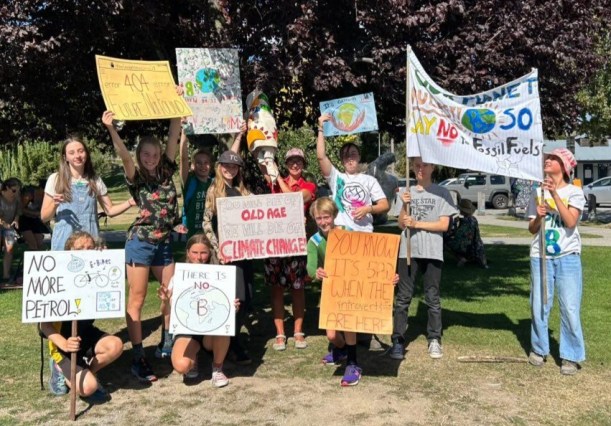
What do we want? CLIMATE ACTION! When do we want it? NOW!
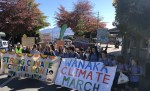
Following and chanting in the Wanaka Climate March on Friday 5 April behind my ex-students (feeling very proud of them!), I reflected on MY climate actions. Here they are, small steps in all aspects of life…
These are actions one person can do at home in their lives. I share these ideas to inspire. I would love to know what you already do to mitigate climate change and enhance biodiversity. Let’s save the planet together, because “We have to“, says Janet Goodall in her Book of Hope.
“Halve our emissions by 2030…”
“…And halve that again by 2040“, says local climate scientist Carly Green. For a long time, I have been looking at my emissions and phasing out fossil fuels and embedded carbon, in plastics, transport, chemicals, consumption, energy, land management, food…
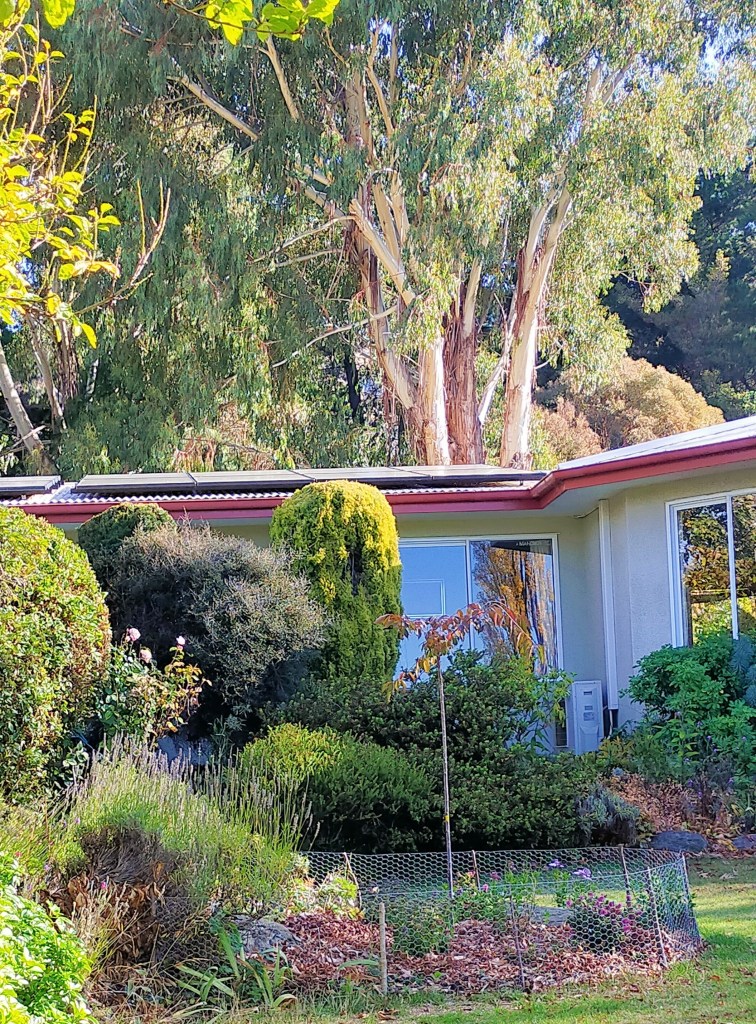
Solar panels, gardens, lots of trees, beautiful and relaxing
So here is a list of changes I and we have done over time, in no particular order.
Plastic and waste
For years, I stopped single use plastic, always carrying bags and cups. If I forget my cup, I don’t get a single use cup: I either sit and have my drink there, or I don’t have any. Then I don’t forget anymore. When shopping, we are phasing out plastic items, always choosing the non-packaged, wood, bamboo, hemp or cardboard option and this is still ongoing. We refill the same plastic pockets for bulk nuts, lentils, etc. No gladwrap here! Instead we have a bunch of beeswax food wraps, reused and reused. We are not zero waste, yet: Our rubbish bin goes out every two months, our recycling once a month approximately. I make our crackers, bread, etc, to avoid plastic but we still have plant milk cartons. I separate and recycle soft plastics and tetra packs.
I have campaigned the Council for years so they use a chip in the wheelie bins to count people’s waste and practice the Polluter Pays Principle rather than a blanket rate for waste that enables, therefore encourages people to fill a whole wheelie bin of rubbish every week.
I have lived in Wanaka for 20 years, raising my family. I have been involved in several local community groups and initiatives. Green drinks, Transition Towns, Kapa Haka, Mac Team Green, 2015 Climate March, Local Food Wanaka, Plastic Free Wanaka, Friends of Wanaka Wastebusters, Te Kakano, a lot of fun really. I have now retired from all these community involvements but I continue nature advocacy at the local Council level and wholeheartedly admire WAO, WAI and Grow Wanaka work for nature and community education.
Transport
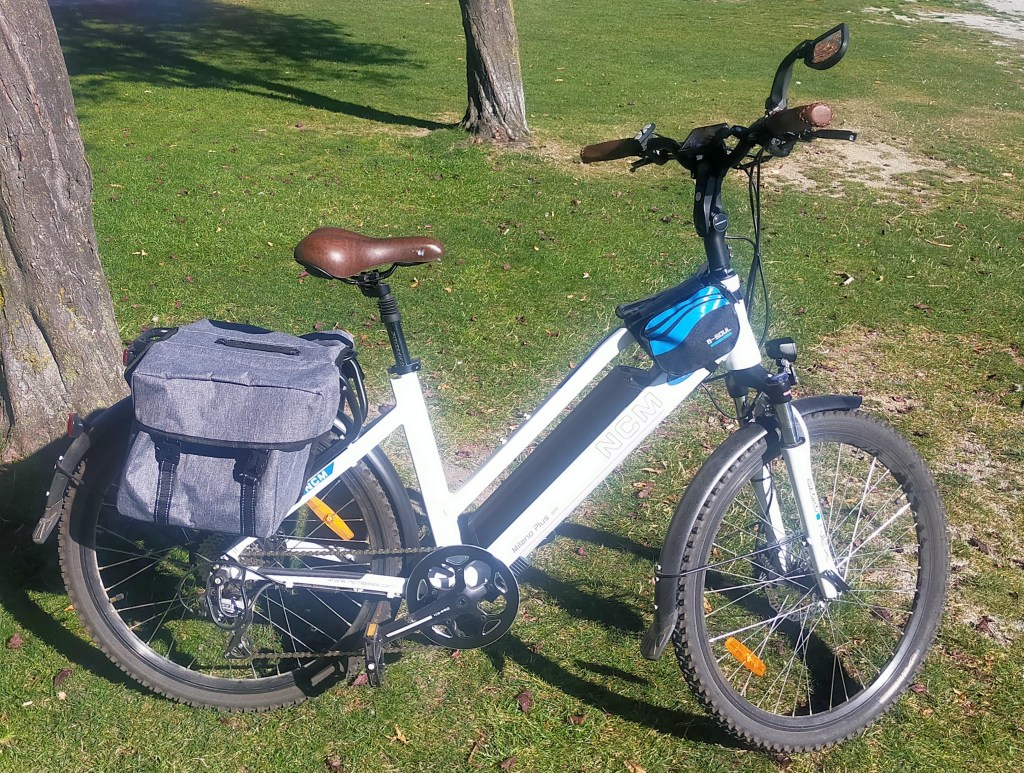
In 2015, I swapped my car to a Prius and had hybrid vehicles since. It means, I have halved my fuel consumption all this time and I halved my fuel bills too. Now with an ebike, all local trips are solar and muscle powered. And I love it, smiling away like a teenager on their moped, just silent and more careful! We make sure our activities and hobbies are not carbon intensive. We have decided to halved our travels, nationally and overseas. This hurts a bit but ethically, I had to! Now, we plan ahead and will stay “there” a bit longer. Many people tell us the planes fly anyway. Of course, until many people also halve their travels and there will be twice less planes. Electric planes are coming up so that will ease emissions of national transports.
With panniers for shopping and mirror for safety
Chemical free
Chemicals are made from fossil fuels, they are polluting and bad for health. So I have always chosen chemical free soaps, creams, cleaning products… Skin Deep database has been helpful to identify the risks of cosmetics. Reading the labels and googling it is helpful too. Making my own oils and cleaning products (easy) is even better. Likewise, we don’t use synthetic chemicals in the garden, fertilisers nor pest/weed sprays, instead we use natural soil enhancers, a lot generated on the land, compost, comfrey tea, etc. To support agriculture without chemicals, I am buying organic as often as possible.
Energy
We are nearly off the grid. This is important because 20% of NZ electricity still comes from fossil fuels. We initially installed 10 solar panels, then a few years later, another 10 panels and a year later, a battery. Over the years, we have swapped all our tools to electric versions. As powerful, lighter, not smelly, not noisy. Our latest car drives 55km on a charge, which is sufficient for most of our trips. It feels good to be powered by the sun and our electricity company owes us money! We have also reduced our own energy use. There are lots of ways to do that: short showers, lights and standby off, replacing bulbs with led, heating the oven for all the baking at once, putting on a jumper instead of a heater, just being mindful of energy, we are energy too, we can tune in…
The solar panels return on investment is immediate! If you have $10K in the bank and put them on the roof, the next bill is $100 cheaper, that’s equivalent of a 12% interest rate! Oh! and it’s so easy to install with local solar pioneer Wanaka Solar and it feels so good to cook, shower, travel, work with the sun!
Several NZ banks now offer a zero% interest loan on solar panels so you can reimburse with the gains.
Rewiring NZ reports that households can save money and also significantly reduce their emissions by electrifying their appliances and vehicles. Let’s ride the ‘electrification tipping point’ together!
In gratitude and awe with the Sun and nature, thank you.
Consume less
For years, I have reduced my consumption, asking myself if I really need it before I buy it, always looking at Wastebusters first and we repair stuff. It’s fun and also cheaper! I am content with what I have, I don’t want more, I prefer simplicity. Granted it doesn’t contribute to the “economy”, it is about degrowth, but degrow we must to come back within the Planetary Boundaries.
A simple way to stop contributing to climate change is to divest my own money from being invested in the fossil fuel industries. I checked the MindFul Money comparison tool and made sure my money is in a bank 100% not invested in fossil fuel, and divested my kiwisaver too. The returns are excellent and it feels good.
Clearly GDP is not a good indicator of progress: disasters creates reconstruction jobs, sickness creates a medical industry, crime creates lots of security devices, war is fostering weapon industry, all tallying up in the GDP. When the economy contracts (0.3% in the last month in NZ), economists, businesses and people freak out, they fear of lacking so they accumulate as much as they can, in case of a rainy day. Thereby creating a rainy day! In fact, it is best for the climate and the planet if we are buying less stuff, making less stuff, working less, needing less. The best policy the government could do is to accompany recession to soften the impacts. A universal salary is a good start, then people would no longer fear lacking. I personally feel I have enough and it is not luck, it is a conscious choice. To me, having “enough” is better than wanting “more”. Another way to look at economics is the Doughnut concept (really good presentation of the Doughnut in NZ here): putting people and the planet first, decoupling economic growth from carbon use, investing in clean technologies, putting the economy back in its role as a tool not an end. Dunedin Council started in 2020 and is going for it (see ODT article here). The Happiness Index seems more holistic, fair, relevant and climate-friendly too. Maybe Confucius said: “Live simply and happy“. No he didn’t! But it is true.
Land management
Here is how we manage our land in harmony with nature to enhance biodiversity, on our 2.5 hectares just on the outskirts of a growing town:
planting hundreds of different trees, creating an arboretum. No monoculture here!
the park is not mowed, lawns are only cut around the house and on footpaths. The uncut uneaten grass grows and dies back every year, absorbing carbon, becoming a sponge, regenerating the land and now a home to insects, birds and skinks.
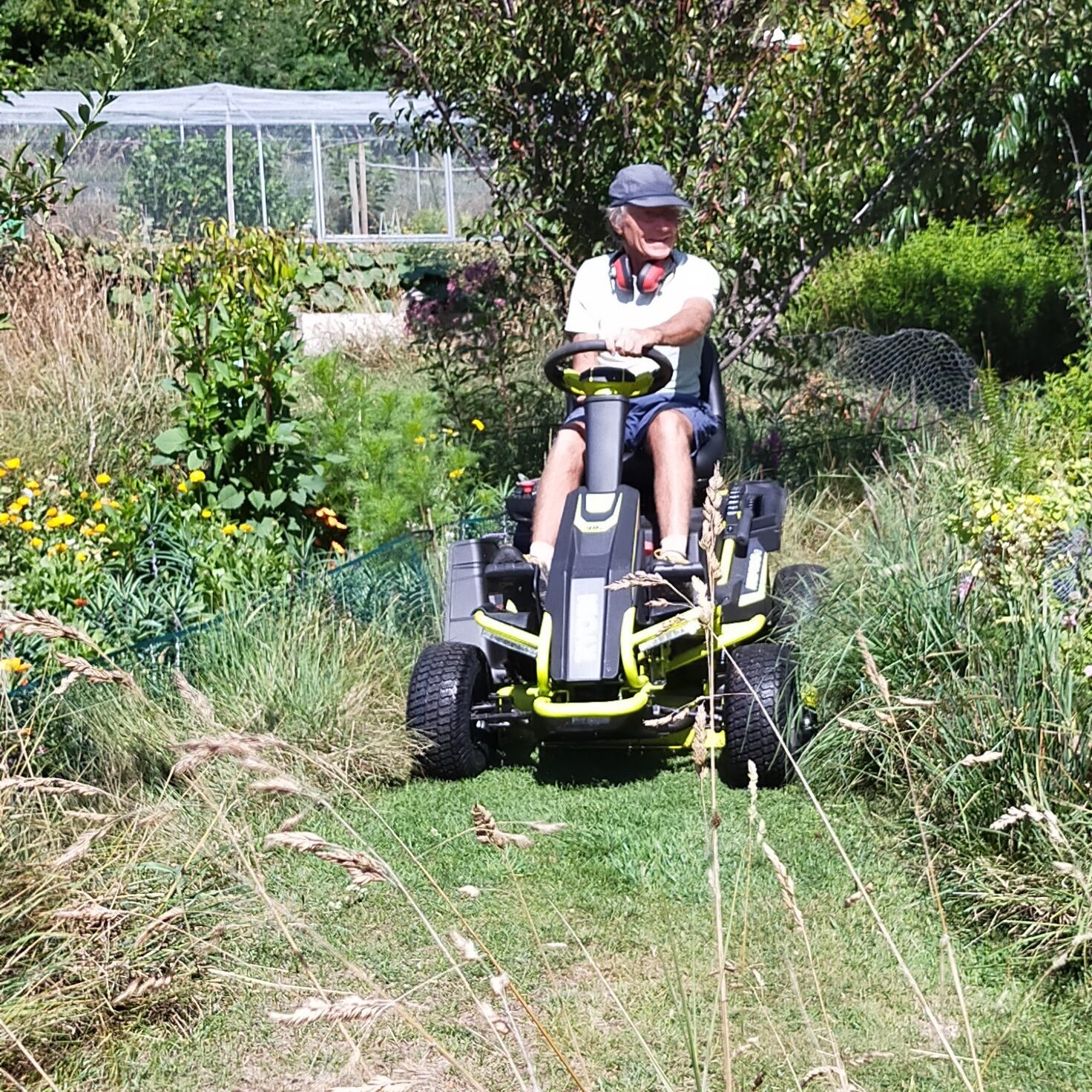
the whole property is cared for without chemicals and without fossil fuels (electric tools, incl. the lawn mower are charged with solar panels)
we share the land: the park is open to the public as part of guided garden tours and the land is shared with another household in a tiny house. And we share the story and how-to as part of the garden tours and Regenerative Lifestyle classes.
Good for the bees, and beautiful too
Food
Food has one of the biggest impact on the climate. In the Drawdown, Solution 3 is “reduced food waste”, solution 4 is “plant based diet”, silvopasture and regenerative agriculture are close behind. Reducing consumption of meat, milk, cheese, and butter are a critical way to reduce our carbon footprint.
I have never been a big meat eater and became vegetarian since my pledge at the first Wanaka school strike for climate March in 2019. And I love it, I feel more healthy. Now, meat production looks unnatural and unethical to me. Fish? Oceans are in crisis so I let the fish replenish. No loss there.
Climate friendly food is a variety of cereal, with lots of vegetables and fruit everyday, a dose of beans or other protein, with a dollop of seeds, a handful of nuts. Simple, healthy, delicious, affordable and allegedly better for the planet too. Planet friendly food is also:
seasonal (cheaper too),
as local and organic as possible (less transport km, no chemicals which embed a lot of carbon and pollute),
not processed, as most processes require energy, degrades the food wholesomeness and comes with packaging. So I make our bread, muffins, juices, etc.
not peeled for all the goodness and fiber (only if organic),
not cooked long (also saves energy),
without fat (easier to wash the dishes, using less water and hardly no dishwashing liquid),
hardly any salt nor sugar (better for health too)
leftovers are reused or frozen.
all the peelings goes to bokashi or compost, without the fruit sticker!
It is important to read the ingredients to avoid chemicals and ban palm oil.
Lots of vegetables, many from the garden
A report published in 2010 by Ella Lawton and R. Vale concluded that in remote areas like Wanaka, the biggest difference we can make is to grow our own food. So we do. Not all of it, but more and more and it is fun. Grow Wanaka Community gardens is a great place to start and learn, as well as the Wanaka Vegetable Growers club.
Action to hope
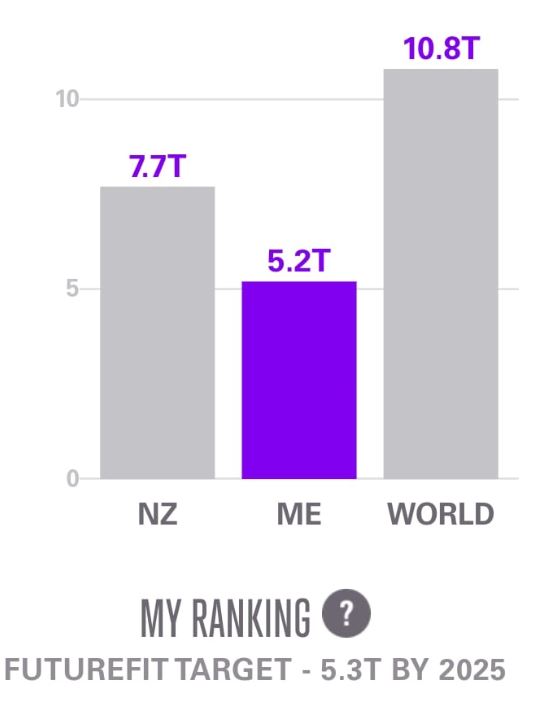
Do these little things make a difference? Yes they do! All the plastic I haven’t bought and discarded, all the petrol I haven’t consumed, for years… I adds up. I have calculated our household carbon footprint with this tool https://www.futurefit.nz/ and it turns out, we are emitting less than the “target”!
We are nonetheless continuing to reduce our waste, energy, consumption, travel and planting more trees, because we love it.
I act to keep hope, I feel the need to share my vision of the world and climate friendly practices. So I am advocating online (Twitter, Regenerative Wanaka and in this blog), in submissions, in climate marches, in community speeches… I love to share solutions, positive actions, no grumble, no judgement, we are together in these crises on one planet. It’s my hobby! I continuously learn more about nature (trees are incredible!!)
Most importantly, we spend a lot of time in the garden, not only to grow our own food, plant a lot of trees and plants adding diversity and beauty, but also to enjoy nature. Connecting with nature, trees, peace, calm, simplicity, I think this is the key, nature changes us.
Relax, do and eat less, be and love more.
Many things that many people can do, if they choose to. It’s no hardship, it’s caring, it’s loving. Because I love nature, because I love children. It is a little effort, a focus, like we attend to our children. I hope I gave you some ideas and inspiration. I believe all these little actions make a difference for the climate and the planet, therefore young people and future generations.
What do you think? What are your climate actions? What are you ready to change ?
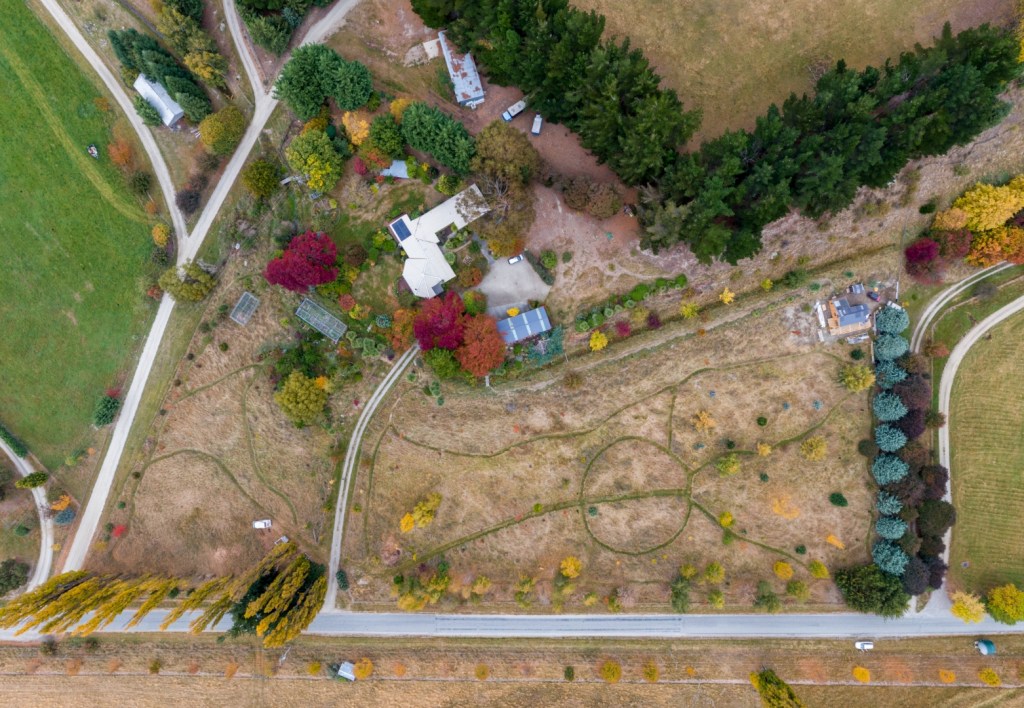
Namaste Park and Gardens is a 2.2 hectares lifestyle property on Studholme Road, Wanaka; currently on the urban boundary of Wanaka. In the upper part of Namaste Gardens around the dwelling, the property hosts a dozen mature trees of significant height and hundreds of shrubs, trees and more formal gardens – home to abundant bird life. The lower eastern side of the property hosts two small ponds, flower gardens, fruit and young nut trees and enclosed vegetable and berry patches.
Namaste Park
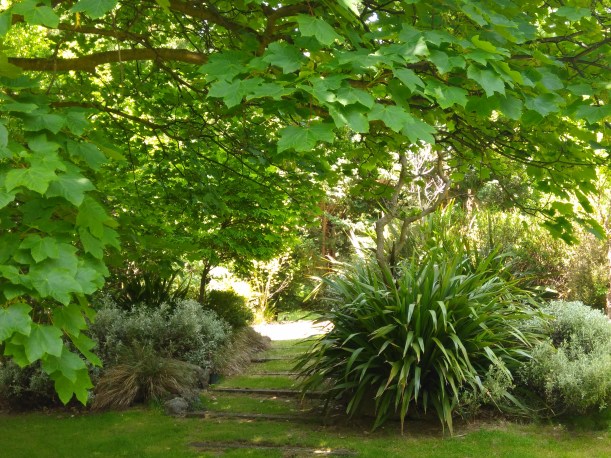
The lower part is a one-hectare arboretum planted by the current owner over the last 16 years. Once a bare pasture, the area has been planted with more than 500 trees, mostly all different, with a forest of silver birches on the road side, a grove of dogwoods, an area with crabapples, lots of maples, and many more different trees from all over the world that survive our Wanaka climate. Established boundary trees of Cypress Glabra align the western boundary and a collection of Conifers are well underway over a fifth of the arboretum. Many of the chosen trees are rare and unusual creating a significant collection of interest. In the heart of the park is a small native area.
The park is a beautiful and lush open landscape, designed to show amazing blossom shows in spring and splendid foliage colours in autumn, along with benches and curved footpaths. Although the emphasis is not on natives, we believe the sheer variety of trees planted offer a unique and valuable open space for people and biodiversity.
Dogwood and maple “avenue”
Sustainability and Regeneration
As Studholme Road is a small valley floor it offers a unique corridor of biodiversity, attracting birdlife which would be lost if the number of established trees were to be removed. Birds include Fantails, Silvereyes, Bellbirds, German Owls, Ruru, Hawks, Oystercatchers, Quails and Tuis along with a number of more common bird species.
With the lawns being cut only on footpaths, the surrounding grass is regenerating the land and is now home to insects, birds and skinks. No biodiversity inventory has been done yet.
The property doesn’t have any town water source and is serviced by a deep bore, which makes the regeneration of the land all the more important. The deep soil now retains enough moisture to keep green in summers with minimal drip irrigation watering.
The whole property is cared for without chemicals and without fossil fuels (electric tools charged with solar panels). It is a fantastic example of how one person can regenerate bare grazed land in just 18 years, bringing the dawn chorus back (all day chorus actually). The landowners intention is to keep the land as a whole, for perpetuity, with owners continuing guardianship and fostering nature life.
Electric ride-on lawnmower
Peri-urban context
The property is sitting in a zone planned to become urban within the next 28 years, which means the sections and trees in this zone will overtime be chopped up, leaving no nature in the area. Already both ends of Studholme road have been subdivided, at the upper end down to 400sq.m. If we look further on the town boundary along Orchard Rd there are currently intensive subdivisions taking place with the usual removal of all existing fauna, flora, top soil and land form. Our park trees start to have enough growth and visibility to be admired by walkers from the road as well as visitors on guided garden tours. It is our intention to open the arboretum to the public once more mature, thereby creating a valuable green space for locals and visitors. When the whole area around becomes dense housing, the Park will be a treasured haven for the community benefit and refuge for wildlife.
We are advocating the Council to create a regenerative land zoning or whichever way to enable people like us with properties planted with mature trees to be possibly preserved, but at this stage, council staff and councilors turn a blind eye.
There are other established zones of vegetation around Studholme Road so we have submitted for its inclusion in the Mount Alpha Outstanding Landscape zone.
The Wanaka Community Board have been consulted as well and have encouraged that this preservation be discussed with QLDC…
We have started a Biodiversity group on Studholme Road, facilitated by WAI, to encourage a more collective approach to ensuring open green spaces can be included in future Council rezoning. We also have excellent support from Lake Wanaka Tourism who are keen to see more examples as outlined above.
We are working with QEII Trust to support us to enable long term protection of our property for the benefit of the “greater good”.
It’s our beloved home, we enjoy enhancing the gardens, soil, wildlife. We love planting and nurturing the trees, watching them grow. We are privileged to be caring for this land in harmony with nature, guardianship, kaitiaki, gratitude 🙏🏵️
We are proposing a new Regenerative Land Zoning that encourages landowners to protect, regenerate and possibly share the land they are guardians of.
Context: the situation in Wānaka
In our district, urban growth is transforming the small town we love and pushing nature further and further away, decreasing inhabitants wellbeing and tourism appeal.
The urban area already stretches 10km from Bills Way to Albert Town bridge, which requires everyone to hop in a car to go anywhere, work, shopping, hobbies…
As developments start by removing all trees (incl. natives), massive earth moving and soil compacting, life, trees and soil present in the previously rural landscape are destroyed. It doesn’t have to be that way.
We now have kilometers of suburbia with houses four meters away from each other, where people can’t grow food let alone trees.
In 2023, we have to consider the climate, biodiversity and cost of living crises. To adapt, we need:
Connected pathways for commuting and recreation biking and walking
Plenty of trees and nature, 30% of land and water left to nature by 2030
Local food production
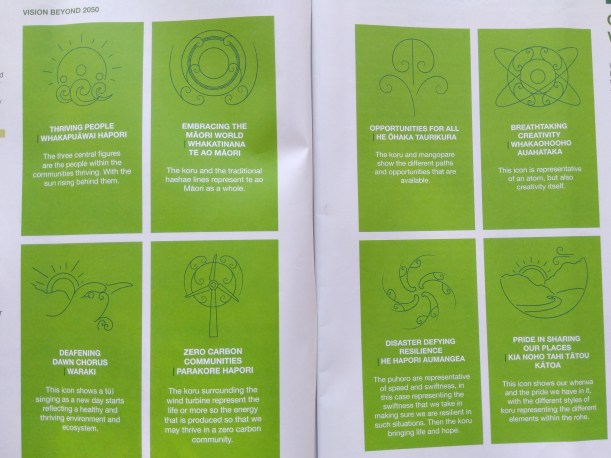
These 3 simple points enable low carbon living, good for nature and wellbeing, good for resilience and affordability. And it’s aligned to the QLDC Vision beyond 2050 principles:
Green belts exist on private land
The new subdivisions are now well beyond initially planned green belts and reserves.
Nature is pushed further and further away from the people. But in a sustainable resilient low carbon society, we do need nature and space for food production on our doorstep, not half an hour drive away.
Urban development is creeping on rural lifestyle areas, bulldozing them. Have a look at Orchard Road. It doesn’t have to be that way.
On many lifestyle properties in town and adjacent to town, landowners have planted trees and enhanced biodiversity on the land they are owners and guardians of. They are givers not takers. Kaitiakitanga. Thank you for having planted trees, established trees are treasures🙏 Taonga.
The current rules and price of land mean that when these creators sell, the land is chopped off with all the life on it. A simple optional new land zoning could prevent that.
Innovative Regenerative Land Zoning
We are proposing a regenerative land zoning, allowing landowners to voluntarily secure their land for perpetuity, providing they enhance biodiversity and/or the community.
The land can be sold with the same conditions.
The owners can choose how they want to regenerate: planting trees, native or not, restoring or creating wetlands, planting orchards for local food, planting fast growing well managed forests for local timber and firewood…
And the owners can choose whether they share it with the public or not, or which part of it. For example a strip along the road can be made into a bike lane; a grove of trees can be open as a park for the public; an orchard can be open for a time for locals to harvest; a land can be gardened by community groups or as plots…
It already happens. A few enlightened and generous landowners are already offering their land for the greater good.
A regenerative land zoning would foster green belts connections. It would create a network of biodiversity and community enhancing parks and corridors. Tracks through these corridors would enable low carbon transport. Food would be produced locally for resilience and affordability, and nature would be accessible for everyone with all its biodiversity and wellbeing benefits. Win-win-win.
Steps
I have shared the idea for two years, in emails to local influencers, including all the Councilors, several times. I have talked with many Council staff, I have presented it to several community groups and in the tourism sector, even prompting a standing ovation (at the WAO Regenerative Tourism hui October 2022). It IS a great idea with huge desirable benefits for all, thriving nature, resilient community and cheap for the Council.
Now is the time to sit around a table and make it happen.
Let’s start with the pioneers who have already created something beautiful which is at stake of being destroyed by growth. Let’s start with the landowners who already regenerate and share (or wish to).
What would encourage landowners to participate is yet to be discussed and finetuned, from rebate to maintenance or simply protection.
The Council is the entity capable of creating a land zoning and I am talking at a Council meeting on the 10th August to invite them to start the process. LWT, WAO, WAI, UCTT, Te Kakano, are invited in the discussion and action.
The innovative land zoning protects what we already have and deploys it to an exciting collective creation that, we all agree, would be great.
From landtaker to landmaker; From land management to guardianship; From $growth$ first to Nature first: a mindshift is happening.
One example of outstanding landscape, nature and biodiversity right on the urban boundary. Are we going to Love it? Or to bulldoze it?
To go deeper… here are 4 documents with more details.
Please contact us for any further information, if you are interested in participating, contributing, or if you know of similar public/private regenerative schemes in New Zealand and the world.
Spring series, 6 Saturday mornings, 4 Nov – 9 December 23
Are you interested in taking care of your property in harmony with nature?
Do you want to regenerate your lifestyle property or garden without fossil fuels?
Do you love a healthy natural life?
Do you ask yourself “what would nature do?”?
Learn more than you expect with garden guide and regenerative lifestyle practitioner, Florence Micoud, in a relaxed atmosphere in the beautiful inspiring garden she is a grateful kaitiaki / caretaker of.
Contact Florence 02102792481 for more info or booking.
6 sessions Saturdays 9am-12 pm starting 4 November
3 to 7 Participants
Price: $240pp – $210pp with Community Service Card or Duet
Location: Namaste Park and Garden, 2 hectares of climate positive lifestyle block run in harmony with nature in Wanaka.
Level: Beginner, intermediate
Bring: Gloves, notebook+pen, jar+box for takeaways
20 times, I walked past the glass house, telling myself “I want to” redevelop it. It was in the too-hard-basketdon’t-know-where-to-start for a while.
Then I set my mind to it, looked at what was needed, researched and got bits. Then I did it, in four or five sessions, helped by my partner ♡ and we now have a clean and lush source of seedlings and joy. Done. Happy.
What happened? I chose to do it. I switched to I-can-do-it, I looked deeper, with a bit of curiosity, adventure and creation, one step at a time, it was easy. And fun.
Quite an ordinary experience, isn’t it? We know how to do new stuff, we do it all the time. All change, small or big, starts with a conscious choice, a decision, a mindshift.
Our renewed glasshouse
For the big challenge of climate change, we need is a mindshift too. And it’s happening. TVNZ has started a Climate Special programme, showcasing solutions and opportunities. They said 51% of people don’t know what to do. Here it is:
Start with a mindshift
Shift to NOW, not in 2030. In my case, I have chosen sustainability and regeneration for a long time. I don’t wait for a law that forces us to do it. Whatever carbon I don’t use now, is not in the atmosphere. Over the years, that’s a lot of carbon that I haven’t added in the atmosphere.
Wean yourself off fossil fuels
I switch to electric vehicles and tools, solar panels, local food, renewable energy provider, I divest…
In what I buy, in what I do, I look for carbon and embedded carbon (eg. plastic, chemicals, kilometres, waste) and find the best I can, or stop altogether.
Choose nature
I chose nature a long time ago. I defend nature, enhance nature (plant trees, foster biodiversity…), mimic nature. I align with nature, I slow down, it’s relaxing. Forest bathing is now a thing, it changes us, it is our nature. I convey the experience within Beautiful Gardens of Wānaka guided garden tours, admiring and immersing in nature. Knowing nature better to care for her better. And for everyone to enjoy connecting with nature, I am advocating for Biodiversity and Community enhancing Parks and Corridors. It’s an elegant solution to many local issues and it is getting traction.
I value nature more than money. In our society still very much based on monetary value, it’s a big mindshift. From “I want/I need more/fear of lacking” to “I have enough“, simplicity, contentement. I can’t think of something that has more value than an old tree, or a forest, it can’t be bought, it can’t be replaced. I take all my decisions on how it will impact nature, not how much it costs.
Flower bathing, guiding a garden tour
In short, I care.
I care for my garden, feeling in gratitude for being a guardian of this beautiful part of Papatuanuku.
I care for the planet and all its beings, and specially trees. I love trees -but that will be another post.
And I care for myself. Because this is where I have most effect. I choose what I eat; Food that is good for us and for the planet is one of the major solutions of the climate crisis (this food subject also deserves an entire post). I choose what I drink, what I put on my skin, what I wear… I choose as local, natural and least transformed as possible. I care for my mental health, I breathe, I exercise, in nature, in the garden. I become aware, conscious and this is a big mindshift, always work in progress!
Becoming aware…
I stopped saying it’s difficult: this stops me from trying! Instead, I tell myself it IS easy and I find a way.
I stopped blaming others, the council, the media… Instead, I ask myself: “How can I help?” and I take responsibility, I connect and inform as best as I can. It is a humbling exercise in vulnerability.
I stopped saying “I will.., I can’t, they should…” Instead, I create the world I envision. I do. It is very empowering, creative, fun, beautiful.
I choose to care for the planet, the community and life now, in all ways and to contribute to the regenerative culture shift.
Enough talking, next post will be about grassroots. Literally grass roots!
Feel free to share other mindshift examples♡
Simply being in nature, connecting, with all senses

























 Regenerative Livestyle Blog