Trees Gone or going. All of them! That’s what the current laws allow.
Wānaka is going through a continued growth. We all witness current bulldozer suburbia practice, removing all trees, destroying soils and building nearly boundary to boundary with token native plantings. We all experience traffic, pollution and landscape degradation. It is unsustainable, decried by locals, it ruins the natural beauty and feeling of our little town. Yet it is fostered by the Council and current laws and regulations.
Over 20 years, I have attended many community meetings or Council workshops on Wānaka future, and many korero, as part of wonderful Festivals of Colour and Aspiring Conversations, Shaping Our Future, WAO Summits, Regenerative tourism huis, Royal Society, U3A, Paradiso movies etc… I am taking notes, so I have several notebooks of minutes. They show that in every meeting I went to, the attendants clearly declared the need to stop the growth, for over-capacity reasons and lifestyle choices.
But the Council rules still allow bulldozers advance and tree windbreaks to go down. Where do the birds go? The QLDC Strategic Framework “Dawn Chorus” outcome depends on it.
Message to the Council: Please pause new Consents now!
In 2011, Wānaka town centre design guidelines were produced by the Council to add quality to Wānaka character, with appropriate space for the public and trees. Yet, the 66-pages report being advisory only, maximization of sqm2 is practiced by developers making the whole exercise pointless.
In 2013, Shaping our Future conducted workshops in all the villages of the district. I attended the workshops in Wānaka and remember the discussions: we were most concerned about growth and our vision described a sustainable urban community, with kids biking, people growing food together, renewable energy produced here and plenty of green space. I am currently locating these foundational results.
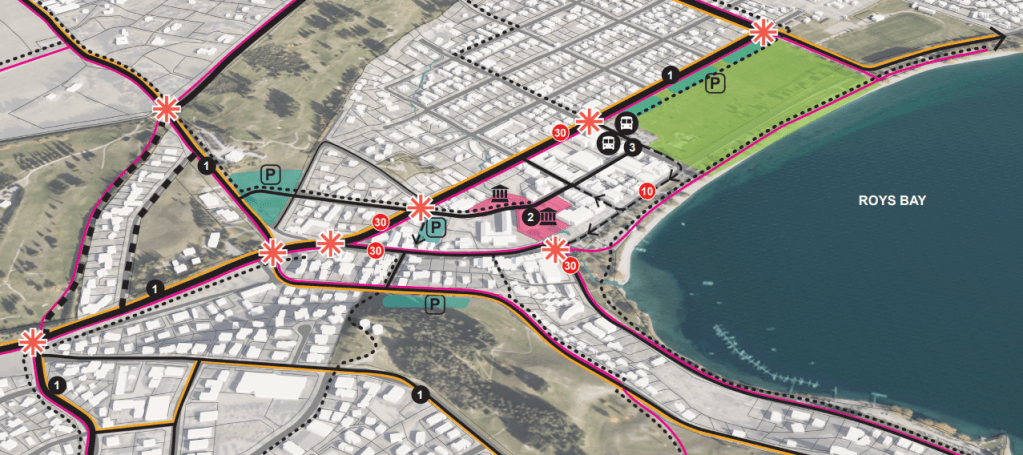
In 2019, the Council extensively consulted for the Wānaka Town Centre Master Plan. 55 pages later in 4 pdf documents, there are 3 more carparks, several roundabouts, hardly more nature nor bike lanes, but cars are removed from the lakefront (overloading Brownston Street).
Master Plan 2019 page 95 – Plan for 2030-50
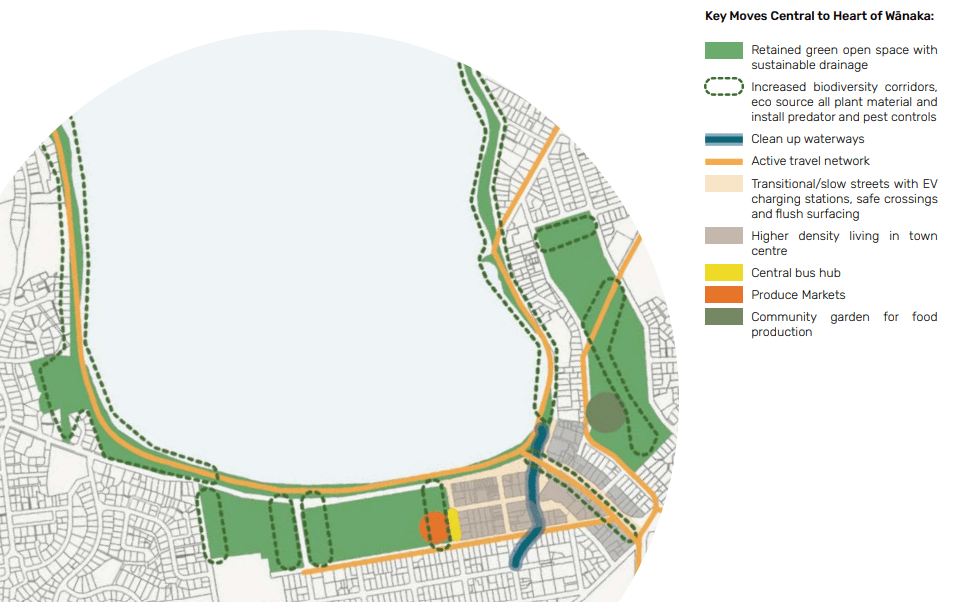
In 2023, the locals group Heart of Wānaka worked on the traditional town centre from Wānaka Station Park to Mount Aspiring College. The proposed active transport and retained open spaces seem to happen. The increased biodiversity corridors, slow streets and community gardens are yet to manifest.
What did happen is urban intensification, after many hearings and dozens of pdf documents, buildings are now allowed to block views, all bits of grass built up: new zoning has been created to cater for developers wishes, including “greater heights and density will be enabled in locations near central and on generally greenfield land in Wānaka South, increasing current permitted heights from 8m to 11m and removing density requirements of one residential unit per 250m2 net site area.”
This urban strategy is planning for intense growth, despite the community reiterated wishes and way beyond Wānaka town centre. Let’s talk about the wider Wānaka Area.
Please share a thought for the elders who planted the trees creating these green spaces. GRATITUDE. Respect.
Beyond the Wānaka town centre
In March 2002 started a well-remembered community consultation, the Wānaka 2020. With 150 participants in the launch meeting, followed by well attended 3-days workshops, the 2020 Wānaka report recommends that “The long-term town boundary should remain inside the Clutha and Cardrona Rivers and to avoid sprawl. The 40-pages report highlights the need for better water, transport and green infrastructures.
Extract:
It also recommends “A new sustainable urban extension zone with new rules“. The Green Belt, never really connected and is now rapidly nibbled.
Location and focus of Wanaka 2020 process. Base map source: NZMS 26:F40, Crown Copyright.
In November 2019 in the Whaiora Grow Well workshop roadshow for the QLDC Spatial Plan, community members were invited to have a vision for Wānaka growth then ask to vote for their preferred option for the future: all tables voted to stop Wānaka growth to where it was then and growing satellite towns (Hawea Luggate, Cardrona) with well-connected public transports. ONE table raised their hand to grow Wānaka and they were booed! If you were there, do you remember that?
Following these clear consultations, the report mentioned for the first time, a “Wānaka South area supporting 5000 new dwellings”! That is completely the opposite of the community preference and creates unrestrained unsustainable urban sprawl.
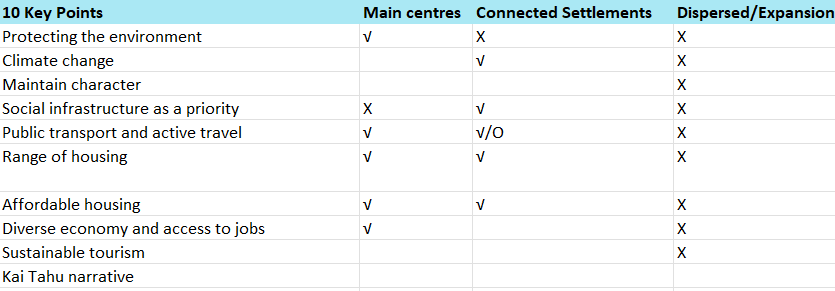
59 people attended in Wānaka. 8 groups were asked to evaluate 3 scenarios. Tick is “better”, O is “same”, X is “worse”. The “Dispersed/Extension category” received X from ALL groups expect one table giving them 4 “better”, 4 “worse”, 1 “same”.
In August 2023, at a Blue-Green Network workshop, all attending stakeholders expressed their concern about the growth paradigm declared by the Council. The Council anticipates and fosters growth of population, business and tourism. “All consultations reveal the community wants to STOP growth. Why does the QLDC continues to promote growth?” asks a participant. The growth is already beyond people’s desired lifestyle and the carrying capacity of the land is over the maximal load, particularly water pollutions.
All participants wished for more biodiversity and food space in the plan presented and proposed to cap growth at a sustainable post-growth level. Several times was raised the missing tool to enable the change from unsustainable business-as-usual growth.
I suggested a regenerative land zoning to create commons on private land on a voluntary basis. I followed up without answer so far. It’s such a good idea, it’s generous. It’s community building, resilient, low carbon… it’s nearly free.
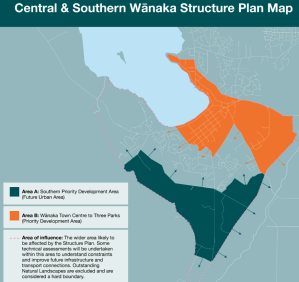
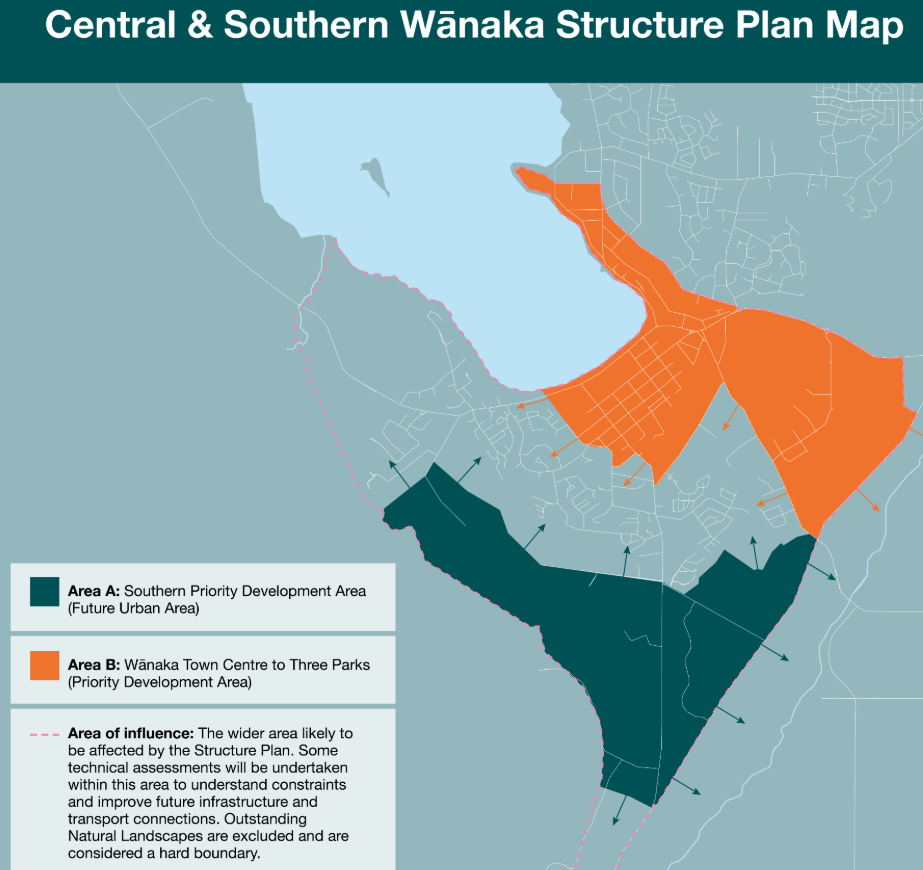
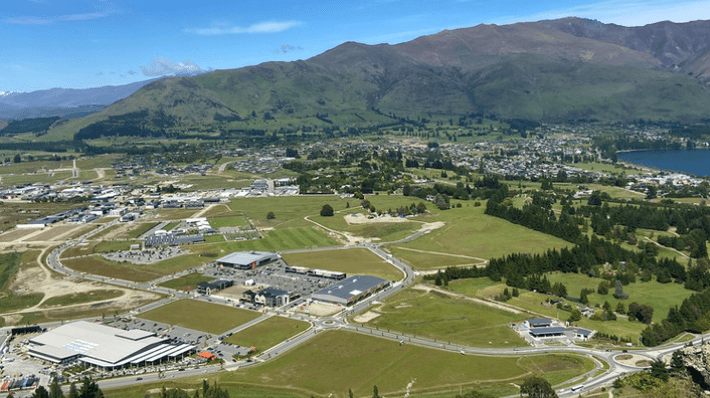
the urban area is planned to be 10 km from East to West and 10 km from North to South.
Going South, there are no public park beyond opposite the Medical Centre
The area in blue is currently “Rural“, with lifestyle blocks of minimum 2 hectares, some more than 20. This zoning allows development at a density of up to one residence every 4000m².
Many blocks have substantial mature trees planted by their owners over generations.
The area is full of birds. Dawn chorus already here. And birds need vast areas of nature to thrive.
This green large tranquil area is jeopardized by the plan to change zone and allow subdivision. It concerns landowners. They bought a piece of land in a natural area many years ago, because they wanted a tranquil natural life and many planted trees. The plan, putting growth first, is disrespectful and damages the environment irreversibly. Specially if the trees are the first to go.
All the zones in orange, dark blue and within the “area of influence” are concerned by this QLDC Structure Plan.
A new QLDC initiative Smart Growth Wānaka is promising, with a planned citizen assembly. I am a strong advocate of citizen assemblies as I believe it is able to lift society beyond the current misfunctioning democracy. However, since the community has time and time again expressed the same idea (Stop growth), there is no divisive issue here, it delays the action further.
The action is to pause growth immediately, until the results of the citizen assembly. It IS possible to pause growth as in Greytown in Wairarapa.
Now is the chance to create a landmark Wānaka, before all the trees are gone, before it’s all built up.
What does regenerative urban growth looks like?
To be regenerative, first be sustainable. Sustainable means not extracting from the Earth, not polluting the Earth, not damaging the Earth, and sharing within communities. Regenerating is improving above that baseline.
Research has also shown that the ideal sustainable population of a urban area is “whether a city’s population matches what its systems can handle” Associate Professor Kamruzzaman said. “That’s the key to sustainability.”
Some research shows that about 1000 inhabitants settlements is the best size for resilience and ecological responsibility. A NZ study says that people’s preference is to walk less than 15mn which is 5mn drive.
The End of Suburbia documentary describes the fossil fuel overuse and wellbeing decrease in suburbs which is the current trajectory. Green sustainable urban development is well documented, including for small towns.
In Wānaka
Wānaka development is removing all green areas and existing trees.
Only one community garden, and a few satellite food growers but most of the food is disaster dependent
Wānaka is already beyond capacity eg. waste water leaking the river.
It already takes 15mn at a quiet time to drive from boundary to boundary, not to mention the daily queues.
Solutions exist to create a beautiful healthy sustainable low-carbon equitable district.
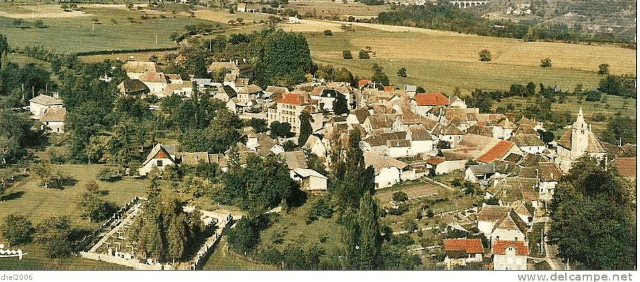
Traditional villages 300-1000 inhabitants, green space with food production and trees
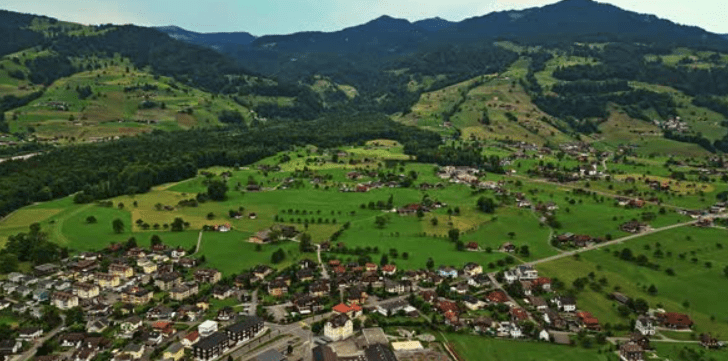
In modern denser urban sustainable environment, there is also a lot of nature and community wellbeing
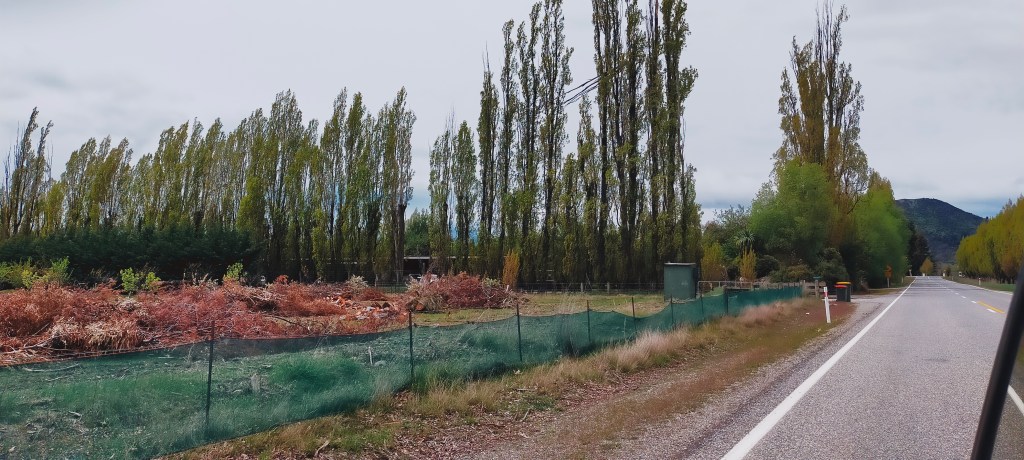
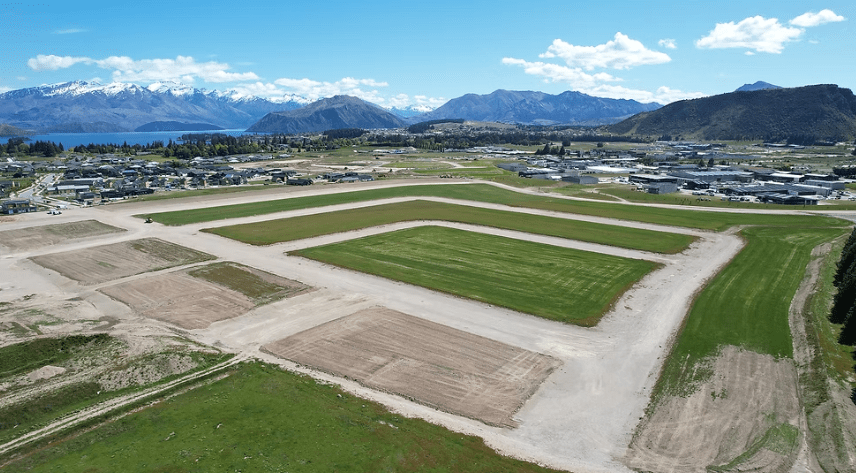
Bulldozer land clearing in Wānaka-not one tree left
– immediately enforce 10% of land kept for nature. It is already on the guidelines for subdivisions. let’s make it a prerequisite for all new consents. Educate, encourage all landowners, small or large to create a 10% nature buffer.
– Plan and support (with financial and practical help) landowners to protect/restore 30% of their land by 2030. eg. Jobs for nature, support for social enterprises who provide fencing, local food growing and natural pest management…
Up until recently, the Council had some reserves between developments and some area kept as Parks with connecting pathways eg. Lismore Park. But beyond the existing centre, there are only private properties with no provision for Reserves. The absence of land available for shared green space was raised at the Blue-Green corridors meeting (August 2023). Potential solutions are to enforce reserves on all new projects and foster voluntary reserves by a Regenerative Land Zoning (see 3 below)
2- Protect all existing trees and groups of trees.
Proposal: Treat all trees as protected and strengthen existing rules about trees on public land to control how they can be removed and I am asking for an immediate moratorium on feeling trees until discussed.
I presented this tree protection policy concept and a demand for a moratorium in a QLDC public forum in February 2026. I had no feedback; since then, at least 5 windbreaks of mature poplars have been felled in the outstkirts of Wānaka. My heart breaks!
If we are serious about climate change and enhancing biodiversity then we will extend trees protection to the whole district. All trees are important and there are so few left! Trees are living beings, historical, sacred.
Native/Non-native trees… In Wānaka, most mature trees are non-native therefore viewed as “worthless” and are chopped by inconsideration or convenience. The problem is, if we remove them, we have a 20-50 years of bare land until the baby natives grow. Poplars, willows and douglas firs, cherry, dogwoods, cedars are not native but if we continue removing them all, our town will be bare. With the native-only logic, sheep, cows, and pakehas… all culled! I love natives and plant lots of them. But existing trees should never be removed to plant natives, it goes against common sense and climate science.
So we need to discuss how to protect trees effectively and learn how to love them and manage them. I realise there will be exemptions but starting by a blanket protection is the most effective easiest solutions. A moratorium right now will save many trees.
I believe Protecting trees is the cornerstone of sustainable urban development as trees need space. The space allowed for trees can be left for nature, used for bike lanes, walkways, parking, park, food growing, all things wanted by the community.
I understand it is the responsibility of the developers or the landowners to choose to protect or kill trees. So I am creating a campaign for cherishing Wanaka Trees, ALL of them. Jump on if you love trees too. I am continuing this campaign and appreciate all contributions/ideas.
3 – Create public-private partnership where the Council and the public benefits from land without the need to own it. It doesn’t matter who owns the land, 30% need to be protected.
Since 2022, I work on a new voluntary land zoning that protects a land from subdivision for perpetuity when it contributes to the community, future generations and the planet. Maybe 30% minimum of the land is kept for nature and regenerated, and maybe also shared for the greater good.
When someone planted trees, it’s not to be cut for houses next generation. It’s for the Trees, for Papatuanuku. For All.
Some landowners are already sharing part of their land as civic assets for wildlife habitat, for food growing (essential in a low carbon society), for access (bike commuting, walk, bike and horse tracks, for parks…). This creates commons that serve both the environment (so that it can continue to provide ecosystem services) and the community (recreational parks, connected bike lanes for commuters, food production areas…)
Developers can subdivide well, with keeping all the trees, regenerating 30% of the land creating shared spaces rather than stripping the land and adding as many rows of houses as possible. 30% for nature means: out of 60 sections, 20 should be reverted to a natural environment.
Loosing fertile greenfields to concrete and buildings is unsustainable, as highlighted by a government report dated April 2024. I am not radical here. Science is clear. In a climate and biodiversity crises, it’s land clearing and tree killing that is radical.
I hope the opportunity is taken by the Council, as this would foster a beautiful green low-carbon resilient and happy community. We need nature and land for food here, not 83km away where the National Park starts. That’s whaiora, with dawn chorus and other principles in the 2050 spatial plan. This new land zoning is the missing tool of the shift, allowing willing landowners to start and pave the way. Please refer to the well-research page on the powerful yet simple proposed piece of regulation here.
Bold Inspiring Vision
I urge the Council to be bold and inspiring, actually creating a beautiful future, starting now, not in 10 years when it’s all built up – when what we do have and love will be destroyed.
At the historic Regenerative Tourism Hui 3 in 2023, the Carbon Zero by 2030 goal was adopted. Solemnity rippled on the crowd after we collectively committed to it, fully understanding the why and meaning of such a bold engagement. Tyler Robinson said “Queenstown Lakes is the ideal place to show the world that decarbonization and regeneration is possible. We have an ecosystem of early adopters here“.
We all know that carbon zero goal means slowing the crave for more. More houses don’t solve the affordability crisis or cities like Auckland or London would be cheap. More money for more consumption exhausts the planet already beyond capacity. Living simply, locally, circular, without chemicals and pollutions, keeping precious remnants from the natural world and regenerating the land, that’s achievable.
But not with the current rules and the touted growth goal. Growth is the money-carrot for many, growth will benefit the developers and workers but growth is not the solution, it worsens all the crises. Instead of planning for growth, let’s plan for a sustainable, circular economy, where all people have enough. We need a paradigm change, that put people and planet first BEFORE the money and bulldozer growth; It’s a culture where we share, creating a beautiful connected community.
I will speak at the QLDC Council meeting in Wānaka on the 23rd July 2026 to encourage sustainable urban development with urgency and practical solutions. It’s all possible -and better. And invite Councilors to take responsibility for us and future generations. What else?
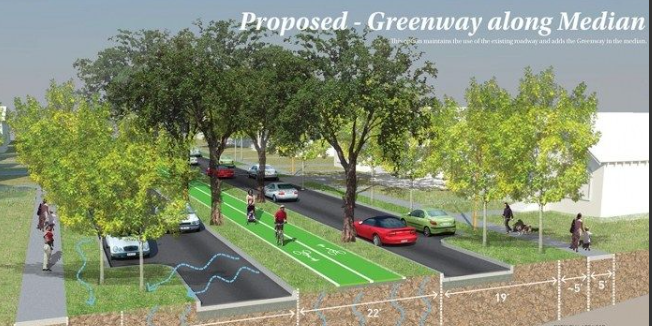
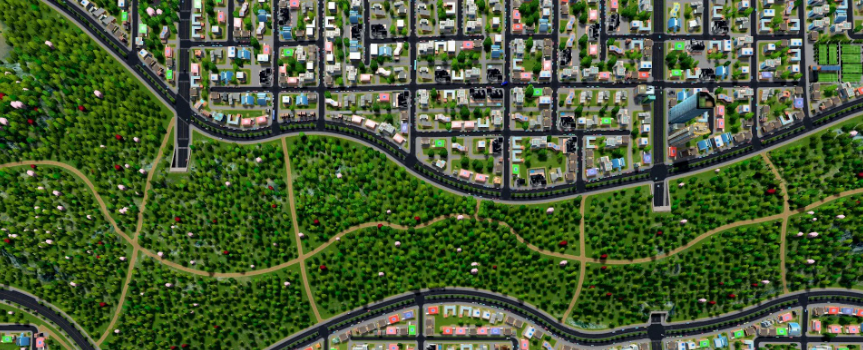
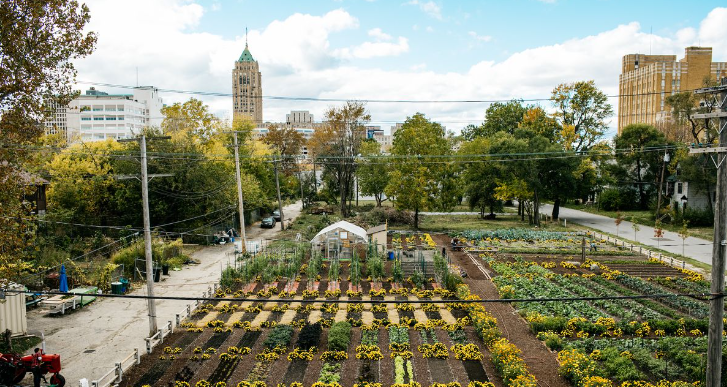
Appendix Exemples of rules that results in generous green connecting natural spaces (click on image for links)
Substantial sustainable greenways in Baton RougeThe most generous green corridor image I find online is from the gameplay Cities: SkylinesDetroit green space food production
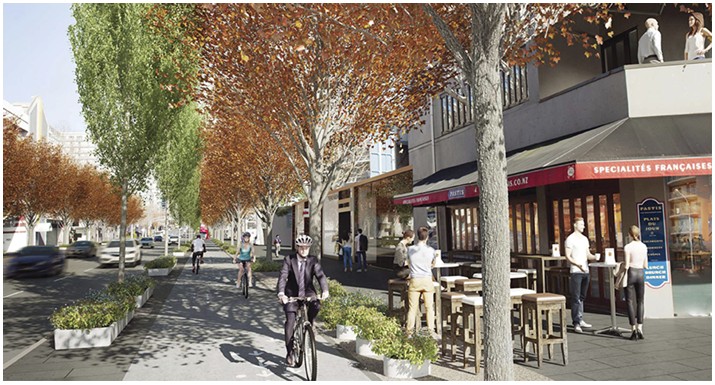
Appendix Example of Regenerative Urban Roads
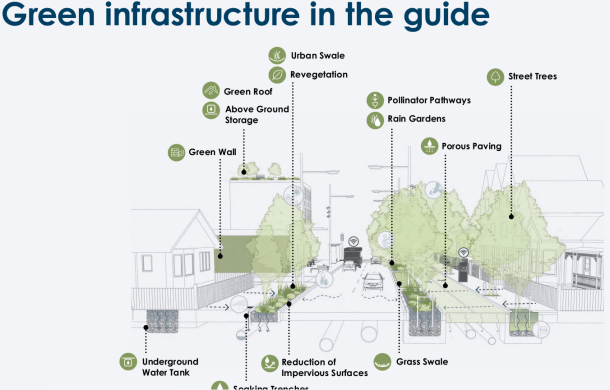
Roads become green corridors, much wider than the current plan “New street trees shall not be planted where the projected mature canopy spread is within 5 meters of any street light or overhead services.” A 5 meter canopy is reached within 10 years by many trees. Allow for 12 or 15 meter canopy, the average crown size of a medium size oak tree.
Appendix Practical rules for subdivisions and all landowners
Here are better practices, to embed in compulsory rules, as we see that discretionary recommendations do not work.
30% of nature is integrated into subdivisions as parks, surface water management, shared food production, connected pathways, beautiful and great for wellbeing
Each section keeping 30% for nature OR each subdivision keeping 30% for nature OR each group of apartments built on land with 30% for nature around them.
mandate to ensure existing trees on subdivision are protected particularly the trees surrounding the property, protected as public land trees, ban clear felling.
Limit terraforming, soil removal and compaction to maintain soil life and its sponge properties
All rainwater to be slowed down with surface planted drains, reed beds and wetlands, the local Kirimoko Park offers some of these features
compulsory roof rainwater harvest tanks, possibly subsidised like on the Kapiti Coast, also great for resilience.
Protect ridgelines, no dominant house, all ridge houses to be integrated in planting
Keep at least one viewpoint to be preserved for public access,
All new streets and access to have separate connected bike-lanes and separate footpaths
All streets and dead ends to be connected with at least foot access to adjacent streets
Appropriate junctions with existing roads paid for by the developers, not minimal intersections generating traffic congestion for both new residents and neighboring residents, as we have on North Lake or on the Ballantyne/Sir Tim Wallis intersection.
Developers to pay the costs of infrastructures needed to accommodate the new housing residents, not existing ratepayers. (eg. The Longview Hawea waste water is literally a shame)
Ban the use of herbicides and pesticides
What does it look like?
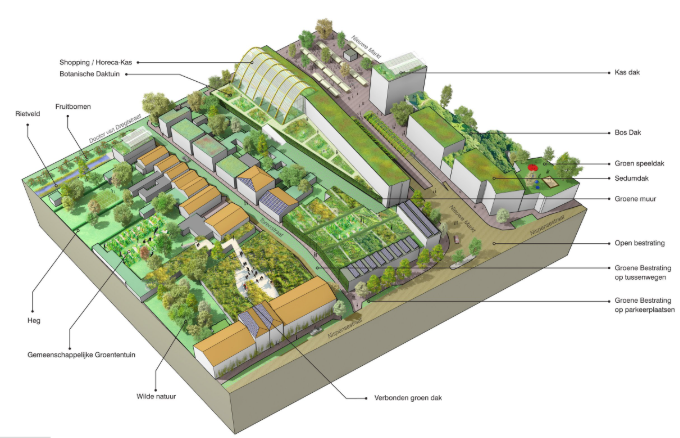
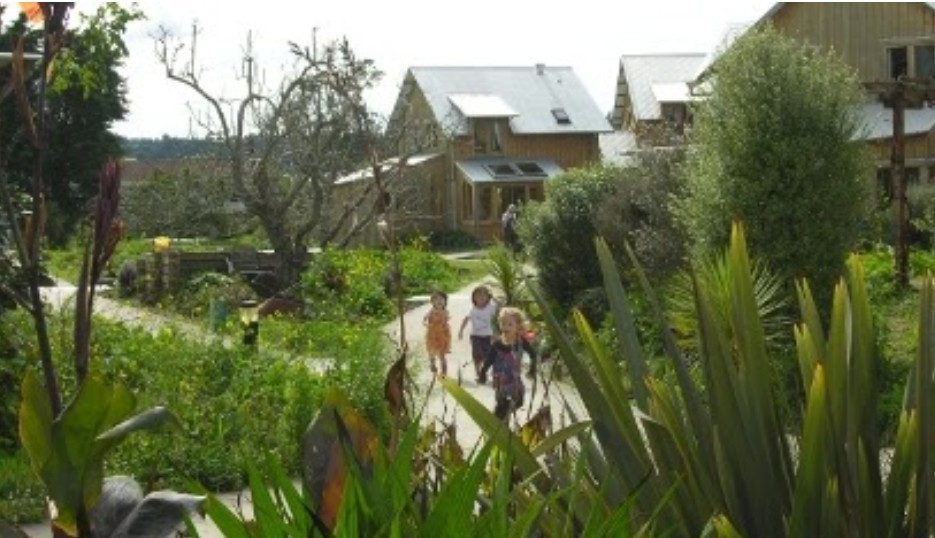
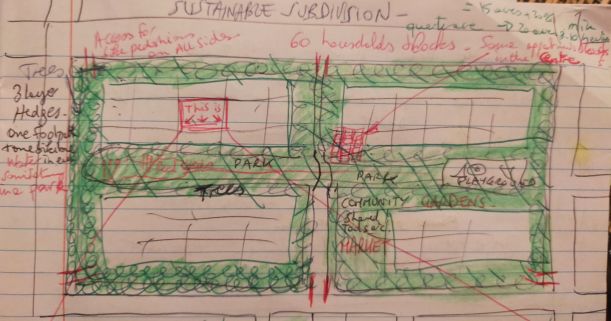
Exemple: a 8-10 hectares block holds 60 household blocks. All the trees have been kept. The outer hedges trees are complemented with three layers of plantings for a generous hedge, hosting wildlife and tracks. There is access for pedestrians and bikes on all sides. The centre of the subdivision is a park featuring trees, children playgrounds, reed beds for water sanitation, shared gardens or plots for food production. The park can be borded with a couple of apartment blocks with view on the trees. The centre of the subdivision can host shared spaces, shared tools, market place, community building…
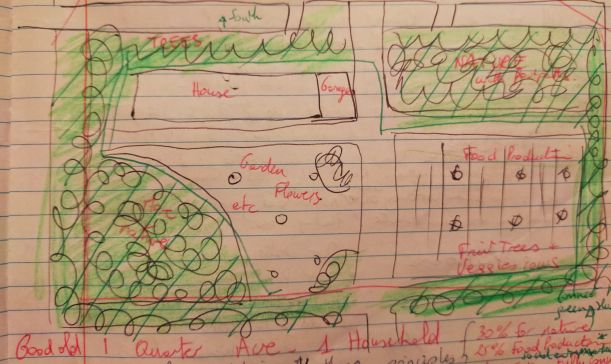
Each 1/4 acre section is well surrounded by trees, space for gardens and play, a sustainable house, water harvesting, orchard, food production and nature, at least 30% or more. Imagine the wildlife and privacy here!
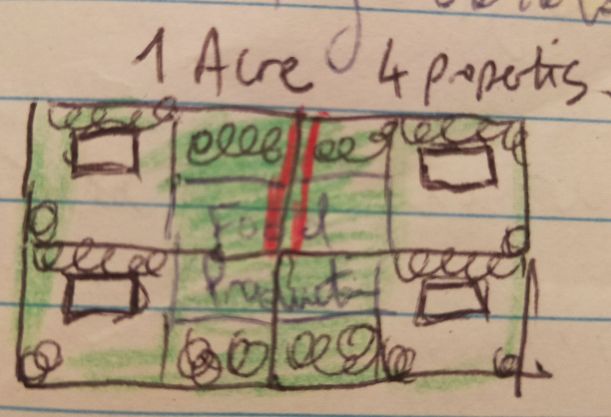
Or any combination of these, like here: 1 acre showing 4 households with a shared nature zone and food production to ensure wellbeing for people and nature. Sorry, the drawings are not the best! But I hope you get the idea. Lots of trees. Just make sure you plant deciduous trees on the sunny side of the house for cooling in summer and sun in winter.
Does any of this inspire you? Let us know in the comments below.
From iconic Wastebusters shaping Wanaka and New Zealand zerowaste future to Te Kakano reforesting our area with thousands of volunteers for 15 years, to WAO inspiring and empowering the community in yearly Festivals, many ecofriendly businesses, the Regenerative Wanaka Facebook page and the QLDC Climate and diversity action, our active community is loving and caring for the place, often choosing a lifestyle in harmony with nature.
View our Here – Us – Now List here send us a note if you believe your business or organization should be included.
WAO Summit
Coming up in October, WAO Summit is a great inspiring and galvanising festival in Wānaka.
I will talk about: 1- low-carbon, resilient, biodiversity-enhancing lifestyle at household level 2- beyond individual action, how to foster regeneration at district level.
Exciting!
Beautiful Gardens of Wanaka
Our guided garden tours are a great complement to this thriving sustainability culture, showcasing outstanding private gardens, a unique way to share garden beauty and connection with the place and people. Great activity for manuhiri/visitors, our tours also benefit locals presenting local gardeners’ best practices for Central Otago special conditions (frost, heat, draught, rabbits…)
New this season is our educational tour featuring biodiversity attributes and practices to adapt to our current climate crisis era, demonstrating how to regenerate land and gardens in harmony with nature. The property showcased on this tour is an inspiring example of sustainable living with forest and regeneration, food growing, beautiful flowers fostering biodiversity, entirely run without fossil fuels… Come and learn how it’s done.