Regenerative Livestyle Blog


1 Comment

How climate change affects our region

Just like Wanaka is a “lifestyle reserve“, Wanaka is also likely to be far less affected by climate change than many other places in the world. Not worried by sea level rise! And a bit warmer wouldn’t hurt, would it?

However…

In our mountains, the biggest worry will be a shortened duration of seasonal snow lying, a rise in snow-line and a decrease in snowfall events. Glaciers will continue to melt.

The Ministry for the EnvironmentCopyright Ministry for the Environment Climate change projections for the Otago region page is worth reading. They predict:

  • around 0.9˚C warmer by 2040,
  • it will be wetter in winter and spring (more 29 % in Queenstown by 2090), drier in summer and autumn.
  • very heavy rainfall events are likely to become more frequent in Otago, increasing the risks of floods.
  • more often and stronger storms in winter (less in summer), with winds increasing between 2 and 5 per cent in winter, increasingly westerlies.
  • About the snow, “at heights between 1000 and 2000m:
    • the maximum seasonal snow depth is likely to decrease by approximately 20 per cent by 2040 and approximately 40 per cent by 2090
    • a low snow year is expected to be five times more likely by the 2090s.”

Unfortunately Treble Cone summit lies at 2088m and Cardrona at 1860m…

In the NIWA Natural hazard 2008 report, landslides, hailstorm, snow storms and electrical storms are all described for Otago. The fruit industry in Otago will be affected by summer droughts. The winter frosts will decline therefore bugs are likely to thrive.

And climate change is going to affect our native species, and their habitats in many diverse ways, states the Forest and Bird website. Birds and natives may have to move up to survive in their usual temperature but it is not always possible so it may mean they are out. Also some species, like tuataras -we don’t have any in our area to my knowledge- need a specific temperature for incubation therefore climate change is adding a threat to their survival.

Conversely, pests and insects are opportunist creatures and will make strides in changing conditions.

There is a last aspect I think is significant for our area: the impact of climate refugees, coming to live in our town because theirs is doomed. It may well have already started.

We are definitely all in there together!


1 Comment

It’s time to talk about climate change

Surely you’ve heard of it: the United Nations are having a conference in Paris in December to talk about climate change. And hopefully make some decisions. Well, they need help because they are going in the right direction but far too slow.

SO JOIN US FOR CLIMATE ACTION!

Climate march

What we need to know:

ErosionStClair beach98% scientists agree and the IPCC reports are peer-reviewed and include “skeptics” point of view. The IPCC report “Climate Change 2013: Physical Science Basis” summarizes all data with a level of confidence (depending on amount and quality of data as well as degree of agreement) and a measure of probability (based on models results and expert judgement).

Therefore any data or projection that comes with a high confidence and a very likely probability has -virtually certainly- happened or is going to happen. This is what the report states:

Climate change IS happening

  • Data collection around the world averages nearly 1°C increase in temperatures since 1870.
  • Extreme temperatures, droughts, floods, storms, have doubled or tripled since 1880.
  • Sea levels have risen 250mm since 1880
  • Glaciers have lost an average of 14 meters depth since 1950, particularly since 2004.
  • Wildlife has declined and species have migrated. Biodiversity main threat lies more in habitat destruction and wildlife trade than in climate change. However, the coral reef demise (only 12% of coral reef is left) is directly linked to ocean acidification which is due to CO2 increase.

Climate change IS human induced

Climate change is caused by the release in the atmosphere of vast quaE48400 - Lower part of Fox Glacier with glacier mouth, February 2013ntity of CO2 from coal and oil extracted by humans to create the extraordinary unprecedented growth since last century. Massive deforestation and other land use have also contributed to the increase in CO2 in the atmosphere. In the last 800 thousand years, atmospheric CO2 has varied between 100 and 300 ppm. Today it is nearly 400 ppm.

Methane and nitrous oxide (also created by humans – agriculture) are less concentrated but have a higher greenhouse effect than CO2 and therefore need to be considered as seriously as CO2.

Now, for people who still wonder why we should worry, click on the image below. Early humans appeared sometimes in Pleistocene and all the civilizations we know have developed in the relatively regular Holocene period. If we don’t prevent this sharp heating of our planet to happen, the world as we know it is GONE.
All palaeotemps

There is hope though. If we choose the right scenario, we can help make this temperature rise go slower, enabling as many as living creatures (includes humans) as possible to adapt…

What will happen?

Projections have been made for 4 scenarios (called Representative Concentration Pathways (RCPs).

  • RCP 2.6 is a mitigation scenario which aims at, with active policies, stabilizing then decreasing the CO2 emissions before 2100.
  • RCP 4.5 scenario aims at stabilising the CO2 concentrations by 2100.
  • RCP 6 scenario aims at stabilizing the CO2 concentrations after 2100.
  • Now RCP 8.5 is what will happen if we continue business as usual.

So I’ve been very nice and read everything for you and here is a summary of the effects, depending on the scenarios we choose:

Today RCP 2.6 RCP 4.5 RCP 6.0 RCP 8.5
Goal Reduction by 2100 Stabilisation before 2100 Stabilisation after 2100 Business as usual
CO2 concentration in 2100 398 ppm 421 ppm 538 ppm 670 ppm 936 ppm
Average air and ocean temperature(since 1870) +0.85°C +1.8°C stabilised +2.5°C +3°C +4°C (possibly +6°C)
Glaciers (cryosphere) 2% reduction since 1950 and accelerating 15 to 55% reduction 35 to 85% reduction(ice free Arctic ocean in September by 2050)
Ocean acidification 8.1 8.05 7.95 7.9 7.8
Sea level rise (does not include the “not agreed on” possible Antarctic shelf collapse) +1.7 meter since 1900 +0.26m to 0.55m (compared to the average sea level between 1986 and 2005) +0.32m to 0.63m(id) +0.33m to 0.63m(id) +0.45m to 0.82m(id)

And in Wanaka?

Just like Wanaka is a “lifestyle reserve“, Wanaka is also likely to be far less affected by climate change than many other places in the world. Not worried by sea level rise! And a bit warmer wouldn’t hurt, would it?

However…

In our mountains, the biggest worry will be a shortened duration of seasonal snow lying, a rise in snow-line and a decrease in snowfall events. Glaciers will continue to melt.

KeaThe Ministry for the Environment Climate change projections for the Otago region page is worth reading. They predict:

  • around 0.9˚C warmer by 2040,
  • it will be wetter in winter and spring (more 29 % in Queenstown by 2090), drier in summer and autumn.
  • very heavy rainfall events are likely to become more frequent in Otago, increasing the risks of floods.
  • more often and stronger storms in winter (less in summer), with winds increasing between 2 and 5 per cent in winter, increasingly westerlies.
  • About the snow, “at heights between 1000 and 2000m:
    • the maximum seasonal snow depth is likely to decrease by approximately 20 per cent by 2040 and approximately 40 per cent by 2090
    • a low snow year is expected to be five times more likely by the 2090s.”

Unfortunately Treble Cone summit lies at 2088m and Cardrona at 1860m…

In the NIWA Natural hazard 2008 report, landslides, hailstorm, snow storms and electrical storms are all described for Otago. The fruit industry in Otago will be affected by summer droughts. The winter frosts will decline therefore bugs are likely to thrive.

And climate change is going to affect our native species, and their habitats in many diverse ways, states the Forest and Bird website. Birds and natives may have to move up to survive in their usual temperature but it is not always possible so it may mean they are out. Also some species, like tuataras -we don’t have any in our area to my knowledge- need a specific temperature for incubation therefore climate change is adding a threat to their survival.

Conversely, pests and insects are opportunist creatures and will make strides in changing conditions.

There is a last aspect I think is significant for our area: the impact of climate refugees, coming to live in our town because theirs is doomed. This is why it is not only altruistic to act for the climate. We are definitely all in there together!

Solutions are well-known

We all urgently need to stop our petrol and coal consumption. There are so many other ways to produce energy (eg. solar panels), to save energy (e.g. insulate), avoid useless motorized traffic, buy local… And we need to make pressure on our local bodies so they create effective public transport systems, safe cycle lanes, better housing regulations. And we can put pressure on governments so that they encourage renewable energy rather than support fossil industry.
Worms-from-coffee-compost-pile
Agriculture and forestry also need to improve their practices. An IFOAM report explains in 2009 that “agriculture currently accounts for 10-12% of global greenhouse gas emissions” (ruminants and deforestation mainly) whereas, “global adoption of organic agriculture has the potential to sequester up to the equivalent of 32% of all current man-made GHG emissions“. So we can choose to buy organic, plant trees, have less meat and dairy… and again pressure governments so that they promote organics rather than throw some sand into their wheels.

We can choose to avoid plastic, to recycle, to grow our own food to build up our own soil… In fact, there are so many solutions, that it will be the object of another article!

Mostly, we need governments to take the right decisions at the next Climate Conference, to choose effective mitigation of climate change and we have the opportunity to tell them :

Come and participate in the Climate March here in Wanaka, on Sunday 29th November, at 2pm in the Dinosaur park.

We can choose to change our lifestyle OR the climate will change our lives.

Sources:

Watch the Climate March video here. 320 participants, beautiful day, thank you to all participants and passionate creative volunteers!


Leave a comment

I try, and I made it!

I’ve just finished to read “The Boy who Harnessed the Wind”, by William Kankwamba and it was so inspiring I wish everyone would read this book…

It’s the true story of an African boy who builds a windmill so that his family never has to live through famine again. He does this mostly alone without any money, with the help of a few library books, a lot of work and determination.

I value this book because William talks about his rural community.  It is not told by an ethnologist, a development officer or a tourist. It’s how life really is for more than one billion people and we hardly ever hear it from the inside.

Moreover, the local solution he offer is, I believe, the way to solve the global problem of scarcity in the world. I really like how he analyses that development must come from within.

Besides, we, in rich countries, take everything for granted (well, we do have more than everything) so we so have much to learn from this story. William is amazing in determination, simplicity, cleverness and altruism.

This book particularly resonates for me because I am librarian, like Mrs Sikelo, and my passion is to bring people the information they need. This story shows my work is all worthwhile as it can be life-changing.

It also tickled me deep inside because when I was 13-14, I told my science teacher that I wanted to be renewable energies engineer (way back in 1980) and he laughed at me… I gave up the dream. William did not give up. As he said in his first TED talk online: “I try, and I made it!” What a grand lesson!

Here is William’s blog, and his Moving Windmills Project website. Worth supporting.


3 Comments

1080, diquat and co.

100% Pure NZ is systematically sprinkled with persistent organic pollutants, but don’t worry! All the studies prove it’s OK.

Actually, independent source Pesticides Action Network PAN declares it’s not OK, these products are on the Highly Hazardous Pesticides list (HHP list).

What’s the problem?

They do not disappear despite some biodegradability, they enter the food chain and they accumulate. From highly acute toxicity to long term toxic effects (carcinogenic and mutations), endocrine disruption, environmental degradation (ozone layer, effects on animals…), to hazard to ecosystems services (bees), HHP effects are varied. Cause and effects are not always obvious, often long term. Only highly acute toxicity is tested in most cases.

DiquToxicat dibromide is on HHP list. It can be fatal if inhaled ; Also toxic by ingestion and  dermal contact, including neurologic effect. It is chemically close to agent orange and was used in Vietnam too. It makes rats infertile. It is often found in cow milk.  It is unlikely carcinogenic but is known as a potential ground water contaminator. Diquat is used every year in Lake Wanaka in an attempt to stop lagarosiphon spread. It doesn’t stop it nor prevent it to grow again. In fact, lagarosiphon is not toxic, it is a habitat for native species, it absorbs nitrogen. It does annoy boaties, getting stuck in propellers. It does disrupt hydro dams (turbine shutdown and lost energy production), obliging hydro companies to invest in expensive measures against the plant.

ToxicGlyphosate (RoundUp)  is listed on the HHP list. It is not as biodegradable as Monsanto says. Not only it is quite persistent in water and sediments but also its degradation creates other toxic substances. It is known to have long term health effect on kidneys and reproduction organs. Its massive use also leads many weeds to become resistant and it is present in many surface and ground water tables. Besides, glyphosate is often associated with other chemicals for the weedkiller to be more efficient so you get the perfect cocktail for unknown consequences. Actually not so unknown as many many studies show severe effects but Monsanto’s powerful marketing machine is still winning.

ToxicPindone (not on the HHP list), however on PAN database, it is listed as highly toxic, causing nosebleeds, bleeding gums, bloody urine, extensive bruising in the absence of injury (ecchymoses), also fatigue, shortness of breath (dyspnea) on exertion. It may cause fluid in lungs (pulmonary edema). It is fatal or highly toxic for fish. Toxicity data is missing (no study done/recorded) as to cancer, water pollution potential and the bees. It is used to kill rabbits, with some success, although rabbits invariably spread again, possibly getting resistant.

Toxic1080 (Sodium fluoroacetate), is on the bad guys list as Extremely hazardous (Class 1a) according to World Health Organisation and fatal if inhaled. May also be absorbed through the skin. Leads to convulsions, laboured breathing, unconsciousness and death if untreated. DOC says 1080 is OK for NZ because it targets mammals and there is no native mammals in this country. 1080 is not used in any other country in the world because it would destroy mammals. Well, sorry but I AM a mammal and my children too. More and more research show that it accumulates and that it has long term carcinogenic and reproductive effects… In the local papers today, DOC kindly reassures us that fish ingesting 1080 are safe to eat because you need to “eat several tonnes of affected fish” to get a fatal dose. For me, “not fatal” does not equal “safe”. What about everything in between?

2014 is a mast year

In 2011, the Parliamentary Commission for the Environment publishes a report that supports the use of 1080 as the best solution available to help protect our native birds. Interestingly, independent scientists demonstrate just the opposite on their site 1080science.co.nz. A lot of information is on the Ban 1080 website.

Solidly based on the PCE report, DOC launches the “Battle for our birds”, with a record dropping of 1080, when we know that 1080 kills about as many birds as it protects them.

Which to believe?

I am not a scientist but I see clearly there is not enough consensus on that matter among scientists to keep using these HHP without questioning.

I know about Rachel Carson landmark book, Silent Spring, which warned, in 1962, that the use of pesticides would lead to wildlife destruction and a dramatic increase in cancer cases.

I have read Our Stolen Future, by Theo Colborne, which demonstrated in 1996, that even tiny doses of pesticides can alter human development and reproduction, as they are endocrine disruptors.

So I wonder… and I worry…

What do the pro 1080 win? Lots of money $$$ from selling and applying their product. Pro-1080-diquat-and-so-on justify themselves by any mean to keep doing business as usual.

What do the anti 1080 win? Nothing! They must have good precautionary reasons to spend so much time and energy fighting this!

Solutions?

I am not saying I have solutions. I just want people stop saying these substances are solutions. They are not. They are dangerous and don’t solve problems, hardly mitigate them. Saying they are solutions prevents everyone from searching for better ways -non toxic please.

I think we must stop thinking in terms of pests that we need to eradicate. Maybe consider them as resources? Lagarosiphon is excellent composted. Possums of course have made the fortune of many trappers. Some rabbit terrines are served in the best restaurants in some countries…

Maybe widen the issue to the whole system? We don’t have a “pests” problem in an otherwise perfect world. I know this may shock but it strikes me that National Parks are protected (from destruction by humans) and DOC is sole responsible for their maintenance yet forests are becoming silent. I know of some valleys that are privately owned and well looked after by their owners. No possums, no stoats, lots of birds, lush native bush. Maybe the system needs revisiting…

What if humans became again guardians of the land, respectful of nature, not consumers and controllers of nature? This does require quite a mind-shift and a lot of open-minded discussions. I don’t have solutions. But if we don’t look for them, we won’t find any and we’ll keep doing the same things with the same results.

What you can do

  • Take the warning signs seriously! It IS dangerous!
  • Join groups who set traps
  • Take photos of abuse and send them to the media, OSH, local authorities and beyond
  • Love your weeds instead of poisoning them
  • Generally avoid using chemicals, they all add up!
  • Prompt debates…

PS- I could make a very similar article about the pesticides used in agriculture, less visible but more widespread…


1 Comment

Joel Salatin in Wanaka

Joel Salatin talk, last year in Wanaka, was an energizing speech as much in content as in the presentation itself, a great toastmaster exercise. Basically the recurring idea is orthodoxy vs heresy… These are my notes from the event.

Joel Salatin in Wanaka


Orthodoxy and heresy

People used to think the earth was flat – orthodoxy, then came Galileo saying that the earth was round – heresy. Even more when Copernicus said that the Sun was not going around the earth; the Earth was going around the sun- heresy. Then when slavery was the norm- orthodoxy, the Magnacarta established the right to be free- heresy.

We used to learn the Amazon as the ultimate wilderness- orthodoxy, whereas it is actually a planted and manicured forest- heresy …

In medicine, doctors used to think illnesses were spirits- orthodoxy, then it was discovered that it was due to bacterias and viruses… More recently, Pasteur established the germ theory, where we are victims, we can blame something else if we are sick. Meanwhile and more discreetly, Beauchamps was developing the terrain theory. Germ theory – orthodoxy vs terrain theory- heresy. Allelopathy is valid for illness but not for wellness. Heresy is to think you can create terrain for wellness instead of curing illness. More recently still, heresy is to upgrade genetic lines rather than repair genetic weaknesses…


Then, there was this joke…

Imagine we are a club of people who want to create the most unhealthy farm. Then we would choose only one specie, closed inside with no outdoor and a high density, no sun even aircond. All these criteria aggregate, encourage and nurture pathogens. It is the reality of industrial monoculture…

On the other hand, Nature cultivates diversity with an average of 20 species per square meters, to confuse pathogens, create balance and stability.

Today, orthodoxy on a farm is that fertility must be brought from outside, the government creates policies and agriculture rules. Heresy is to believe nature creates fertility, trusting the powerful carbon cycle. Nature is not sterile by definition. The orthodoxy is to grow quicker, cheaper, better, bigger pigs or corn.

The heresy is to grow balanced meaningful biological soup for species to thrive for itself. Let a pig express his pigness!


Then wider…

If a bull was destroying your flower garden, you would sue the bulls owner. GMO are imposed on our flower garden and we are being sued for not accepting being imposed them!

Society promotes segregated food systems instead of integrated food systems. One side producer / one side sellers / one side buyers vs producers/sellers/consumers, all local on site.

We destroyed a lot but we can heal, restore, via environmental participation.

A strong society has few rules and is not compromised by the choice of some individuals, be they different, on the contrary,  a strong society nourishes on different progressive ideas.

A weak society is fearful and paranoid and creates many rules to protect itself from change.

So listen to the heretics!


There are many solutions.

Edible landscaping

Lawn was started by British Royalty as a sign of richness, to show you don’t have to cultivate all your land to survive. This does not mean you do not have a food garden…

Participate viscerally with the earth and sun to create sufficiency and live in abundance.

Build up soils

The biomass creates itself if not impaired. Let the grass grow, so that the total energy/matter on the farm does not deplete with eggs and meat leaving the farm for sale. Lawn and low grass is dramatic in NZ because it does not let nature build up biomass into the soil. High grass not only nurtures soil but it is also a habitat for predator/eater therefore nurtures  biodiversity. Let herb grow to build up soil.

Read the whole story in Joel’s book, now available at Mount Aspiring College Library

Only 1/5 of soil depth is left after 50 years of grazed land. Letting the grass grow sequesters more carbon. Re-carboning the soil is one way of adapting to climate change, as just doubling soil depth would absorb most carbon released since industrialization.

Also build dams, ponds, water retention systems. Build up organic matter.

Local local…

Market locally to avoid transport. 50% of an average farm cost is fuel…. On Salatin’s farm, there is only 5% oil cost.

It does not matter if everyone is still asleep and brainwashed. Do not contribute to the problem. Grow your food, eat locally, grow your grass, build up soil!


Leave a comment

I “met” the Dalai Lama

One of the highlights of my winter was our visit to the Dalai Lama. I had bought two tickets upfront when I heard about him coming in Otago  and thereafter waited and organised our trip to meeting him.

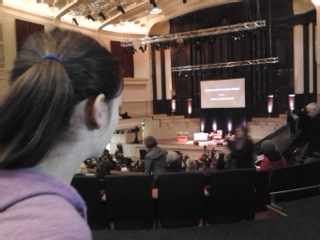
It was great! Here we are, in the Dunedin townhall, waiting for HIM.

2013-06-11 12.23.22 2013-06-11 12.22.19

When HE arrived and after a long round of applause, what stroke me first is that I could not understand HIM. His English is appalling and it took me a while to understand HE repeats and repeats until everyone understands. And after a while, I became a bit more used to his accent and understood more and more. The main words I understood were love, forgiveness, compassion, and also peace, patience, happiness…

I did not want to take notes and instead wanted to infuse HIS saying. Therefore, just after HIS talk, I was unable to express what HE’d said. All I knew was:

When HE laughs, everybody laughs.

In Sydney during the same tour...

In Sydney during the same tour…

HIS meekness is most amazing!

Interestingly, over the next few days, I realized what HE had said about religion,  about politics, about school, about living today, about China,…

Beyond religion: Buddhism is not a religion anyway, just a spiritual path, a growing up practice. Religions generally support love and understanding. When they start to support hatred and divisions, when they serve other purposes than spirituality, then people need to be wary of them.

About politics: Same as religion! If politics do not support the people, then, be wary of them… Governments need to be inclusive, not divisive.

About school: We prepare tomorrow’s adults. If young people are taught to meditate, the world will be different.

About China in Tibet: Sometimes in the past, Tibet was autonomous. Sometimes, one area is dominated by such and such. Now Tibet is under Chinese regime. This may change over time. What is important, anywhere and anytime, is not who rules the country but how human rights are applied, including freedom of religion. No use to battle for a political freedom but imperative to fight for human rights.

Last but not least, we need to learn to meditate if we have not already. We will be better. People around us will be better; the world will be better…


Leave a comment

Doing it again… in Tarras

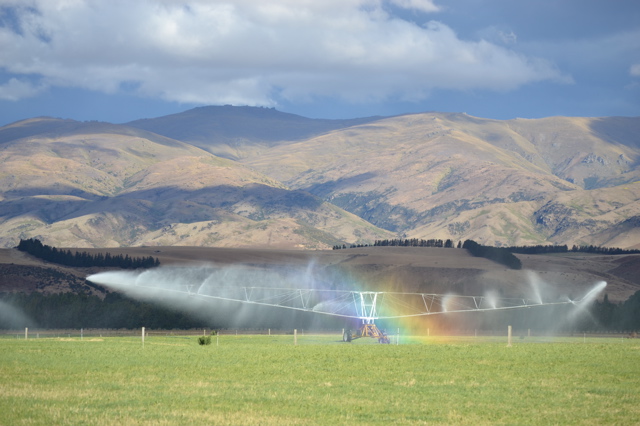
Tarras irrigation (c) HolgerTake a dry area, beautiful and lean and decide to make dairy farms here! It will be costly… But it’s all right, the ratepayers will pay for it… Sounds unbelievable? or only too familiar?

I have published below the full story and call for help by some Tarras residents, together with the links to the submission documents, to fill in and send by the 3rd of May to the ORC if you care… Click here to see my submission, feel free to copy/paste it and just change the name and address. Cheers.

Florence

Subject: Submission to Otago Regional draft annual plan – Tarras water scheme

Dear friend,

As part of the Otago Regional Council (ORC) draft annual plan, the ORC proposes a $ 3.6 million dollar investment in a privately owned irrigation scheme in the Tarras area (230 residents). The Council’s investment will be even higher as there are ongoing costs during the proposed 5 year investment, bringing the spending of public money up to $ 6-7 million. It is proposed to fund this investment through rates increases.
Any Otago rate payer and resident can make a submission to the Council on this investment proposal. This is your opportunity to have your opinion heard by the 11 councillors who are divided on the subject. Public submissions on the plan close this coming Friday, 3 May 2013, and the councillors will have to make a decision on the proposed investment at their meeting on 24 June 2013.
You might have read some reports over the last few months in the Otago Daily Times on the Tarras water scheme. Here is a brief summary:
Tarras Water Ltd. (TWL), a privately owned company, proposes to pump water from the Clutha river to 6000 hectares of hitherto unirrigated land in the Tarras district. Currently, there are 40 shareholders, mostly farmers, with 8 farmers controlling 90% of the company, four of which are also directors of TWL. The proposed cost for this project ($ 37 million) requires a large bank loan ($ 26 million, 20% of which would be guaranteed by the Central Otago District Council) and the ORC investment in order to proceed. TWL shareholders would fund $ 7-8 million themselves upfront.
Even though the water scheme was initially promoted and presented as a “community” water scheme and public grants sought and used for preliminary studies, the cost of the scheme for the vast majority of the Tarras community is too high to be part of.
However, TWL continues to rely on public money for this private enterprise. TWL proposes the ORC to become a “dry” shareholder, i.e. hold 30% of the shares in the scheme without using the water. The ORC would only recoup its investment if it were able to sell the 30% of the shareholding over a five year period. However, over the last 6 months some landowners in Tarras have already invested in their own irrigation schemes, with others not interested in the TWL scheme for reasons of cost. The high cost will inevitably lead to intensified farming in the area, with the most likely outcome being dairy support and dairy farming in general over the proposed 6000 hectares.
While the ORC is being asked to become an investor in a private irrigation scheme, by law it also has to handle resource consents for water permits, as well as enforcing legislation relating to water quality and use in the Otago area, in other words it would put itself in a position of conflict of interest (private investor and regulator at the same time).
Such an investment would also set a precedent for other irrigation schemes in the wider Otago region, the latest one proposed for the Maniototo area. In fact, it would set a precedent for any private business to ask the ORC for public money to partially fund their enterprise, whatever it might be!
Despite being asked by the ORC for information on alternative funding, TWL has not sought private business investment in its scheme, suggesting that it doesn’t stack up as a good deal. TWL solely relies on public money input and very strongly lobbies the 11 ORC councillors to vote in favour of the investment.
Again, TWL is a private company which asks the ORC for millions of dollars of public money, funded through rates increases affecting every Otago rate payer, with a high risk to the Council to be able to recoup the investment. And TWL is effectively owned by a small number of wealthy farmers.
Should you be concerned about the use of public money in this fashion, please use the attached form to make a submission to the Otago Regional Council by Friday, 3rd May 2013. 
The draft annual plan with the TWL investment proposal is available on the ORC home page, www.orc.govt.nz
Please, also forward this email to anyone you think might like to make a submission.
Best regards,
Holger Reinecke


2 Comments

Global Change for Beginners

Puzzle ClipArtSo you sort of sense there are some issues looming, but it is quite confusing, seems still controversial and certainly helpless… Here are some basic elements and inspiration to help you assemble the puzzle.

The links and organizations mentioned in this article (in maroon) have credentials, are reputable and are important sources for further information. I recommend you read the whole article first and then click and explore the links.

Hard facts

There is proven human induced climate change. In its latest Climate Change Report dated 2007, the IPCC states that temperatures had already increased by an  average of 1 degree in the 20th century, and will continue to increase by 2 to 4 degrees by 2100 if greenhouse gas emissions are not curbed. Climate changes also include an increase of extremes, draughts, winds, floods, colds and heatwaves. Some places will become colder. The next report is in progress but intermediary announcements have underlined that the projections and scenarios are lower than what is actually happening. People who cast doubt about it have either an interest in keeping business-as-usual or are looking for excuses, being unable to consider change yet.

Human activity and settlement is creating irreversible damage on world biodiversity, jeopardizing its capacity to regenerate itself.  It is not only sad that many species disappear but it is also hugely harmful to human society as biodiversity provides us with a wide range of services, free and taken for granted. Here is the summary of the very official Convention of the Global Diversity.

Resources are running out, whether it is water, oil, or minerals… Clean air too! Some, like phosphorus, are not directly essential for us but their rarity would have dire consequences… The nitrogen cycle change is another example of the human activities tremendous impact.

There is a global economic and social crisis -just watch TV!- and despite rebounds, we all know that doing more of the same thing is not going to improve anything.

Well, the reality is that our earth has boundaries and we have been in ecological overshoot for many decades.

I have a “Drivers of Change” set with 175 cards each detailing different aspects of energy, waste, climate change, water, demographics, urbanisation, poverty. One group game consists in picking up one card each and meeting every other participant and discussing the links between the two seemingly totally distinct subjects. An amazing eye-opening experience.

Everything is connected. For example, the practices of modern agriculture, combined with the world demographics, creates a catch-22 to feed the everyone when productive land is being depleted or constructed for human expansion, resulting in rocketing food prices, worsening the social crisis and the state of the environment… “Whatever befalls the Earth – befalls the sons of the Earth. (…) Whatever Man does to the web, he does to himself.” Says Chief Seattle in his famous 1854 speech.

Ostrich clipartFlight or Fight!

Too much!! Panic!!!

You may prefer to ignore or escape in consumerism, in drugs, in hopes that we will go on Mars…

Or read on…

There are solutions! Lots! And we need lots of people to make them happen. It is a team work. Everyone’s little action at his level contributes.

30 years ago, we were wacky… or pioneers. And yes some of us are extremist! Many people like me worked to identify, analyse and communicate the issues; many people have been experimenting and finding solutions. It may be new to you, but it not new and many solutions have been tested and approved.

Today, we are innovators and there are many early adopters. Be part of them!

It has been demonstrated that when 13.5% of the population has embraced a change, then the majority engages. No need to spend energy to convince people, they will come on board. Just Change yourself, what you can, when you can. That is your part of the Global Change.

Change is not easy and everyone is not venturesome. Around us, many people act to make change easier, for example creating cycle lanes to enable people to cycle to work safely. So while more and more people embark on the boat- bike!- , more and more change is possible in a virtuous spiral. Listen to Elizabeth Sahtouris inspirational talk.

Change for what?

Here I introduce the sustainability principles as guidelines for change, from the Natural Step (explained in 2mn, or for kids)

  1. Is a choice/ an action taking always more resources from the earth crust?
  2. Is it creating things that the earth cannot digest and therefore persist and accumulate in our ecosystems or atmosphere?
  3. Is it somehow destroying part of the biosphere, undermining its regenerative capacity?
  4. Is it preventing other people from having a decent life?

If an answer is Yes, then try and change it. If all answers are No, then your choice / action is sustainable. Simple, no?

Solutions levels

Intergovernmental and governments decide on rules and laws

I do not expect much from them as they are very lobbied.  However we can influence these:

  • with online activism following Avaaz, Choice and many others ;
  • write submissions and get involved politically;
  • or for the bravest, stand as a candidate for the Local Government elections

Business and industry profit more when saving the planet

Business is driven by profit, which derives from the difference between the selling price and the cost to produce a good or service. Therefore,  for many MANY years, business has tried to get the cheapest resources, get more work done by workers paid minimally and externalizing costs.  Today resources are increasingly expensive. Delocalisation for cheap labor reaches its limits, polluting is getting to visible, laws and consumers are more demanding…

Paul Hawken demonstrated way back in 1994, that business and industry can be restorative of the environment. Because it is more profitable, more and more businesses, like InterfaceFlor,  are redesigning the way of producing. Sustainable and socially responsible business is the way of the future.

Community level can be very effective
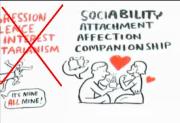
Together, we achieve lotsBe part of or create associations that promote energy descent, nature restoration, social justice… The Transition Town movement is getting momentum and induces a lot of change. In New Zealand, Transition Town Aotearoa networks and support communities, responding to the twin challenges of climate change and peak oil.

Also locally, write submissions and get involved politically. It may be worthwhile participating in Community Associations to bend them in a sustainable direction.

There are many global-change-friendly communities in the world, even some large ones like Whistler in Canada, Curitiba in Brazil or Nelson in New Zealand.

Individual level is the most reachable

How you spend your money is a powerful tool with which you can really make a difference. For example, you choose to support an industrial farmer using pesticides, polluting water, harming his animals etc when buying his produce at the supermarket OR you support the living of a friend at the local farmers market. Do you see how strong your choice is?

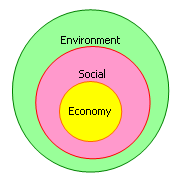
Changing requires a mind shift, a change in yourself. It requires you realize that you are a human,  part of the society, itself part of the environment. Economy is not an aim nor the ruler of all life, but the mere tool for societies to function.

From  to 
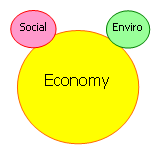
It requires that you realize that you ARE either contributing to the problem or you ARE part of the solution, from “what can I do anyway-I’d better keep going as usual” to “Wherever I am on this track, it is worthwhile for me, for the planet and for future generations, and I am going there”. And just start.

Think on how you eat (best is organic, local, vegetarian food), how you move (prefer bike or collective transports), how you heat your dwelling (reduce your energy consumption). And sieve them through the 4 questions above. Here is a Sustainability at home comprehensive  Checklist, courtesy of The Natural Step Canada.

We are all at a different stage on the path, and depending on circumstances one may have to go backwards. No judgement. It is not an excuse not to “keep aiming at” sustainability.

working together4

I hope that by now, terror and oblivion has been replaced hope and determination. The only problem left is “Are we early enough?” but better late than never...

Lots of actions and initiatives have already contributed to mitigate the issues, giving nature and beings more time to adapt to change. For example, the ozone layer depletion has started to reduce since 2009, thanks to the 1987 Montreal protocol.

Remember, you are not alone, we need many hands to go faster and also”the more the merrier“!

Here are some resources to give you information in specific domains and a lot of inspiration. Have a wonderful voyage!

More main resources

For positive news: Happyzine in NZ ; Guardian Green Living blog (Yes UK but quite worldwide) ; Tree Hugger with humour ; Celsias NZ, solid source but not always fun…

For news about New Zealand nature : Forest and Bird

Check out the resources from the Centre for Alternative Technologies in Wales and Terre Vivante in French

Here are Sustainable Initiatives and projects in NZ, mainly by the Centre for Sustainable Practice students.

Here is the American Earth Policy Institute Action plan B.

Lots of cool stuff on RSA Animate and TED talks


Agriculture, gardening, food and health

Organic New Zealand and Permaculture New Zealand

Information about Pesticides, in New Zealand and internationally, also What’s wrong with Pesticides?

Energy, transport, building

Rocky Mountain Institute, US based but lots of positive information about energy, transport and housing. See Amory Lovins inspiring TED talk here.

Renewable Energy World blog

The Future From black oil to a green future

Economics

Living Economy website in New Zealand

New Economics Foundation, Economics as if people and the planet mattered

Here a New Zealand online guide to eco-accommodation, organic cafes, food supplies, Māori cultural tourism, and environmental tourism activities.

Sustainable business network in New Zealand

Here are many more interesting links . It is also worthwhile “Liking” some organisations of your interest on Facebook and exploring their “Likes”. Focus on the good news and practical how-to aspects.

Please leave a comment if you find inaccuracies or to suggest too-good-to-miss links.

Leave a comment

Yellow Blue Park Project

Inspired by Terre Vivante where I worked as information manager for 7 years, I have created a concept of “Yellow Blue Park” ( Hint! I am not allowed to say green!!) where an existing public campground combines with a campus and a community social place, for the best use of space and facilities, to enhance interactions and to benefit from synergies.

We’re having a meeting to talk about the future of Wanaka Campground on Tuesday 12th March 8pm, in the rugby club rooms.

I will be there !


Leave a comment

Localising food tour coming to Wanaka

Flower

While Wanaka transition town people were starting to meet regularly to try and set up a transition town framework,  we were contacted by the Localising Food Tour Aotearoa team who would be in our part of the country in 5 weeks.

So the meetings changed to organising the Local Food event and here it comes, from 5th to 9th December.

Here is the Localising Food Tour Schedule and here is the website for bookings and more information about the workshops, presentations and facilitators.

I hope it will launch a local movement for more local food production, both as individuals and as a community, to build on the Farmers’ market.