
This is a summary/extracts of the Climate Change 2014: Mitigation of Climate Change, Summary for Policymakers, IPCC. I’ve added some indicators: In red are the people’s potential for action, in green are the co-benefits. I did not add any comment or anything that is not in the original 31-pages document.
Mitigation is a human intervention to reduce the sources or enhance the sinks of greenhouse gases.
Climate policies, to be effective, need to cross over all sectors and societal goals, include all countries and collective interests, based on sustainable development and equity. Addressing climate change creates co-benefits or adverse side-effects. No one action can itself solve the problem but working on all aspects has the potential to keep temperatures within 2 degrees increase (that is 450ppm) over the century, on which this report focuses.
Without additional effort to reduce GHG emissions, temperatures will have increased from 3.7 to 4.8 degrees celsius by the end of the century.
Anthropogenic (=man-made) greenhouse gas are CO2, methane, nitrous oxide and fluorinated gases. They’ve accumulated at an ever increasing rate in the atmosphere (+2.2% per year in the last 10 years).
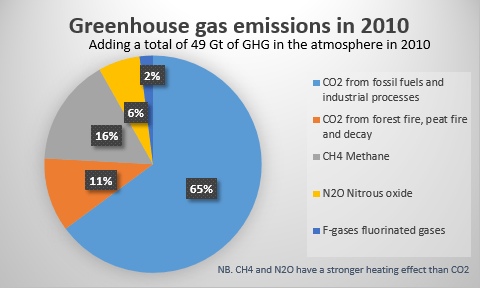
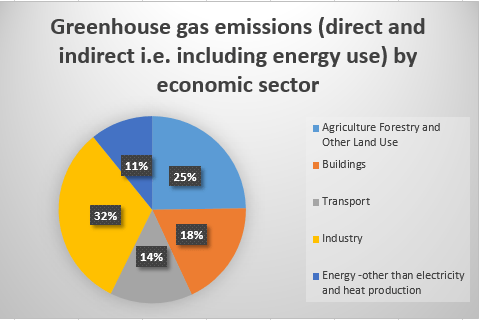
Now these gases come from these activities:
It is demonstrated that the increase in population itself has not increased the CO2 emissions. It is the GDP per capita increase that has. Consumption has grown between 300% to more than 900% over the century.
Adverse side effect of mitigating climate change (within 2 degrees) is to reduce consumption growth by 0.04 to 0.14 percent points per year. Co-benefits include reduced costs for achieving air-quality and energy security, significant benefits for human health and ecosystems. Overall, the potential co-benefits outweigh the adverse side-effects. Mitigation costs vary between countries.
Mitigation policy could devalue fossil fuel assets and reduce revenues for fossil fuels exporters.
ENERGY PRODUCTION
Energy demand will be reduced by efficiency enhancements and behavioural changes.
Energy use will be reduced by behaviour, lifestyle and culture change, complemented by technological and structural change.
Decarbonizing (i.e. reducing the carbon intensity of) electricity generation is a key component of cost effective mitigation. The share of renewable energy, nuclear energy and carbon capture and storage (CCS) needs to increase to more than 80% of electricity generation by 2050 and fossil fuel power generation without CCS is phased out by 2100.
Renewable energy performance has improved and costs have reduced substantially, enable deployment on large scale.
Nuclear energy is a mature low GHG emission source of energy but barriers and risks exist: operational risks, and the associated concerns, uranium mining risks, financial and regulatory risks, unresolved waste management issues, nuclear weapon proliferation concerns, and adverse public opinion.
Natural gas power generation could act as a bridge technology.
Carbon dioxide capture and storage technology could reduce GHG emissions but has not yet been applied at a large scale. Also it raises concerns about operational safety and long-term integrity of CO2 storage.
Combining bioenergy with CCS offers prospects while it entails challenges and risks.
ENERGY USE
Transports
- Technologies existing and in development improve vehicles performance: electric, methane-based fuel, biofuels (with CCS)
- Integrated urban planning: investment in public transport systems and low-carbon infrastructure, transit -oriented development, more compact urban form that supports cycling and walking, high-speed rail systems…
- Behavioural change to adopt these
A combination of the 3 strategies not only halve the transport contributions but also provide important co-benefits: improved access and mobility, better health and safety, greater energy security and cost and time savings.
Buildings
The energy demand for building is in expansion, as wealth, access and lifestyles improve. Opportunities to stabilize or reduce global buildings sector energy use by mid-century exist:
- Energy efficiency policies, strengthening building codes and appliance standards
- Implement recent advances in technologies and know-how
- Retrofit existing building can achieve 50-90% of reductions of heating/cooling energy use.
- Life, culture and behaviour significantly influence energy consumption in buildings (three- to five-fold difference).
Co-benefits: savings, energy security, health, environmental outcome, workplace productivity.
Industry
Currently the biggest emitter; Opportunities to reduce Industry GHG emissions below the 1990 baseline exist:
- Energy efficiency can directly reduce emissions by 25%.
- Process optimization, substitutions,
- Resource use improvement, recycling, re-use
It is not only cost effective but it also comes with co-benefits for the health and environment.
Waste reduction and recycling are key to reduce landfill emissions.
Agriculture, forestry and other land use
A quarter of global emissions come from deforestation, emissions from soil, nutrient (fertilisers) management and livestock. Therefore solutions are:![By DarKobra Urutseg Ain92 (File:Tango icon nature.svg File:Blank_template.svg) [CC BY-SA 3.0 (http://creativecommons.org/licenses/by-sa/3.0)], via Wikimedia Commons](https://upload.wikimedia.org/wikipedia/commons/9/98/Tree_template.svg)
- afforestation (planting trees), and sustainable forest management
- building humus,
- improving cropland and livestock management
- changes in diet and reduction of food loss
These strategies also benefit biodiversity, water resources and limit soil erosion.
Bioenergy can reduce GHG emissions only if fast growing species are used, land-use is well managed, biomass to bioenergy systems are efficient and biomass residues are well used.
Human settlements, infrastructure and spatial planning
Urbanization is a global trend and will include 64-69% of the world population in 2050. It comes with income increases which are correlated to higher consumption. The next 2 decades are a window of opportunity to get it right as a large proportion of urban areas will be developed during this time and it’s quite locked in. Mitigation strategies involve:
- co-locating high residential with high employment densities (reduce urban sprawl),
- high diversity and integration of land use,
- increasing accessibility in public transport and other demand (access oriented development).
Advantages are better air and water quality, time and health benefits.
Mitigations policies and institutions
Sectoral and national policies
Currently USD1,200 billion are invested each year for energy security. Large changes in investment patterns are required:
- decrease of 20% in fossil fuel technologies (-USD 30 billions per year). The complete removal of subsidies for fossil fuels in all countries could result in reductions in global emissions by 2050.
- renewable energy investments double (+USD147 billions per year)
- investing in upgrading existing transports, buildings and industry systems require another USD 336 per year.
- achieving nearly universal access to electricity and clean fuel for cooking and heating are between USD72 and 95 billions per year until 2030 with minimal effects on GHG emissions while improving lives, environments and equity throughout the world.
That is plenty of opportunity for business and growth and it creates large energy efficiency gains.
Policies integrating multiple objectives, increasing co-benefits and reducing side-effects have started to be experimented and reveal that:
- Regulations and information (education) widely used are often effective.
- Cap and trade systems for GHGs (carbon offsets) could be effective if the caps are constraining.
- Tax-based policies (for example on fuels) raise governments income and allow them to be proactive or to transfer to low-income groups.
- Technology policy include public funded R&D and governmental procurement programs.
![By lumaxart (Working Together Teamwork Puzzle Concept) [CC BY-SA 2.0 (http://creativecommons.org/licenses/by-sa/2.0)], via Wikimedia Commons](https://upload.wikimedia.org/wikipedia/commons/b/ba/Working_Together_Teamwork_Puzzle_Concept.jpg) Private sector can contribute to 2/3 to 3/4 of cost of mitigation with appropriate and effective policies, i.e credit insurance, power purchase agreements, feed-in tariffs, concessional finance and rebates.
Private sector can contribute to 2/3 to 3/4 of cost of mitigation with appropriate and effective policies, i.e credit insurance, power purchase agreements, feed-in tariffs, concessional finance and rebates.
International cooperation
Various cooperation arrangements exist yet their impact on global mitigation is limited. Many climate policies can be more effective if implemented across geographical regions.