Regenerative Livestyle Blog

Protecting All Trees

Leave a comment

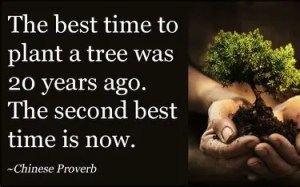
We all agree with the Chinese proverb “The best time to plant a tree was 20 years ago” and we are now well aware of all the services trees provide (biodiversity habitat and food, cleaning and regulation of air/wind, water, climate/temperature, wellbeing/esthetics etc.);

Yet in our district, established trees are cut in great numbers, from Northlake to Riverbank Road, on road sides, public and private land. It is shocking and hurting to many people, we value trees. It is an offense to the elders who have planted these conifer windbreaks and plantations, beautiful poplar rows, or mixed planting in private land for future generations, not for us to dispose off.

If we are serious about the declared climate and biodiversity crises, then we need to protect our trees.

Our Council has a tree protection policy for public land. There is no distinction in tree value whether they grow on public or private land. So rules can be extended to all trees. It is as easy as replacing “On Council land, we“, with “On all land in QLDC, we” on the current tree policy.

Even with the Tree Policy, too many trees are felled (and planned to be felled) on public land so a better protection is needed to include native and non-native trees, shelterbelts, windbreaks, hedgerows, groups of trees and stand alone trees. Clear felling, burn offs, monoculture and poisoning practices are unsustainable and must stop (read on for details).

Trees are life and they should and CAN be protected by extending the QLDC Tree policy on public land and strengthening this policy to Protecting All the trees of the land. To adapt to today’s crises, regulations must be changed to set interdictions and consent requirements before harvesting trees on the land you’ve bought.

I am opening a conversation and welcome contributions to save trees. I will revise and present the request to the Council in a full meeting asap.

Thank you for your advice. Have your say!

Go back

Your message has been sent

Warning
Warning
Do you agree to extend the QLDC Tree policy on public land to All the trees of the land?(required)
Warning
Are you interested in learning more about regenerative land zoning – or other way to protect the land? (required)
Warning
Warning
Warning.


Intrinsic value of trees

Trees are beings, they are made of carbon and water like us, they have strategies to thrive in most adverse ecosystems, they live, breathe, make babies, die. At a scale so large, in a time so long that many humans do not see them.

To the Māori, trees are sacred and revered, respected and used with gratitude. Trees are taonga (treasures) with strength, resilience and interconnectedness with all living things, mirroring humans in all their diversity.

I love trees. I feel their life force, I appreciate and admire, caress and hug trees. I am like tree, carbon and water, we are the same, we are life, we are one. Trees are to me the bridge to oneness. I believe trees are unique living intelligent beings that have a right to live.


Planting native trees with Te Kakano in 2013


Just like Jane Goodall had demonstrated that chimpanzee are intelligent beings worth of protection, just like the Project Ceti deciphers whale communication, so too has Suzanne Simard demonstrated that trees are sentient beings, they cooperate to live in harmony in forests, they communicate, help each other, nurture their children… we only begin to understand their intelligence.

One day, when human society progresses, it will give civil rights to trees, and I am asking to start by protecting them now.

We need to stop killing trees just because “we’ve always done that”.

US master arborist Basil Camu has made a daring business move – refusing to cut down trees. Instead he’s turned his focus on educating people in a bid to keep their trees. He says 90% of trees don’t need to be cut, only managed. He says people can save money, time and help develop ecosystems by not cutting down their trees.

Trees are intelligent beings and have the right to live.

No money can buy
an old tree

Natives and Non-natives

I feel an intense sadness at the extend to which native forests have been removed from Aotearoa over centuries and it continues today, only protected by National Parks, just.

I understand the need to “recloak” New Zealand with native forests. I love native trees and we planted many natives over the years. I understand native areas must be weeded off non-natives in National Parks which role is to conserve the authentic original canopy.

Locally, Te Kakano is doing a formidable native tree planting effort with the community since 2013.

In human settlements however, I believe ALL trees have huge value. There is an unnecessary division between native and exotic trees. All trees are beautiful carbon-loaded and valuable resources. Fast growing and resilient maples, oaks, conifers and poplars offer splendid colours along the lakes and streets, in parks and gardens, exotic trees are precious. Existing trees, old and recently planted are all invaluable as once cut, they take 20/60/100 years to grow again, if replanted, which is a loss of time and leaves a gap between now and when they will be big again.

Particularly, existing trees should not be cut to be replaced by native trees.

An ancestor has planted douglas firs? Thank you for the shade and windbreak.

A forest of pinus radiata is growing on its own? Great! Let it grow, thank you nature, thank you tough tree. It can be interplanted with natives. When it is grown, it can be selectively harvested.

I think it is great to plant lots of natives but existing trees should never be cut to make space for them. Tony Rinaudo shows that the habitual way of removing what grows naturally (ie. cutting weeds) is depleting the land; keeping them instead hold moisture and nutrients fostering more life.

Be careful what we wish for. Cutting non-native trees could result in a bare land as many established trees are willows and poplars, conifers and oaks. Where will the bird live when they are removed?


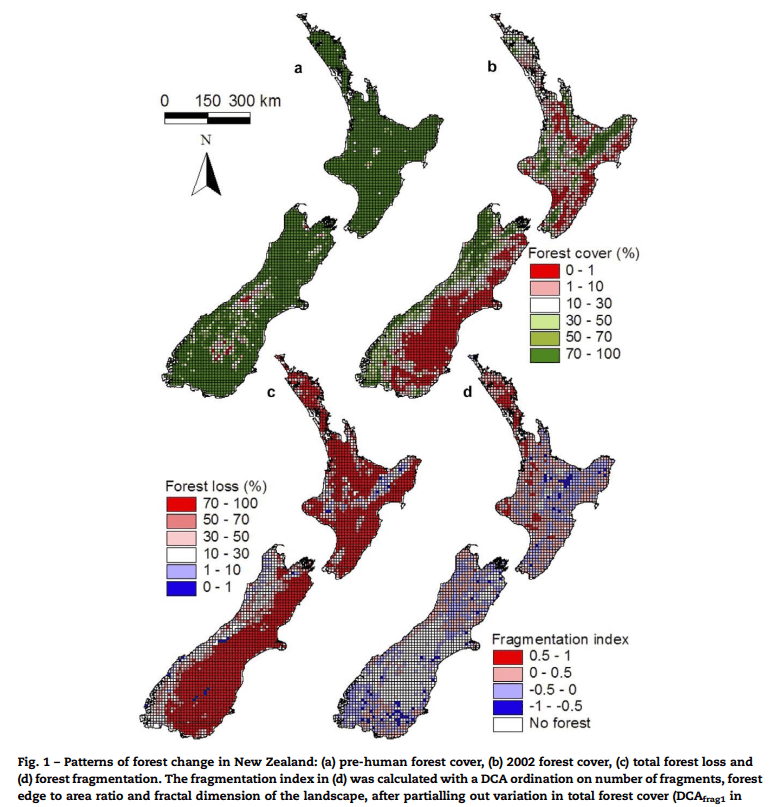
NZ forest loss
Source: EPA Environmental Protection Authority (New Zealand government agency) – click on image to open the source document

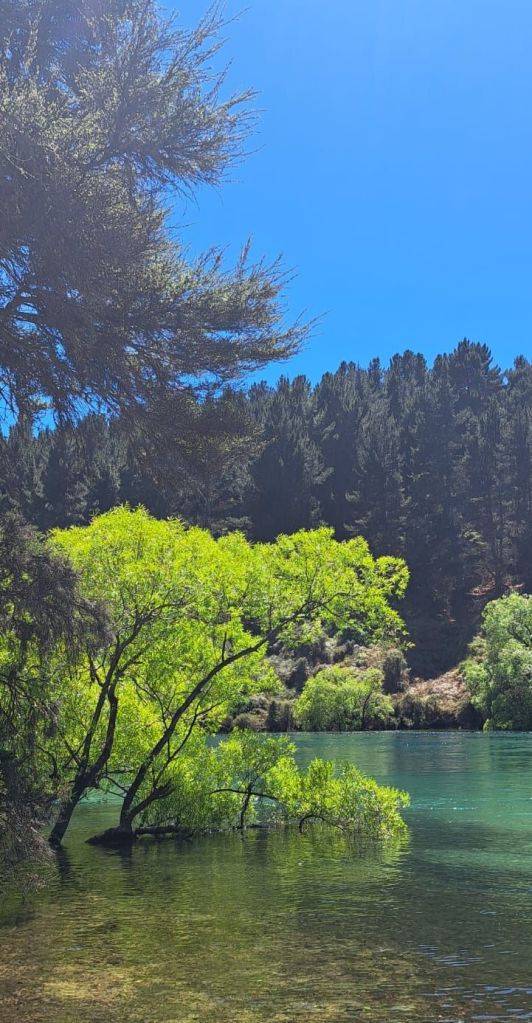
On the Fisherman track along Mata-Au, a mix of natives and non-natives grow happily together, protecting each other, feeding and protecting wildlife in complementarity. Beautiful!
What’s wrong with the pine forest in the other side on Dean’s Bank? Nothing.


I will add here that non-native trees were introduced lawfully to New Zealand, they provide valuable services and are often grown in plantations. Wanting trees “here but not here” is madness, segregation. Wanting only natives is also extreme when most food in NZ is not native; pasture, sheep, kiwifruit, non native… Just like us people, most of us are not native, yet we are an asset to our chosen beloved country and we thrive to live in harmony with people who were here before. New Zealand is one country in the world where we learn to live together, enriching us all on the way. It requires effort, but it is worth it. So with the people, so with wildlife. I believe native and exotic trees can live in harmony together, in complementarity. They certainly do at our place.

If we want a truly sustainable carbon future, we need a diversified forest portfolio — some species for quick sequestration, others for lasting stability“.

Carly Green

What exactly is invasive?

Aspen trees, cherry trees, poplar trees form clusters, clonal colonies; oaks and sycamore grow thousand of trees babies every year; all trees in forests, native trees in native forests, multiply and reproduce. Of course they reproduce, they are life. Let’s embrace this quality, not fight it.

“Ticking time bomb” I hear some say, well everything is relative… In 20 years, we have just 3 baby Pinus radiata coming from the nearby forest and we decided to keep 2 of them. I don’t call this an invasion. It is manageable.

We all like a good ground cover, don’t we? And it’s beneficial for the soil and wildlife too! So when a yellow archangel lamium, a purple ajuga, an arctostaphylos or dandelions really enjoy it and spreads, I hear people say: “Oh no! we need to remove it” and they spray.

It is similar with trees, only on a much longer time frame. Some trees enjoy an area and grow well and create a family. Great.

If a tree or a plant IS a problem, we make sure we cut it back with as much root as possible and remove all seeds before they spread. By removing 80% of it every year, we are on top of it in a few years.

When we are in harmony with nature, we welcome the vigour, manage it to keep room for other plants and ourselves. Whether a plant is a weed or welcome is political and cultural, it is a mental construct, a world view of nature.

Qualities of the so-called-invasives.

Many conifers, gorse or broom have same or better carbon values than natives.

And yes, so-called-invasive are tough! That is why they grow in the wild. Many of the so-called-invasive are ruderal, they are the first to cover the soil after scarring or poisoning. Interesting how thistles come back over and over again just on the herbicide sprayed areas, which then need spraying again.

Broom and gorse grow well on bare land and traditionally offer protection of native plant regeneration then dissolve when the natives shade them. Over the years, other plants will colonise too, native trees will pop over the protective cover and the shade they create will dim gorse which will die, nature left to her own devices usually comes back to a forest. Hinewai Nature reserve near Christchurch is a great example of this. It takes time.

The beauty is it can be greatly accelerated by inter tree planting.

Wilding pines?

The main wilding pine is Pinus radiata which is widely planted for forestry in areas previously deforested from their natives. “These trees are good here“. “These (same)trees are not good there“… This control of nature is damageable to the planet and a mindshift is required. These trees are precious long term resources and harvesting them selectively at the right time for timber and other local materials make better economic sense. Trees that grow on their own are a gift from nature and can be used as resources. We could choose to let “wilding pines” grow, then harvest them for timber and firewood, selectively like they do in Europe (no clear cut on the Swiss mountains, is there?). They are not invasive; they are growing instead of monoculture of pasture. We see many images of wilding pines colonizing bare pasture but very rarely pines growing amongst natives.

Conifers do not grow in the shade, this is why they are outcompeted worldwide by deciduous trees that grow faster when young, says conifer expert Aljos Farjon. Conifers are often seen on margins along track and roads (created by humans), in ditches and ravines where nothing else grows yet and in riverbeds where they are watered. They can be managed. In our region, I have never seen wilding pines growing in a native forest and smothering it. It is likely that with climate change, trees are now growing in places they didn’t use to. But I believe culling wilding trees is the wrong war. What needs to stop is the destruction of carbon absorbers

These trees grow on their own on our -difficult- land and they should be let to grow and harvested when grown for timber, resins and other goodies trees provide. I realize I am hurting some people with this radical view! I hope, with good intention, they will widen their views soon.


Do we need to mow all land? Or just footpaths?


Trees that grow well and fast in our climate are larches, sequoias, eucalyptus, douglas firs, walnuts, cherry and apples, all absorbing huge amounts of carbon, much more than a slow growing native. They are also providing excellent timber, firewood and food. Larches produce such a durable wood that it doesn’t need treating even used as roof tiles in European Alps.

Going deeper, I believe, the “invasive” issue is due to a mis-repartition of land. Some people have a land bigger than they can be guardians of. Meanwhile, many people can’t afford a quarter acre, which is the size of the land where you can grow some trees and some food. The iconic 1/4 acre New Zealand of the 60’s was allowing every household to live. Now, people are pushed into boundary to boundary house with no space to grow, unlivable, so as soon as they can, they move somewhere bigger, impacting the land further and creating a runaway economic growth which erodes wellbeing and is incompatible with the climate, biodiversity and inequality crisis. Adapting does require a change of culture but change we must as the crises are squeezing us.

Proposals

  • Manage, not kill.
  • Manage a 20km margin around National Parks to remove self seeding trees;
  • Welcome these plants growing well naturally
  • Practice selected harvesting
  • Interplant with natives as wished
  • Share. If you don’t cope with your land, then share it with others who will help
  • Do not poison as it pollutes the planet

Do you embrace – grow – appreciate – protect ALL trees?

It IS cultural and political. It IS reflecting a different world view.

In our district

In our district, big trees are not native and they take an expensive real estate space. It has been leading to their destruction, for example Northlake, Three Parks, Orchard road etc. “They are just Douglas Firs, get rid of them” I hear. Well, they are trees.
Of note here, douglas firs, along with many conifers, live for several centuries, 500 years is common. In our region, trees planted won’t be more than 150 years old so killing them is like killing a young adult with many years of good service ahead.

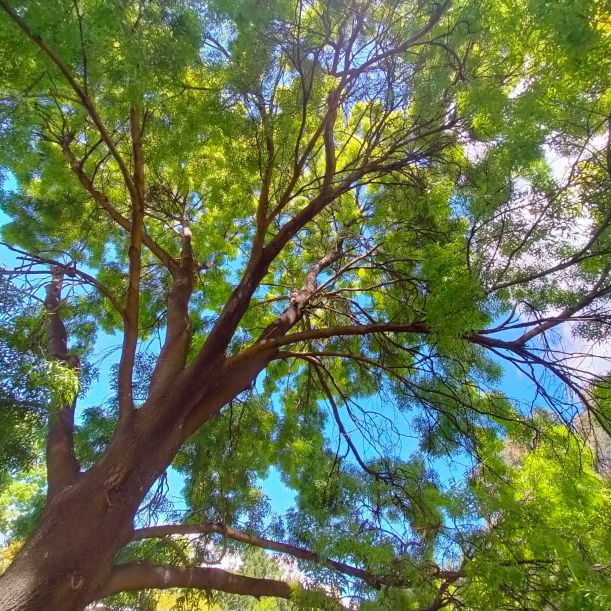
For many residents and visitors, Wānaka trees have huge value. There are world-known poplar and willow rows along the lake, there are still a few beautiful established trees in town, a dozen standing survivors on Orchard road, a mighty old Douglas fir across the police station, a small forest left at Eely point and Lismore park, there are patchy areas of big trees in parks, on the Golf course and on private land. They are all condemned by current rules and practices…

In Wanaka, some Wanaka Station Park trees and the start Mt Aspiring road trees are protected along with 15 others, including the three mighty McDougall sequoias.

Spectacular and much admired McDougall sequoias


In our district urban areas, most natives have been replanted recently and are still too small for wildlife habitat. We do not have tall totaras. There are established kowhais, plenty of kanuka and flaxes and small native hedges (eg. griselinia) and grasses. I observe every day that native wildlife lives and sings in tall trees, mostly non-native. Each of these existing trees are extremely valuable as they are what we (and wildlife) currently have. If we let these non native trees be cut, birds have nowhere to live, therefore disappear. 

Trees need to be kept. The plan for Eely Point reserve to remove hundreds of healthy windbreak trees is inappropriate in a climate emergency; I hope the new Council and the Blue Green network step up to protect this important part of the existing (patchy and disappearing) Wānaka green belt. Natives can be planted understory, between the gaps, or on grassland further along. It is nice to read that in the Queenstown gardens (also planned to be culled), public consultation has resulted in “trial planting sites before any trees are removed, helping to demonstrate what the replacement plantings will look like ahead of future works.” Well, collections of little tree guards containing beautiful native baby trees do NOT replace mighty canopies… Not for us anyway…

Tree Protection in QLDC

QLDC has created, with public consultation, a tree policy designed to protect the trees.

It is in fact very weak as it really only protects native trees on public land. Douglas firs on public land are not protected, on the reason that they are not native. Queenstown botanic gardens, Eely point recreation area, a group of douglas firs on a public area in Peninsula bay… All cut or about to be.

This tree policy is more a process to cut trees. Not to protect them.

There are a few protected trees in Wanaka. Many trees of the Wanaka Station Park and the start of Mt Aspiring road are protected, along with less than 20 trees on private land.

I inquired in August 2024 about protected trees in QLDC. I was referred to The Upper Clutha Historic Records Society, who didn’t know much. Very little importance is given to protected trees, trees at all, I’d say!

I asked how to protect trees and was informed that the 10-year district plan is the time to apply for that.

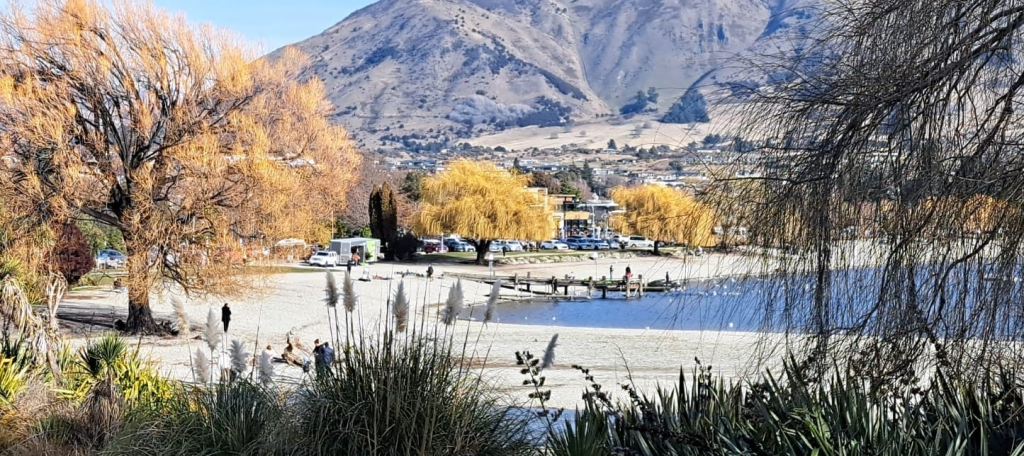
Iconic Wanaka Lake front in autumn, lighten by poplars and willows. Beautiful! That Wanaka tree itself is a willow, a post in fact.

They grow happily and protect native planting happening around them.


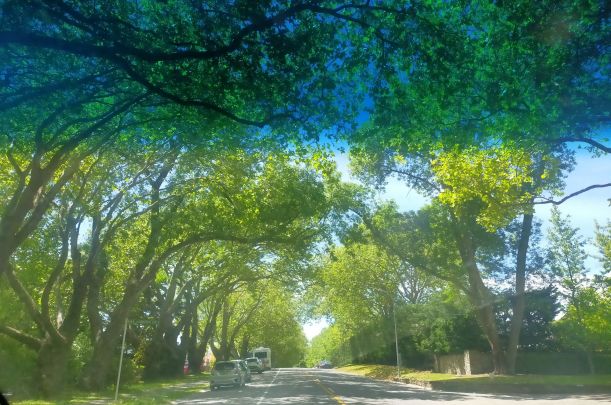
Mt Aspiring road beautiful tree tunnel, many of these trees are protected.

Little group of douglas firs on the little reserve opposite the medical centre, full of birds. These trees on public land should be protected but being non-native, they could also be on the chopping board.

This screenshot of protected trees from the QLDC maps system in 2023 doesn’t seem to work anymore. It speaks volume to me.

I understand that wilderness areas deserve to keep or restore their native-only status. I don’t believe native-only is good for human settlements areas. Importantly, these established trees exist -thank you- and cannot be replaced.

The blue-green plan could include spaces for planting these essential resources for human settlements – as the draft stands, the Blue Green plan is only about natives. How are we going to build and heat houses in a zero carbon economy or in a disaster zone? The wood is no longer going to come from over the ocean, or across highways with broken bridges. It must be grown locally and the blue green plan can include that. Always in diversity (no monoculture). Which landowner has enough space for a couple of rows and allocate a part of that wood to the community ? Are you in?

Let’s maturely rise above the native/non-native invasive viewpoints and embrace all TREES.

Beyond trees, a whole district regenerative design

Yes it IS Political and the Council has the potential to fix all these crises by capping growth and planning steady state local circular economy, by protecting trees and encouraging sharing of the land, creating commons, to grow food, for recreation access or commuting, for tree growing or biodiversity restoration… I suggest Council elected members and staff go and talk with the landowners. Ask them what would they need to be on board with sharing a part of their land as commons. It doesn’t need to be money.

Many landowners I know are creating a biodiversity asset on their land (eg. they plant trees or create ponds…)  and they just want the certainty that their land is not chopped up after their death. When we plant trees, it is for us to enjoy when we are alive. It is also for future generations and the birds, and the planet. It’s generous. It needs intergenerational guardianship and the current land zonings do not allow that. It is the governance responsibility to change rules to protect what we have for now and future generations. We cannot wait and squander what we have.

Carbon sequestration is calculated over many years and at the moment, trees are planted with no guarantee that they will be kept, it is wrong. We need to create a way to protect what IS. A land zoning or any form of protection of private land is an essential part of the creation of a regenerative community.


“I don’t want to die!
Because then…
All this gets chopped up”

Says an old gardener with an ample movement showing extensive gardens and unusual established trees 🌲 🌸🌳


Solutions
  • Create citizen assemblies to define community and the planet future best outcomes and implement them
  • Stop growth where it is already planned now. It is essential to keep fertile greenfields close to urban areas and stop over-building.
  • Keep All trees, Keep 30% for nature at all levels, on a section, in a subdivision, in the urban space, in a connected way. Use these commons for planting useful and native trees fostering wildlife, connected walk and bike ways for recreation and commute, surface water reticulation, community food growing (food forest, plots, orchards, community gardens or social entreprise growing market food…) – and to be resilient, add local energy production on all roofs, with subdivisions requirements to build battery capacity. Make it part of resource consents, it is just a political will (or not?)
  • Encourage landowners to regenerate 30% of their land and share and join the commons network.

This is how we create and re-create biodiversity, resilience and wellbeing.

I think it is time to have a wise holistic view on the trees, cherish and protect them all. It’s possible. It’s a matter of time and humanity maturity. It’s happening. In 2017,  the Whanganui River became the first river in the world to be recognised as an indivisible and living being and it is award winning now.

How about we politically deliberately recognise trees and forests as indivisible living beings?


Alternatives to current practices of clear felling, burn offs, monoculture and poisoning

Alternatives to clear felling

Since 2021, NZ Farm forestry recommends replacing clear felling with a selection system to halve (or reduce tenfold) soil erosion and to retain forest ecosystem, maintaining soil nutrients, nesting sites, food sources, cover, shade and protection from climate extremes. Read the article here.
Clear felling only looks cheaper, it is externalizing actually higher costs to the public. The impacts on roads during rain events is costly and detrimental to the communities. The devastation of the cyclone Gabrielle even cost death.
Clear felling is also ugly and severally impact landscapes, a detriment to wellbeing and tourism. Nelson area, Golden Bay, Coromandel etc. are no longer beautiful, they have scars, it is hurting, visitors often comment on it.
We don’t see clear felling in Europe where selective forestry is generalized, nor in North America where they hide clear felling behind rows of uncut trees. Clear felling is a practice for underdeveloped countries with uncontrolled illegal logging, eg. Indonesia or Brazil. Clear felling must be banned in New Zealand, starting in our district.

In our district, subdivision developments start by removing all the trees on the land. This is unnecessary and costly. Why do passer-by have to witness yellow machines moving earth etc. for years, where they used to pass a row of singing trees? Where are the birds going? The developers soon replace the once old trees with young ones, which will take decades to provide similar services that already existed! Why?

Solutions:
Move away from intensive monoculture forest management into a well-practiced closer to nature or integrative multifunctional forest management with single tree selection.
In resource consent conditions, keeping trees on the boundaries and keeping 30% of all other trees and natural space.
Practice coppicing: by cutting one every three trees, we keep the 30% for nature ratio, keep the visual shield provided by trees on the boundaries and trees keep growing without the need to replant.

Alternatives to burnoffs

Outdoor burning is sometimes authorised on Check It’s All Right. However, many articles show elevation of air pollution and complaints in burnoff seasons. Furthermore, burnoffs are the main reason of wildfires: “In New Zealand, about 99% of all fires are caused by people. A number of fires are started as a burn-off (farmers getting rid of excess vegetation), which then escapes, becoming a wildfire“, say Scion scientists.

Solution: ban burnoffs. It is not acceptable to continue burn offs in 2025 in a climate emergency. On hills, let it grow, let regeneration in progress. For wood debris: hire a mulcher, with the right tool, landscapers will turn it to valuable fertilizing resource for cheaper than buying mulch.

Alternatives to monoculture

It is so obvious monoculture should not exist, but it does, so it needs regulation! Monoculture is by definition unsustainable. Biodiversity is essential to hold food and shelter year around. Monoculture is the opposite of biodiversity so we need a mind shift away from monoculture, in forests, in agriculture and in lawns.

Solution: Plant a minimum of 10 different trees species for example. Row of slow growing natives with rows of fast growing timber. Plant diverse hedges, small or large, it all improves biodiversity.

Alternatives to poisoning

So much is known on pesticides and herbicides, it’s a wonder people use them still. Do they realise these chemicals require huge amounts of energy for their production, packaging and transport; they pollute the environment and bodies with long lasting chemicals with myriads of more or less known consequences on life. One is sure: by intermingling with human hormones, they create infertility and various cancers. Maybe it is time to stop and instead manage when necessary, mulching, fostering biodiversity to maintain a balance…

Solution: commit to no chemical fertilizer nor pesticide use and care for the land in harmony with nature. Share the practices that work on managing self fertile trees locally.

All these things are possible. We are doing it. We plant trees. We do not pollute. We use bokashi, worm juice or comfrey tea to feed the garden. We only mow what we need, that is less than 10% of the land. We appreciate the privilege to co-create so much beauty and abundance with nature. We trust nature. We connect with nature. We love each of our trees. The land becomes a heaven for us and wildlife. We live in a bird sanctuary! The joy and privilege have unfathomable value.


This famous quote shows the importance of protecting trees planted 20 years ago. And yet…

To All the trees planted and growing, thank you.

If we are serious about the climate, biodiversity and sickness of the world (are you?), then Tree protection is the cheapest easiest essential way on the transition to a planet and people friendly society.

My intention is to gather feedback and revise the text accordingly, then go to a QLDC public meeting and submit the request to the Mayor with all the support received.


I love trees and want to protect them;

All of them, from any unnecessary killing.

Florence

REFERENCES

Ecosystem services https://treesforever.org/2022/02/02/ecosystem-services-and-trees/

QLDC Tree policy https://www.qldc.govt.nz/services/environment-and-sustainability/trees#tree-policy

I am tree https://regenerativelifestyle.blog/2023/03/28/i-am-tree/

Jane Goodall work https://janegoodall.org/our-story/our-legacy-of-science/

Project CETI work https://www.projectceti.org/

Suzanne Simard work https://en.wikipedia.org/wiki/Suzanne_Simard

Interview with an arborist who stopped cutting trees https://www.rnz.co.nz/national/programmes/ninetonoon/audio/2019010570/the-arborist-refusing-to-cut-down-trees

Recloaking Papatuanuku project by Pure Advantage https://pureadvantage.org/recloaking-papatuanuku/

Minimal interference in the Hinewai forest interview https://www.rnz.co.nz/national/programmes/ninetonoon/audio/2018703481/gorse-for-the-trees-how-one-man-brought-back-a-forest

Carly Green article https://www.linkedin.com/posts/carly-green-a2b6598_carbon-sequestration-potential-of-plantation-activity-7383306791494959104–blD

A short history of the McDougall trees in Wanaka https://www.facebook.com/share/p/1D4SQ3f4Np/

Tony Rinaudo experience https://www.facebook.com/reel/748830131506635

QLDC Blue Green Plan draft https://letstalk.qldc.govt.nz/blue-green-network-plan

How to recreate commons with a regenerative landzoning https://regenerativelifestyle.blog/2023/07/25/regenerative-lifestyle-land-zoning/

A river with indivisible living rights https://www.teaonews.co.nz/2025/11/06/groundbreaking-new-zealand-law-wins-global-award/

NZ Forestry discourages clear felling https://www.nzffa.org.nz/farm-forestry-model/tree-grower-articles/may-2021/why-alternatives-to-clear-felling-harvests-should-be-seriously-considered/

Coppicing what why how https://www.nationaltrust.org.uk/discover/nature/trees-plants/what-is-coppicing

Is it safe to light a fire website https://www.checkitsalright.nz/

The case against burn offs https://www.sciencelearn.org.nz/resources/743-managing-fire-risk-in-the-outdoors

Our Stolen Future https://en.wikipedia.org/wiki/Our_Stolen_Future

The problem with fertilizers https://regenerativelifestyle.blog/2011/05/07/nitrogen-cycle/

Forest Management systems in Europe https://forest.eea.europa.eu/topics/forest-management/management-systems

A natural history of conifers, by Aljos Farjon, Portland: Timber Press, 2008

This gallery contains 4 photos


3 Comments

Namaste Park and Gardens

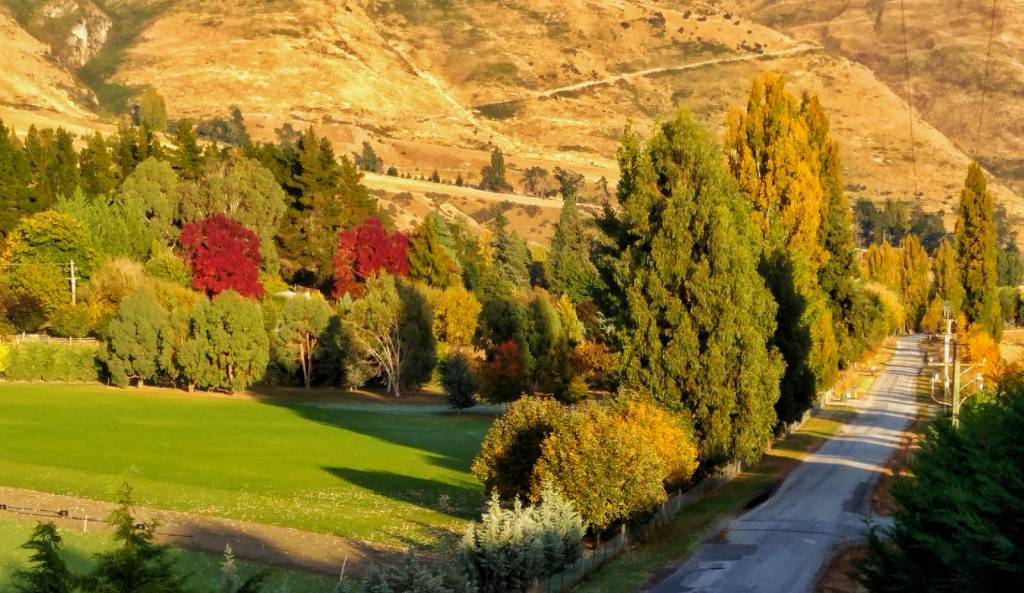
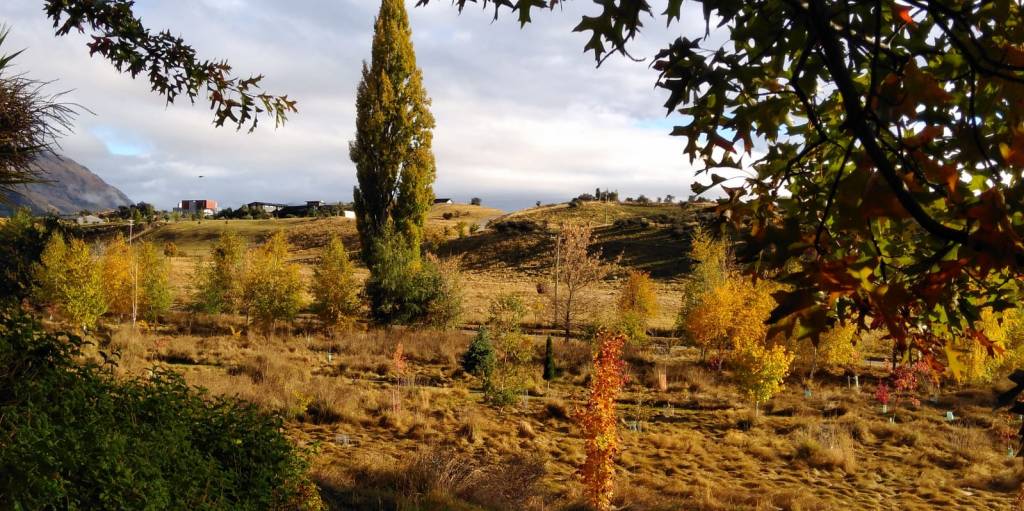
Namaste Park in autumn

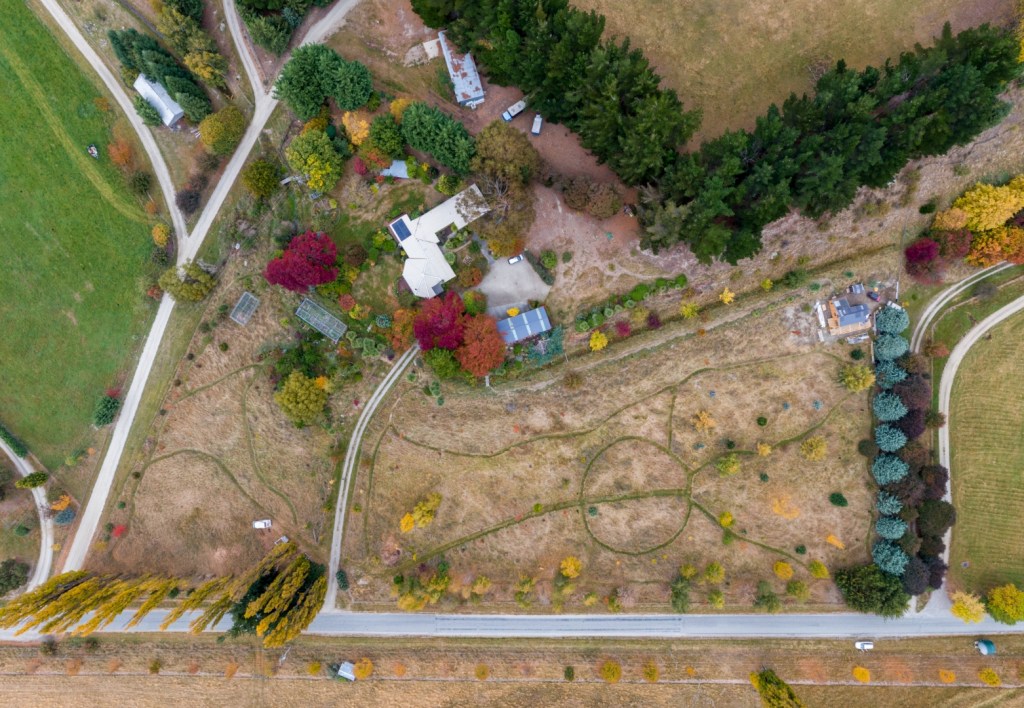
Namaste Park and Gardens is a 2.2 hectares lifestyle property on Studholme Road, Wanaka; currently on the urban boundary of Wanaka.
In the upper part of Namaste Gardens around the dwelling, the property hosts a dozen mature trees of significant height and hundreds of shrubs, trees and more formal gardens – home to abundant bird life.
The lower eastern side of the property hosts two small ponds, flower gardens, fruit and young nut trees and enclosed vegetable and berry patches.

Namaste Park

The lower part is a one-hectare arboretum planted by the current owner over the last 16 years. Once a bare pasture, the area has been planted with more than 500 trees, mostly all different, with a forest of silver birches on the road side, a grove of dogwoods, an area with crabapples, lots of maples, and many more different trees from all over the world that survive our Wanaka climate.
Established boundary trees of Cypress Glabra align the western boundary and a collection of Conifers are well underway over a fifth of the arboretum.
Many of the chosen trees are rare and unusual creating a significant collection of interest. In the heart of the park is a small native area.

The park is a beautiful and lush open landscape, designed to show amazing blossom shows in spring and splendid foliage colours in autumn, along with benches and curved footpaths. Although the emphasis is not on natives, we believe the sheer variety of trees planted offer a unique and valuable open space for people and biodiversity.

Dogwood and maple “avenue”

Sustainability and Regeneration

As Studholme Road is a small valley floor it offers a unique corridor of biodiversity, attracting birdlife which would be lost if the number of established trees were to be removed. Birds include Fantails, Silvereyes, Bellbirds, German Owls, Ruru, Hawks, Oystercatchers, Quails and Tuis along with a number of more common bird species.

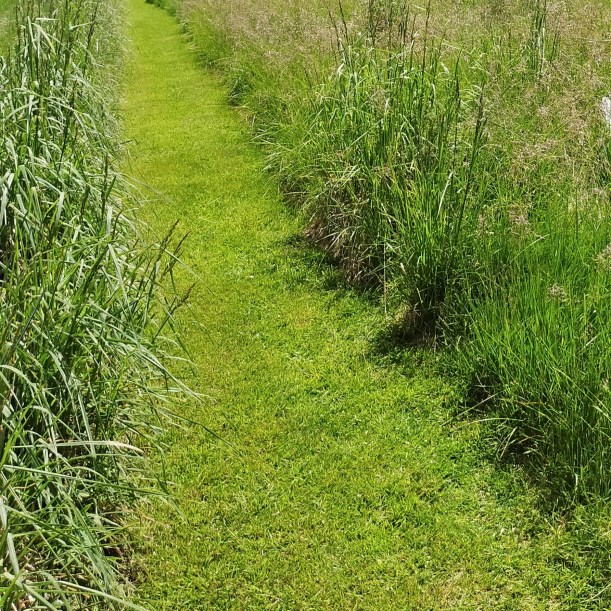
With the lawns being cut only on footpaths, the surrounding
grass is regenerating the land and is now home to insects,
birds and skinks.
No biodiversity inventory has been done yet.

The property doesn’t have any town water source and is serviced by a deep bore, which makes the regeneration of the land all the more important. The deep soil now retains enough moisture to keep green in summers with minimal drip irrigation watering.

The whole property is cared for without chemicals and without fossil fuels (electric tools charged with solar panels). It is a fantastic example of how one person can regenerate bare grazed land in just 18 years, bringing the dawn chorus back (all day chorus actually).
The landowners intention is to keep the land as a whole, for perpetuity, with owners continuing guardianship and fostering nature life.
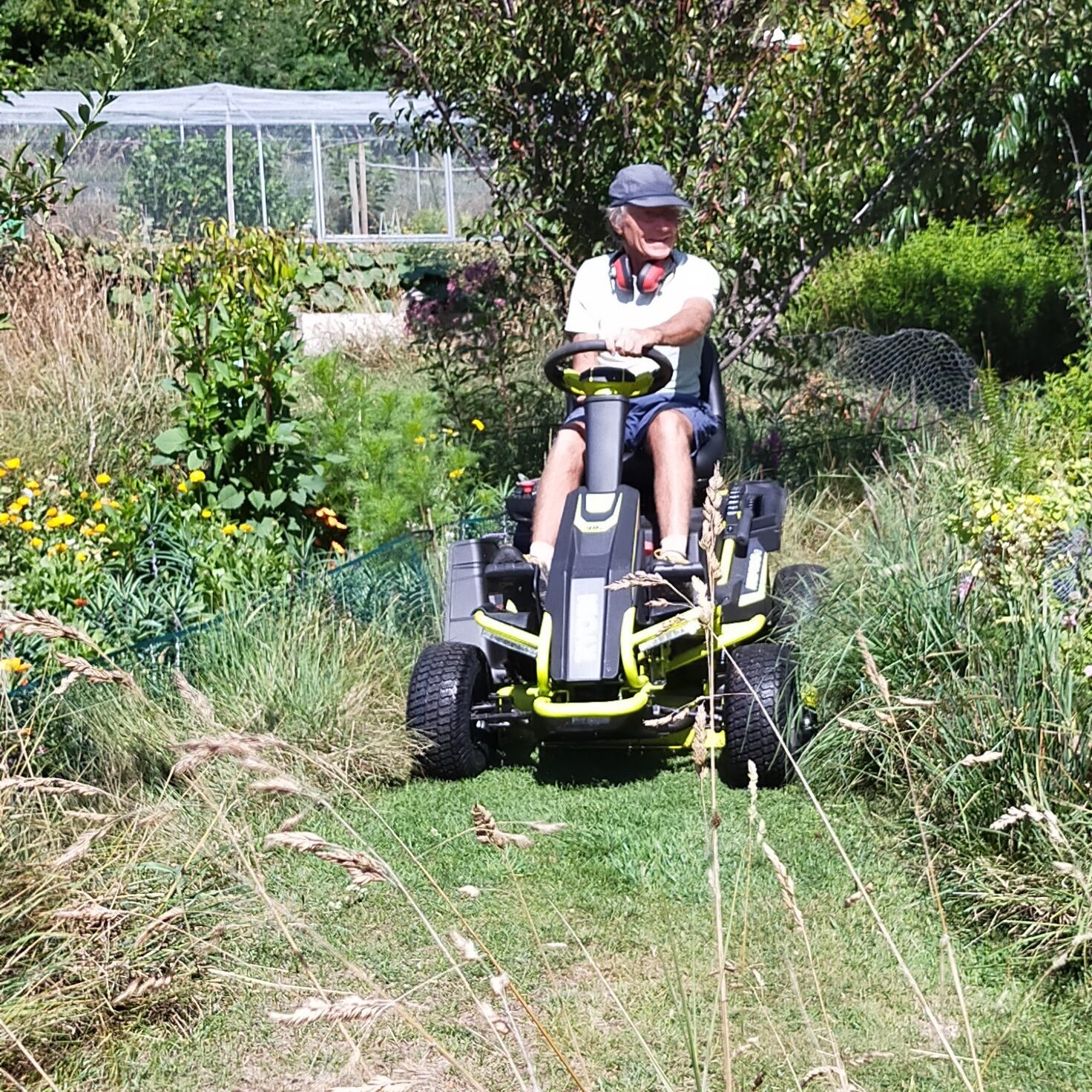
Electric ride-on lawnmower

Peri-urban context

The property is sitting in a zone planned to become urban within the next 28 years, which means the sections and trees in this zone will overtime be chopped up, leaving no nature in the area. Already both ends of Studholme road have been subdivided, at the upper end down to 400sq.m. If we look further on the town boundary along Orchard Rd there are currently intensive subdivisions taking place with the usual removal of all existing fauna, flora, top soil and land form.
Our park trees start to have enough growth and visibility to be admired by walkers from the road as well as visitors on guided garden tours.
It is our intention to open the arboretum to the public once more mature, thereby creating a valuable green space for locals and visitors. When the whole area around becomes dense housing, the Park will be a treasured haven for the community benefit and refuge for wildlife.

We are advocating the Council to create a regenerative land zoning or whichever way to enable people like us with properties planted with mature trees to be possibly preserved, but at this stage, council staff and councilors turn a blind eye.

There are other established zones of vegetation around Studholme Road so we have submitted for its inclusion in the Mount Alpha Outstanding Landscape zone.

The Wanaka Community Board have been consulted as well and have encouraged that this preservation be discussed with QLDC…

We have started a Biodiversity group on Studholme Road, facilitated by WAI, to encourage a more collective approach to ensuring open green spaces can be included in future Council rezoning.
We also have excellent support from Lake Wanaka Tourism who are keen to see more examples as outlined above.

We are working with QEII Trust to support us to enable long term protection of our property for the benefit of the “greater good”.

This beautiful place is visited as part of Beautiful Gardens of Wanaka guided garden tours and the place of Gardening in Harmony with Nature workshops.

It’s our beloved home, we enjoy enhancing the gardens, soil, wildlife. We love planting and nurturing the trees, watching them grow. We are privileged to be caring for this land in harmony with nature, guardianship, kaitiaki, gratitude 🙏🏵️
3 Comments

Regenerative Land Zoning

We are proposing a new Regenerative Land Zoning that encourages landowners to protect, regenerate and possibly share the land they are guardians of.

Context: the situation in Wānaka

In our district, urban growth is transforming the small town we love and pushing nature further and further away, decreasing inhabitants wellbeing and tourism appeal.

The urban area already stretches 10km from Bills Way to Albert Town bridge, which requires everyone to hop in a car to go anywhere, work, shopping, hobbies…

As developments start by removing all trees (incl. natives), massive earth moving and soil compacting, life, trees and soil present in the previously rural landscape are destroyed. It doesn’t have to be that way.

We now have kilometers of suburbia with houses four meters away from each other, where people can’t grow food let alone trees.

In 2023, we have to consider the climate, biodiversity and cost of living crises. To adapt, we need:

  • Connected pathways for commuting and recreation biking and walking
  • Plenty of trees and nature, 30% of land and water left to nature by 2030
  • Local food production

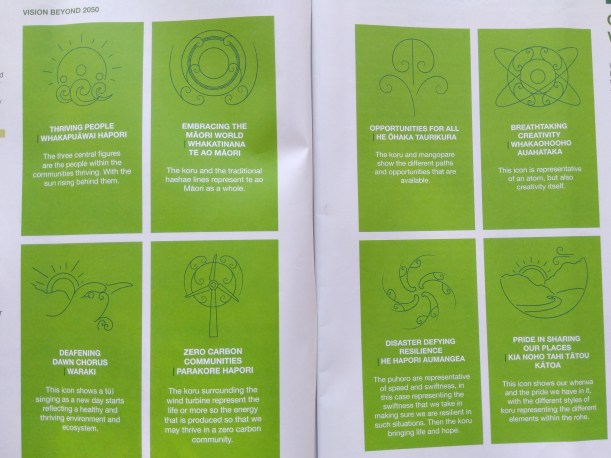
These 3 simple points enable low carbon living, good for nature and wellbeing, good for resilience and affordability. And it’s aligned to the QLDC Vision beyond 2050 principles:

Green belts exist on private land

The new subdivisions are now well beyond initially planned green belts and reserves.

Nature is pushed further and further away from the people. But in a sustainable resilient low carbon society, we do need nature and space for food production on our doorstep, not half an hour drive away.

Urban development is creeping on rural lifestyle areas, bulldozing them. Have a look at Orchard Road. It doesn’t have to be that way.

On many lifestyle properties in town and adjacent to town, landowners have planted trees and enhanced biodiversity on the land they are owners and guardians of. They are givers not takers. Kaitiakitanga. Thank you for having planted trees, established trees are treasures🙏 Taonga.

The current rules and price of land mean that when these creators sell, the land is chopped off with all the life on it. A simple optional new land zoning could prevent that.

Innovative Regenerative Land Zoning

We are proposing a regenerative land zoning, allowing landowners to voluntarily secure their land for perpetuity, providing they enhance biodiversity and/or the community.

The land can be sold with the same conditions.

The owners can choose how they want to regenerate: planting trees, native or not, restoring or creating wetlands, planting orchards for local food, planting fast growing well managed forests for local timber and firewood…

And the owners can choose whether they share it with the public or not, or which part of it. For example a strip along the road can be made into a bike lane; a grove of trees can be open as a park for the public; an orchard can be open for a time for locals to harvest; a land can be gardened by community groups or as plots…

It already happens. A few enlightened and generous landowners are already offering their land for the greater good.

A regenerative land zoning would foster green belts connections. It would create a network of biodiversity and community enhancing parks and corridors. Tracks through these corridors would enable low carbon transport. Food would be produced locally for resilience and affordability, and nature would be accessible for everyone with all its biodiversity and wellbeing benefits. Win-win-win.

Steps

I have shared the idea for two years, in emails to local influencers, including all the Councilors, several times. I have talked with many Council staff, I have presented it to several community groups and in the tourism sector, even prompting a standing ovation (at the WAO Regenerative Tourism hui October 2022). It IS a great idea with huge desirable benefits for all, thriving nature, resilient community and cheap for the Council.

Now is the time to sit around a table and make it happen.

Let’s start with the pioneers who have already created something beautiful which is at stake of being destroyed by growth. Let’s start with the landowners who already regenerate and share (or wish to).

What would encourage landowners to participate is yet to be discussed and finetuned, from rebate to maintenance or simply protection.

The Council is the entity capable of creating a land zoning and I am talking at a Council meeting on the 10th August to invite them to start the process. LWT, WAO, WAI, UCTT, Te Kakano, are invited in the discussion and action.

The innovative land zoning protects what we already have and deploys it to an exciting collective creation that, we all agree, would be great.

From landtaker to landmaker; From land management to guardianship; From $growth$ first to Nature first: a mindshift is happening.

One example of outstanding landscape, nature and biodiversity right on the urban boundary. Are we going to Love it? Or to bulldoze it?

To go deeper… here are 4 documents with more details.

Please contact us for any further information, if you are interested in participating, contributing, or if you know of similar public/private regenerative schemes in New Zealand and the world.


1 Comment

Gardening in Harmony with Nature Classes

Regenerative Lifestyle WORKSHOPS

Spring series, 6 Saturday mornings, 4 Nov – 9 December 23

  • Are you interested in taking care of your property in harmony with nature?
  • Do you want to regenerate your lifestyle property or garden without fossil fuels?
  • Do you love a healthy natural life?
  • Do you ask yourself “what would nature do?”?

Learn more than you expect with garden guide and regenerative lifestyle practitioner, Florence Micoud, in a relaxed atmosphere in the beautiful inspiring garden she is a grateful kaitiaki / caretaker of.

Contact Florence 02102792481 for more info or booking.

  • 6 sessions Saturdays 9am-12 pm starting 4 November
  • 3 to 7 Participants
  • Price: $240pp – $210pp with Community Service Card or Duet
  • Location: Namaste Park and Garden, 2 hectares of climate positive lifestyle block run in harmony with nature in Wanaka.
  • Level: Beginner, intermediate
  • Bring: Gloves, notebook+pen, jar+box for takeaways

Details of the sessions

Each session includes : 

+ Informative tour
+ Activity
+ Q&A
+ Stretch
+ Takeaways (garden goody & recipe)

Contact me 02102792481 for more info or booking, limited space

I’m looking forward to share garden and nature beauty and knowledge with you in spring,
it’s going to be awesome!

Florence


Leave a comment

All we need is ♥… a mindshift

I did it!

20 times, I walked past the glass house, telling myself “I want to” redevelop it. It was in the too-hard-basket don’t-know-where-to-start for a while.

Then I set my mind to it, looked at what was needed, researched and got bits. Then I did it, in four or five sessions, helped by my partner ♡ and we now have a clean and lush source of seedlings and joy. Done. Happy.

What happened? I chose to do it. I switched to I-can-do-it, I looked deeper, with a bit of curiosity, adventure and creation, one step at a time, it was easy. And fun.

Quite an ordinary experience, isn’t it? We know how to do new stuff, we do it all the time. All change, small or big, starts with a conscious choice, a decision, a mindshift.

Our renewed glasshouse

For the big challenge of climate change, we need is a mindshift too. And it’s happening. TVNZ has started a Climate Special programme, showcasing solutions and opportunities. They said 51% of people don’t know what to do. Here it is:

Start with a mindshift

  • Shift to NOW, not in 2030. In my case, I have chosen sustainability and regeneration for a long time. I don’t wait for a law that forces us to do it. Whatever carbon I don’t use now, is not in the atmosphere. Over the years, that’s a lot of carbon that I haven’t added in the atmosphere.

Wean yourself off fossil fuels

I switch to electric vehicles and tools, solar panels, local food, renewable energy provider, I divest…

In what I buy, in what I do, I look for carbon and embedded carbon (eg. plastic, chemicals, kilometres, waste) and find the best I can, or stop altogether. 

Choose nature

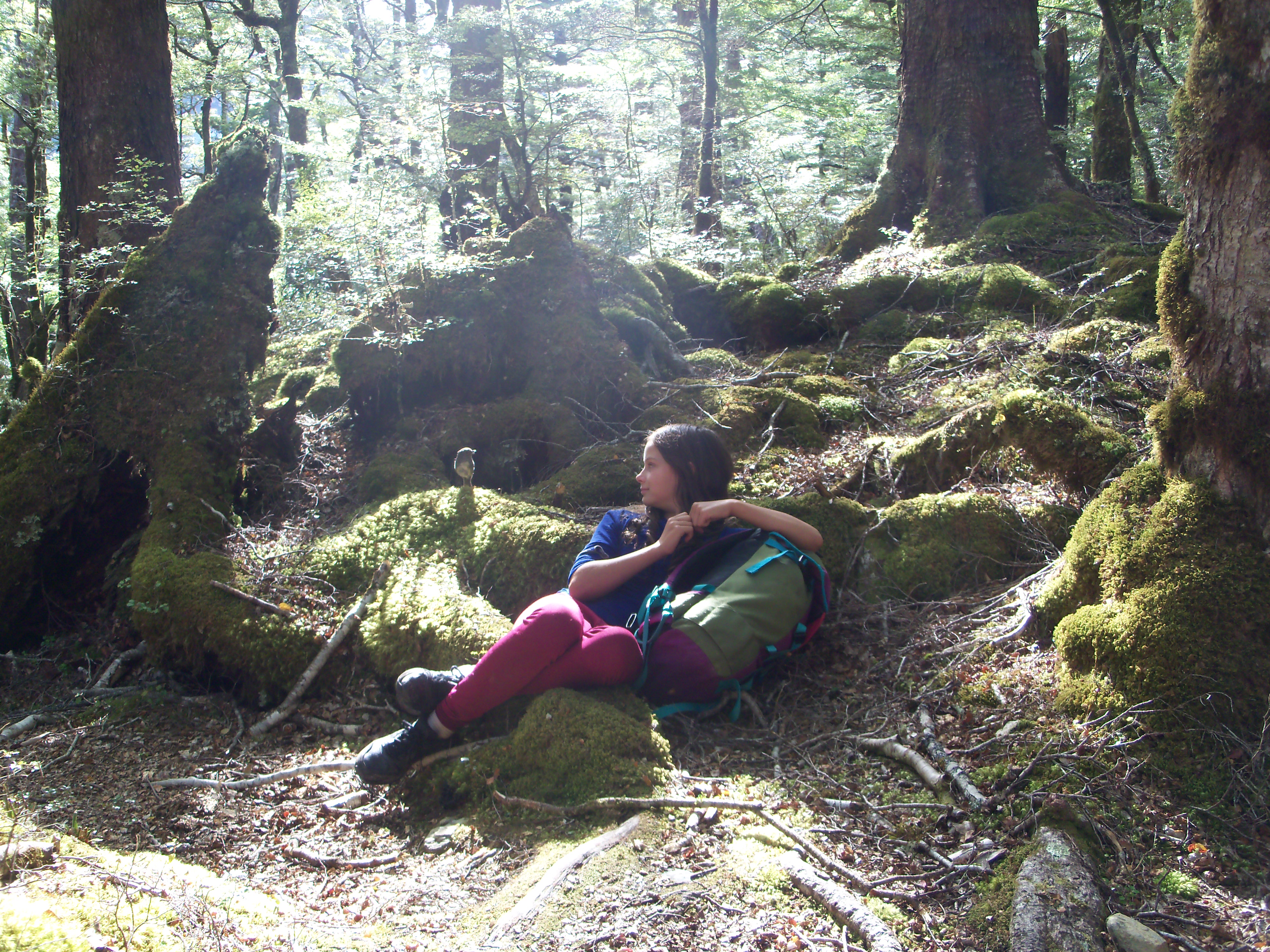
I chose nature a long time ago. I defend nature, enhance nature (plant trees, foster biodiversity…), mimic nature. I align with nature, I slow down, it’s relaxing. Forest bathing is now a thing, it changes us, it is our nature. I convey the experience within Beautiful Gardens of Wānaka guided garden tours, admiring and immersing in nature. Knowing nature better to care for her better. 
And for everyone to enjoy connecting with nature, I am advocating for Biodiversity and Community enhancing Parks and Corridors. It’s an elegant solution to many local issues and it is getting traction.

I value nature more than money. In our society still very much based on monetary value, it’s a big mindshift. From “I want/I need more/fear of lacking” to “I have enough“, simplicity, contentement. I can’t think of something that has more value than an old tree, or a forest, it can’t be bought, it can’t be replaced. I take all my decisions on how it will impact nature, not how much it costs.

Flower bathing, guiding a garden tour

In short, I care.

I care for my garden, feeling in gratitude for being a guardian of this beautiful part of Papatuanuku.

I care for my community by contributing to the local Regenerative Tourism intiative and facilitating Regenerative Wanaka discussion page.

I care for the planet and all its beings, and specially trees. I love trees -but that will be another post.

And I care for myself. Because this is where I have most effect. I choose what I eat; Food that is good for us and for the planet is one of the major solutions of the climate crisis (this food subject also deserves an entire post). I choose what I drink, what I put on my skin, what I wear… I choose as local, natural and least transformed as possible. I care for my mental health, I breathe, I exercise, in nature, in the garden. I become aware, conscious and this is a big mindshift, always work in progress!

Becoming aware…

  • I stopped saying it’s difficult: this stops me from trying! Instead, I tell myself it IS easy and I find a way.
  • I stopped blaming others, the council, the media… Instead, I ask myself: “How can I help?” and I take responsibility, I connect and inform as best as I can. It is a humbling exercise in vulnerability.
  • I stopped saying “I will.., I can’t, they should…” Instead, I create the world I envision. I do. It is very empowering, creative, fun, beautiful.  

I choose to care for the planet, the community and life now, in all ways and to contribute to the regenerative culture shift.

Enough talking, next post will be about grassroots. Literally grass roots!

Feel free to share other mindshift examples♡
Simply being in nature, connecting, with all senses


1 Comment

Climate Change Mitigation

This is a summary/extracts of the Climate Change 2014: Mitigation of Climate Change, Summary for Policymakers, IPCC. I’ve added some indicators: In red are the people’s potential for action, in green are the co-benefits.  I did not add any comment or anything that is not in the original 31-pages document.

Mitigation is a human intervention to reduce the sources or enhance the sinks of greenhouse gases.

Climate policies, to be effective, need to cross over all sectors and societal goals, include all countries and collective interests, based on sustainable development and equity. Addressing climate change creates co-benefits or adverse side-effects. No one action can itself solve the problem but working on all aspects has the potential to keep temperatures within 2 degrees increase (that is 450ppm) over the century, on which this report focuses.

Without additional effort to reduce GHG emissions, temperatures will have increased from 3.7 to 4.8 degrees celsius by the end of the century.

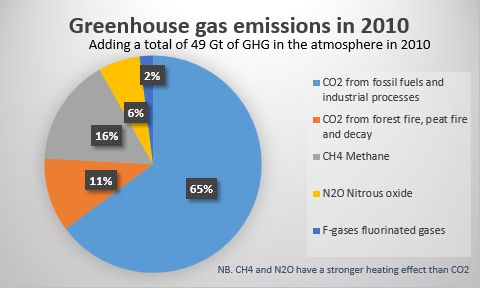
Anthropogenic (=man-made) greenhouse gas are CO2, methane, nitrous oxide and fluorinated gases. They’ve accumulated at an ever increasing rate in the atmosphere (+2.2% per year in the last 10 years).

GHG emissions

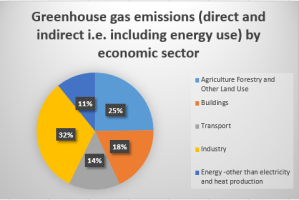
Now these gases come from these activities:

GHG by economic sector

It is demonstrated that the increase in population itself has not increased the CO2 emissions. It is the GDP per capita increase that has. Consumption has grown between 300% to more than 900% over the century.

Adverse side effect of mitigating climate change (within 2 degrees) is to reduce consumption growth by 0.04 to 0.14 percent points per year. Co-benefits include reduced costs for achieving air-quality and energy security,  significant benefits for human health and ecosystems. Overall, the potential co-benefits outweigh the adverse side-effects. Mitigation costs vary between countries.

Mitigation policy could devalue fossil fuel assets and reduce revenues for fossil fuels exporters.


ENERGY PRODUCTION

Energy demand will be reduced by efficiency enhancements and behavioural changes.

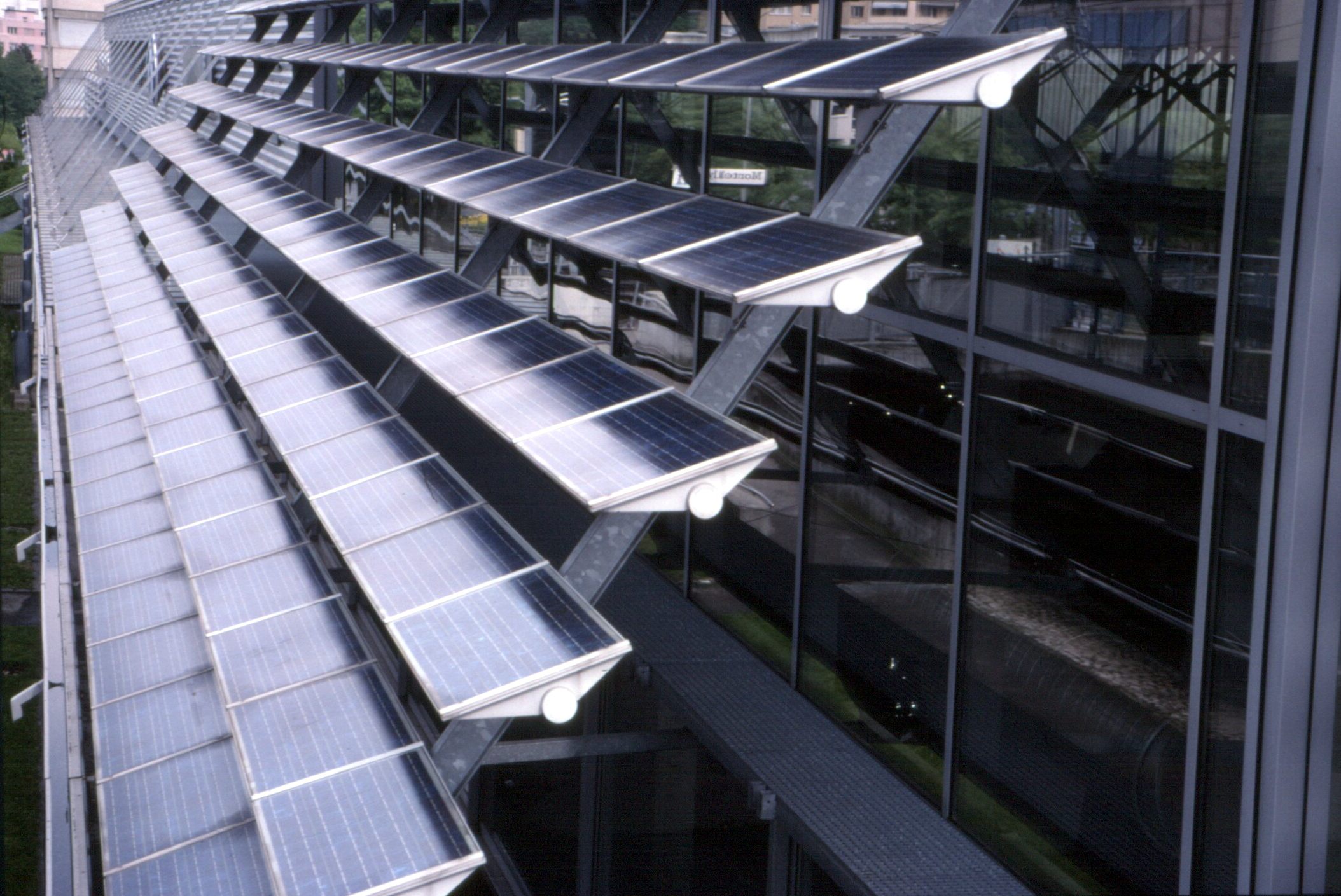
Energy use will be reduced by behaviour, lifestyle and culture change, complemented by technological and structural change.By Rama CC BY-SA 2.0

Decarbonizing (i.e. reducing the carbon intensity of) electricity generation is a key component of cost effective mitigation. The share of renewable energy, nuclear energy and carbon capture and storage (CCS) needs to increase to more than 80% of electricity generation by 2050 and fossil fuel power generation without CCS is phased out by 2100.

Renewable energy performance has improved and costs have reduced substantially, enable deployment on large scale.

Nuclear energy is a mature low GHG emission source of energy but barriers and risks exist: operational risks, and the associated concerns, uranium mining risks, financial and regulatory risks, unresolved waste management issues, nuclear weapon proliferation concerns, and adverse public opinion.

Natural gas power generation could act as a bridge technology.

Carbon dioxide capture and storage technology could reduce GHG emissions but has not yet been applied at a large scale. Also it raises concerns about operational safety and long-term integrity of CO2 storage.

Combining bioenergy with CCS offers prospects while it entails challenges and risks.


ENERGY USE

Transports

  • Technologies existing and in development improve vehicles performance: electric, methane-based fuel, biofuels (with CCS)
  • Integrated urban planning: investment in public transport systems and low-carbon infrastructure, transit -oriented development, more compact urban form that supports cycling and walking, high-speed rail systems…
  • Behavioural change to adopt these

A combination of the 3 strategies not only halve the transport contributions but also provide important co-benefits: improved access and mobility, better health and safety, greater energy security and cost and time savings.

Buildings

The energy demand for building is in expansion, as wealth, access and lifestyles improve. Opportunities to stabilize or reduce global buildings sector energy use by mid-century exist:

  • Energy efficiency policies, strengthening building codes and appliance standards
  • Implement recent advances in technologies and know-how
  • Retrofit existing building can achieve 50-90% of reductions of heating/cooling energy use.
  • Life, culture and behaviour significantly influence energy consumption in buildings (three- to five-fold difference).

Co-benefits: savings, energy security, health, environmental outcome, workplace productivity.

Industry

Currently the biggest emitter; Opportunities to reduce Industry GHG emissions below the 1990 baseline exist:

  • Energy efficiency can directly reduce emissions by 25%.
  • Process optimization, substitutions,
  • Resource use improvement, recycling, re-use

It is not only cost effective but it also comes with co-benefits for the health and environment.

Waste reduction and recycling are key to reduce landfill emissions.

Agriculture, forestry and other land use

A quarter of global emissions come from deforestation, emissions from soil, nutrient (fertilisers) management and livestock. Therefore solutions are: By DarKobra Urutseg Ain92 (File:Tango icon nature.svg File:Blank_template.svg) [CC BY-SA 3.0 (http://creativecommons.org/licenses/by-sa/3.0)], via Wikimedia Commons

  • afforestation (planting trees), and sustainable forest management
  • building humus,
  • improving cropland and livestock management
  • changes in diet and reduction of food loss

These strategies also benefit biodiversity, water resources and limit soil erosion.

Bioenergy can reduce GHG emissions only if fast growing species are used, land-use is well managed, biomass to bioenergy systems are efficient and biomass residues are well used.


Human settlements, infrastructure and spatial planning

Urbanization is a global trend and will include 64-69% of the world population in 2050. It comes with income increases which are correlated to higher consumption. The next 2 decades are a window of opportunity to get it right as a large proportion of urban areas will be developed during this time and it’s quite locked in. Mitigation strategies involve:

  • co-locating high residential with high employment densities (reduce urban sprawl),
  • high diversity and integration of land use,
  • increasing accessibility in public transport and other demand (access oriented development).

Advantages are better air and water quality, time and health benefits.

Mitigations policies and institutions

Sectoral and national policies

Currently USD1,200 billion are invested each year for energy security. Large changes in investment patterns are required:

  • decrease of 20% in fossil fuel technologies (-USD 30 billions per year). The complete removal of subsidies for fossil fuels in all countries could result in reductions in global emissions by 2050.
  • renewable energy investments double (+USD147  billions per year)
  • investing in upgrading existing transports, buildings and industry systems require another USD 336 per year.
  • achieving nearly universal access to electricity and clean fuel for cooking and heating are between USD72 and 95 billions per year until 2030 with minimal effects on GHG emissions while improving lives, environments and equity throughout the world.

That is plenty of opportunity for business and growth and it creates large energy efficiency gains.

Policies integrating multiple objectives, increasing co-benefits and reducing side-effects have started to be experimented and reveal that:

  • Regulations and information (education) widely used are often effective.
  • Cap and trade systems for GHGs (carbon offsets) could be effective if the caps are constraining.
  • Tax-based policies (for example on fuels) raise governments income and allow them to be proactive or to transfer to low-income groups.
  • Technology policy include public funded R&D and governmental procurement programs.
  • By lumaxart (Working Together Teamwork Puzzle Concept) [CC BY-SA 2.0 (http://creativecommons.org/licenses/by-sa/2.0)], via Wikimedia CommonsPrivate sector can contribute to 2/3 to 3/4 of cost of mitigation with appropriate and effective policies, i.e credit insurance, power purchase agreements, feed-in tariffs, concessional finance and rebates.


International cooperation

Various cooperation arrangements exist yet their impact on global mitigation is limited. Many climate policies can be more effective if implemented across geographical regions.


1 Comment

How climate change affects our region

Just like Wanaka is a “lifestyle reserve“, Wanaka is also likely to be far less affected by climate change than many other places in the world. Not worried by sea level rise! And a bit warmer wouldn’t hurt, would it?

However…

In our mountains, the biggest worry will be a shortened duration of seasonal snow lying, a rise in snow-line and a decrease in snowfall events. Glaciers will continue to melt.

The Ministry for the EnvironmentCopyright Ministry for the Environment Climate change projections for the Otago region page is worth reading. They predict:

  • around 0.9˚C warmer by 2040,
  • it will be wetter in winter and spring (more 29 % in Queenstown by 2090), drier in summer and autumn.
  • very heavy rainfall events are likely to become more frequent in Otago, increasing the risks of floods.
  • more often and stronger storms in winter (less in summer), with winds increasing between 2 and 5 per cent in winter, increasingly westerlies.
  • About the snow, “at heights between 1000 and 2000m:
    • the maximum seasonal snow depth is likely to decrease by approximately 20 per cent by 2040 and approximately 40 per cent by 2090
    • a low snow year is expected to be five times more likely by the 2090s.”

Unfortunately Treble Cone summit lies at 2088m and Cardrona at 1860m…

In the NIWA Natural hazard 2008 report, landslides, hailstorm, snow storms and electrical storms are all described for Otago. The fruit industry in Otago will be affected by summer droughts. The winter frosts will decline therefore bugs are likely to thrive.

And climate change is going to affect our native species, and their habitats in many diverse ways, states the Forest and Bird website. Birds and natives may have to move up to survive in their usual temperature but it is not always possible so it may mean they are out. Also some species, like tuataras -we don’t have any in our area to my knowledge- need a specific temperature for incubation therefore climate change is adding a threat to their survival.

Conversely, pests and insects are opportunist creatures and will make strides in changing conditions.

There is a last aspect I think is significant for our area: the impact of climate refugees, coming to live in our town because theirs is doomed. It may well have already started.

We are definitely all in there together!


1 Comment

It’s time to talk about climate change

Surely you’ve heard of it: the United Nations are having a conference in Paris in December to talk about climate change. And hopefully make some decisions. Well, they need help because they are going in the right direction but far too slow.

SO JOIN US FOR CLIMATE ACTION!

Climate march

What we need to know:

ErosionStClair beach98% scientists agree and the IPCC reports are peer-reviewed and include “skeptics” point of view. The IPCC report “Climate Change 2013: Physical Science Basis” summarizes all data with a level of confidence (depending on amount and quality of data as well as degree of agreement) and a measure of probability (based on models results and expert judgement).

Therefore any data or projection that comes with a high confidence and a very likely probability has -virtually certainly- happened or is going to happen. This is what the report states:

Climate change IS happening

  • Data collection around the world averages nearly 1°C increase in temperatures since 1870.
  • Extreme temperatures, droughts, floods, storms, have doubled or tripled since 1880.
  • Sea levels have risen 250mm since 1880
  • Glaciers have lost an average of 14 meters depth since 1950, particularly since 2004.
  • Wildlife has declined and species have migrated. Biodiversity main threat lies more in habitat destruction and wildlife trade than in climate change. However, the coral reef demise (only 12% of coral reef is left) is directly linked to ocean acidification which is due to CO2 increase.

Climate change IS human induced

Climate change is caused by the release in the atmosphere of vast quaE48400 - Lower part of Fox Glacier with glacier mouth, February 2013ntity of CO2 from coal and oil extracted by humans to create the extraordinary unprecedented growth since last century. Massive deforestation and other land use have also contributed to the increase in CO2 in the atmosphere. In the last 800 thousand years, atmospheric CO2 has varied between 100 and 300 ppm. Today it is nearly 400 ppm.

Methane and nitrous oxide (also created by humans – agriculture) are less concentrated but have a higher greenhouse effect than CO2 and therefore need to be considered as seriously as CO2.

Now, for people who still wonder why we should worry, click on the image below. Early humans appeared sometimes in Pleistocene and all the civilizations we know have developed in the relatively regular Holocene period. If we don’t prevent this sharp heating of our planet to happen, the world as we know it is GONE.
All palaeotemps

There is hope though. If we choose the right scenario, we can help make this temperature rise go slower, enabling as many as living creatures (includes humans) as possible to adapt…

What will happen?

Projections have been made for 4 scenarios (called Representative Concentration Pathways (RCPs).

  • RCP 2.6 is a mitigation scenario which aims at, with active policies, stabilizing then decreasing the CO2 emissions before 2100.
  • RCP 4.5 scenario aims at stabilising the CO2 concentrations by 2100.
  • RCP 6 scenario aims at stabilizing the CO2 concentrations after 2100.
  • Now RCP 8.5 is what will happen if we continue business as usual.

So I’ve been very nice and read everything for you and here is a summary of the effects, depending on the scenarios we choose:

Today RCP 2.6 RCP 4.5 RCP 6.0 RCP 8.5
Goal Reduction by 2100 Stabilisation before 2100 Stabilisation after 2100 Business as usual
CO2 concentration in 2100 398 ppm 421 ppm 538 ppm 670 ppm 936 ppm
Average air and ocean temperature(since 1870) +0.85°C +1.8°C stabilised +2.5°C +3°C +4°C (possibly +6°C)
Glaciers (cryosphere) 2% reduction since 1950 and accelerating 15 to 55% reduction 35 to 85% reduction(ice free Arctic ocean in September by 2050)
Ocean acidification 8.1 8.05 7.95 7.9 7.8
Sea level rise (does not include the “not agreed on” possible Antarctic shelf collapse) +1.7 meter since 1900 +0.26m to 0.55m (compared to the average sea level between 1986 and 2005) +0.32m to 0.63m(id) +0.33m to 0.63m(id) +0.45m to 0.82m(id)

And in Wanaka?

Just like Wanaka is a “lifestyle reserve“, Wanaka is also likely to be far less affected by climate change than many other places in the world. Not worried by sea level rise! And a bit warmer wouldn’t hurt, would it?

However…

In our mountains, the biggest worry will be a shortened duration of seasonal snow lying, a rise in snow-line and a decrease in snowfall events. Glaciers will continue to melt.

KeaThe Ministry for the Environment Climate change projections for the Otago region page is worth reading. They predict:

  • around 0.9˚C warmer by 2040,
  • it will be wetter in winter and spring (more 29 % in Queenstown by 2090), drier in summer and autumn.
  • very heavy rainfall events are likely to become more frequent in Otago, increasing the risks of floods.
  • more often and stronger storms in winter (less in summer), with winds increasing between 2 and 5 per cent in winter, increasingly westerlies.
  • About the snow, “at heights between 1000 and 2000m:
    • the maximum seasonal snow depth is likely to decrease by approximately 20 per cent by 2040 and approximately 40 per cent by 2090
    • a low snow year is expected to be five times more likely by the 2090s.”

Unfortunately Treble Cone summit lies at 2088m and Cardrona at 1860m…

In the NIWA Natural hazard 2008 report, landslides, hailstorm, snow storms and electrical storms are all described for Otago. The fruit industry in Otago will be affected by summer droughts. The winter frosts will decline therefore bugs are likely to thrive.

And climate change is going to affect our native species, and their habitats in many diverse ways, states the Forest and Bird website. Birds and natives may have to move up to survive in their usual temperature but it is not always possible so it may mean they are out. Also some species, like tuataras -we don’t have any in our area to my knowledge- need a specific temperature for incubation therefore climate change is adding a threat to their survival.

Conversely, pests and insects are opportunist creatures and will make strides in changing conditions.

There is a last aspect I think is significant for our area: the impact of climate refugees, coming to live in our town because theirs is doomed. This is why it is not only altruistic to act for the climate. We are definitely all in there together!

Solutions are well-known

We all urgently need to stop our petrol and coal consumption. There are so many other ways to produce energy (eg. solar panels), to save energy (e.g. insulate), avoid useless motorized traffic, buy local… And we need to make pressure on our local bodies so they create effective public transport systems, safe cycle lanes, better housing regulations. And we can put pressure on governments so that they encourage renewable energy rather than support fossil industry.
Worms-from-coffee-compost-pile
Agriculture and forestry also need to improve their practices. An IFOAM report explains in 2009 that “agriculture currently accounts for 10-12% of global greenhouse gas emissions” (ruminants and deforestation mainly) whereas, “global adoption of organic agriculture has the potential to sequester up to the equivalent of 32% of all current man-made GHG emissions“. So we can choose to buy organic, plant trees, have less meat and dairy… and again pressure governments so that they promote organics rather than throw some sand into their wheels.

We can choose to avoid plastic, to recycle, to grow our own food to build up our own soil… In fact, there are so many solutions, that it will be the object of another article!

Mostly, we need governments to take the right decisions at the next Climate Conference, to choose effective mitigation of climate change and we have the opportunity to tell them :

Come and participate in the Climate March here in Wanaka, on Sunday 29th November, at 2pm in the Dinosaur park.

We can choose to change our lifestyle OR the climate will change our lives.

Sources:

Watch the Climate March video here. 320 participants, beautiful day, thank you to all participants and passionate creative volunteers!


3 Comments

1080, diquat and co.

100% Pure NZ is systematically sprinkled with persistent organic pollutants, but don’t worry! All the studies prove it’s OK.

Actually, independent source Pesticides Action Network PAN declares it’s not OK, these products are on the Highly Hazardous Pesticides list (HHP list).

What’s the problem?

They do not disappear despite some biodegradability, they enter the food chain and they accumulate. From highly acute toxicity to long term toxic effects (carcinogenic and mutations), endocrine disruption, environmental degradation (ozone layer, effects on animals…), to hazard to ecosystems services (bees), HHP effects are varied. Cause and effects are not always obvious, often long term. Only highly acute toxicity is tested in most cases.

DiquToxicat dibromide is on HHP list. It can be fatal if inhaled ; Also toxic by ingestion and  dermal contact, including neurologic effect. It is chemically close to agent orange and was used in Vietnam too. It makes rats infertile. It is often found in cow milk.  It is unlikely carcinogenic but is known as a potential ground water contaminator. Diquat is used every year in Lake Wanaka in an attempt to stop lagarosiphon spread. It doesn’t stop it nor prevent it to grow again. In fact, lagarosiphon is not toxic, it is a habitat for native species, it absorbs nitrogen. It does annoy boaties, getting stuck in propellers. It does disrupt hydro dams (turbine shutdown and lost energy production), obliging hydro companies to invest in expensive measures against the plant.

ToxicGlyphosate (RoundUp)  is listed on the HHP list. It is not as biodegradable as Monsanto says. Not only it is quite persistent in water and sediments but also its degradation creates other toxic substances. It is known to have long term health effect on kidneys and reproduction organs. Its massive use also leads many weeds to become resistant and it is present in many surface and ground water tables. Besides, glyphosate is often associated with other chemicals for the weedkiller to be more efficient so you get the perfect cocktail for unknown consequences. Actually not so unknown as many many studies show severe effects but Monsanto’s powerful marketing machine is still winning.

ToxicPindone (not on the HHP list), however on PAN database, it is listed as highly toxic, causing nosebleeds, bleeding gums, bloody urine, extensive bruising in the absence of injury (ecchymoses), also fatigue, shortness of breath (dyspnea) on exertion. It may cause fluid in lungs (pulmonary edema). It is fatal or highly toxic for fish. Toxicity data is missing (no study done/recorded) as to cancer, water pollution potential and the bees. It is used to kill rabbits, with some success, although rabbits invariably spread again, possibly getting resistant.

Toxic1080 (Sodium fluoroacetate), is on the bad guys list as Extremely hazardous (Class 1a) according to World Health Organisation and fatal if inhaled. May also be absorbed through the skin. Leads to convulsions, laboured breathing, unconsciousness and death if untreated. DOC says 1080 is OK for NZ because it targets mammals and there is no native mammals in this country. 1080 is not used in any other country in the world because it would destroy mammals. Well, sorry but I AM a mammal and my children too. More and more research show that it accumulates and that it has long term carcinogenic and reproductive effects… In the local papers today, DOC kindly reassures us that fish ingesting 1080 are safe to eat because you need to “eat several tonnes of affected fish” to get a fatal dose. For me, “not fatal” does not equal “safe”. What about everything in between?

2014 is a mast year

In 2011, the Parliamentary Commission for the Environment publishes a report that supports the use of 1080 as the best solution available to help protect our native birds. Interestingly, independent scientists demonstrate just the opposite on their site 1080science.co.nz. A lot of information is on the Ban 1080 website.

Solidly based on the PCE report, DOC launches the “Battle for our birds”, with a record dropping of 1080, when we know that 1080 kills about as many birds as it protects them.

Which to believe?

I am not a scientist but I see clearly there is not enough consensus on that matter among scientists to keep using these HHP without questioning.

I know about Rachel Carson landmark book, Silent Spring, which warned, in 1962, that the use of pesticides would lead to wildlife destruction and a dramatic increase in cancer cases.

I have read Our Stolen Future, by Theo Colborne, which demonstrated in 1996, that even tiny doses of pesticides can alter human development and reproduction, as they are endocrine disruptors.

So I wonder… and I worry…

What do the pro 1080 win? Lots of money $$$ from selling and applying their product. Pro-1080-diquat-and-so-on justify themselves by any mean to keep doing business as usual.

What do the anti 1080 win? Nothing! They must have good precautionary reasons to spend so much time and energy fighting this!

Solutions?

I am not saying I have solutions. I just want people stop saying these substances are solutions. They are not. They are dangerous and don’t solve problems, hardly mitigate them. Saying they are solutions prevents everyone from searching for better ways -non toxic please.

I think we must stop thinking in terms of pests that we need to eradicate. Maybe consider them as resources? Lagarosiphon is excellent composted. Possums of course have made the fortune of many trappers. Some rabbit terrines are served in the best restaurants in some countries…

Maybe widen the issue to the whole system? We don’t have a “pests” problem in an otherwise perfect world. I know this may shock but it strikes me that National Parks are protected (from destruction by humans) and DOC is sole responsible for their maintenance yet forests are becoming silent. I know of some valleys that are privately owned and well looked after by their owners. No possums, no stoats, lots of birds, lush native bush. Maybe the system needs revisiting…

What if humans became again guardians of the land, respectful of nature, not consumers and controllers of nature? This does require quite a mind-shift and a lot of open-minded discussions. I don’t have solutions. But if we don’t look for them, we won’t find any and we’ll keep doing the same things with the same results.

What you can do

  • Take the warning signs seriously! It IS dangerous!
  • Join groups who set traps
  • Take photos of abuse and send them to the media, OSH, local authorities and beyond
  • Love your weeds instead of poisoning them
  • Generally avoid using chemicals, they all add up!
  • Prompt debates…

PS- I could make a very similar article about the pesticides used in agriculture, less visible but more widespread…


Leave a comment

Trees trees trees

My favourite activity is to walk in a forest. I enjoy the softness of the forest floor, the smells, the noises, the atmosphere and hearing and spotting birds. It calms, regenerates and grounds me. But ever since I was a kid, I have always heard that forests are destroyed. When I check on the Internet to find how quickly, it is worse than I could imagine: 33 soccer fields per minute, as calculated in 1999 in a  FAO Study! It is estimated that only between 20 and 30% of the native forests remain worldwide. In New Zealand, Te Ara Encyclopedia states that 80% ot the New Zealand islands was covered in forests before human settlement. In 1997, natural forest covered just 24% of the land area, and planted forest covers 5% of land area, the FAO reports.

2011 was the International Year of forests to say loudly and clearly that it’s more than time to stop the destruction and start regenerating them. Why and how is summarised below.
Feel free to leave a comment to add or discuss a point.

Role and importance of forests

    • Forest ecosystems act as a sink of carbon. A fifth of greenhouse gases come from forest destruction was calculated in the  FAO Study .
    • Forests are vital in rain and water regulation. Trees are water column, and attract and retain water and humidity thus regulating water cycle. Haikai Tane from  the Living Water Foundation says for example “in Twizel, our two met stations during the hydro project days 1970-1985 recorded atmospheric humidity below 50% (MOSTLY 20-40%). Now with the arboreta of trees maturing, Twizel’s humidity rarely falls below 60% now… it’s a micro-meso-meteorological process… storing and recycling moisture through ecosystem performance...
    • They are hugely important ecosystems for biodiversity: they are the habitats of 2/3 of land animals. Vitally important for plants too which provide us for food and cure.
    • They usually have a high degree of endemism: in New Zealand for example, more than 80% of the approx 2300 native species in NZ forests occur nowhere else in the world (1), meaning that if we let them being destroyed, we loose these species and their genetic qualities all together.
    • When healthy, forests are an incredible resource for people who live near them (food, refuge, medicine, materials, firewood) and love them too.

Why are they destroyed?

  • For timber, sometimes just a few valuable trunks are taken (example the kauri in NZ), some is used for charcoal and wood chipping
  • For making space for farmland, particularly cattle farming and other exportation crops
  • Also burnt for hunting (example: the moa in NZ).
  • For mining and other uses. Here in the South Island forests were burnt to allow access for gold mining. Still today in many places forests are heavily damaged for mining and transport, oil rigging and dams. Example: open-cast mining in Denniston Plateau
  • For human settlements as we do not like to feel enclosed or they hide the view… and more and more humans need space.
  • Or they menace to change the landscape. That’s what happening currently in New Zealand with this wilding pine control frenzy!   They invade the pasture land, which is not natural in the first place… This is very controversial, sorry, and does not refer to the native forest indeed. But they grow so well, they would still be a useful resource (firewood… How much firewood do you use each year? Is it actually replaced by plantations?) and would help catch much needed rain too…

How can we stop it?

Support groups who protect them, for example:

Buy carefully:

    • paper with FSC label ,
    • wood products made from non exotic woods,
    • local or organic fair trade foods will ensure they have not been extracted from forests (unlike palm oil based food for example)

Campaign locally and globally (Avaaz, Greenpeace, for example) to protect forests.

And go and enjoy them, if National Parks are utilised, then they will not be as easily dismissed and nibbled. In some countries, eco-tourism is essential to keep National Parks doing their conservation work (example in Kenya).

Tree plantingAnd we can be restorative

Read the moving novella The Man who planted trees, by Jean Giono translated by Peter Doyle  http://www.pinetum.org/GionoUK.htm

The power of reforestation is fascinating. Wildlife comes back (example  QEII ), nature becomes abundant again. Watch for example this Oasis en tous lieux experience in Mali   or this amazing, complex and successful project of recreating rainforest  in Borneo, by biologist Willie Smits.

And locally, we can volunteer at Te Kakano nursery every Tuesday and Wednesday and there are Saturday planting days too. It is wonderful that a few passionate people managed to create a movement that allows us to regenerate native bush in our area. Thank you!

Or we can learn how to Grow Seedlings from the Wild and do it in our backyard.

Every tree counts and many trees recreate a forest…

Sources:

(1) New Zealand’s native trees, by John Dawson and Rob Lucas, Nelson: Craig Potton, 2011

http://www.fao.org/DOCREP/ARTICLE/WFC/XII/MS14-E.HTM

http://www.globalforestwatch.org/english/about/faqs.htm

http://www.wri.org/project/global-forest-watch