Regenerative Livestyle Blog


Leave a comment

Doing it again… in Tarras

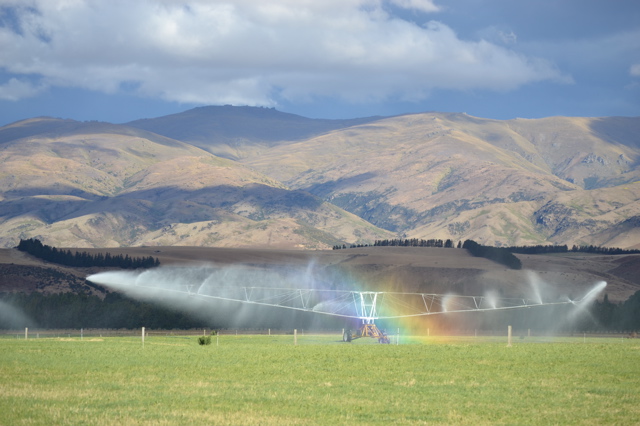
Tarras irrigation (c) HolgerTake a dry area, beautiful and lean and decide to make dairy farms here! It will be costly… But it’s all right, the ratepayers will pay for it… Sounds unbelievable? or only too familiar?

I have published below the full story and call for help by some Tarras residents, together with the links to the submission documents, to fill in and send by the 3rd of May to the ORC if you care… Click here to see my submission, feel free to copy/paste it and just change the name and address. Cheers.

Florence

Subject: Submission to Otago Regional draft annual plan – Tarras water scheme

Dear friend,

As part of the Otago Regional Council (ORC) draft annual plan, the ORC proposes a $ 3.6 million dollar investment in a privately owned irrigation scheme in the Tarras area (230 residents). The Council’s investment will be even higher as there are ongoing costs during the proposed 5 year investment, bringing the spending of public money up to $ 6-7 million. It is proposed to fund this investment through rates increases.
Any Otago rate payer and resident can make a submission to the Council on this investment proposal. This is your opportunity to have your opinion heard by the 11 councillors who are divided on the subject. Public submissions on the plan close this coming Friday, 3 May 2013, and the councillors will have to make a decision on the proposed investment at their meeting on 24 June 2013.
You might have read some reports over the last few months in the Otago Daily Times on the Tarras water scheme. Here is a brief summary:
Tarras Water Ltd. (TWL), a privately owned company, proposes to pump water from the Clutha river to 6000 hectares of hitherto unirrigated land in the Tarras district. Currently, there are 40 shareholders, mostly farmers, with 8 farmers controlling 90% of the company, four of which are also directors of TWL. The proposed cost for this project ($ 37 million) requires a large bank loan ($ 26 million, 20% of which would be guaranteed by the Central Otago District Council) and the ORC investment in order to proceed. TWL shareholders would fund $ 7-8 million themselves upfront.
Even though the water scheme was initially promoted and presented as a “community” water scheme and public grants sought and used for preliminary studies, the cost of the scheme for the vast majority of the Tarras community is too high to be part of.
However, TWL continues to rely on public money for this private enterprise. TWL proposes the ORC to become a “dry” shareholder, i.e. hold 30% of the shares in the scheme without using the water. The ORC would only recoup its investment if it were able to sell the 30% of the shareholding over a five year period. However, over the last 6 months some landowners in Tarras have already invested in their own irrigation schemes, with others not interested in the TWL scheme for reasons of cost. The high cost will inevitably lead to intensified farming in the area, with the most likely outcome being dairy support and dairy farming in general over the proposed 6000 hectares.
While the ORC is being asked to become an investor in a private irrigation scheme, by law it also has to handle resource consents for water permits, as well as enforcing legislation relating to water quality and use in the Otago area, in other words it would put itself in a position of conflict of interest (private investor and regulator at the same time).
Such an investment would also set a precedent for other irrigation schemes in the wider Otago region, the latest one proposed for the Maniototo area. In fact, it would set a precedent for any private business to ask the ORC for public money to partially fund their enterprise, whatever it might be!
Despite being asked by the ORC for information on alternative funding, TWL has not sought private business investment in its scheme, suggesting that it doesn’t stack up as a good deal. TWL solely relies on public money input and very strongly lobbies the 11 ORC councillors to vote in favour of the investment.
Again, TWL is a private company which asks the ORC for millions of dollars of public money, funded through rates increases affecting every Otago rate payer, with a high risk to the Council to be able to recoup the investment. And TWL is effectively owned by a small number of wealthy farmers.
Should you be concerned about the use of public money in this fashion, please use the attached form to make a submission to the Otago Regional Council by Friday, 3rd May 2013. 
The draft annual plan with the TWL investment proposal is available on the ORC home page, www.orc.govt.nz
Please, also forward this email to anyone you think might like to make a submission.
Best regards,
Holger Reinecke


2 Comments

Global Change for Beginners

Puzzle ClipArtSo you sort of sense there are some issues looming, but it is quite confusing, seems still controversial and certainly helpless… Here are some basic elements and inspiration to help you assemble the puzzle.

The links and organizations mentioned in this article (in maroon) have credentials, are reputable and are important sources for further information. I recommend you read the whole article first and then click and explore the links.

Hard facts

There is proven human induced climate change. In its latest Climate Change Report dated 2007, the IPCC states that temperatures had already increased by an  average of 1 degree in the 20th century, and will continue to increase by 2 to 4 degrees by 2100 if greenhouse gas emissions are not curbed. Climate changes also include an increase of extremes, draughts, winds, floods, colds and heatwaves. Some places will become colder. The next report is in progress but intermediary announcements have underlined that the projections and scenarios are lower than what is actually happening. People who cast doubt about it have either an interest in keeping business-as-usual or are looking for excuses, being unable to consider change yet.

Human activity and settlement is creating irreversible damage on world biodiversity, jeopardizing its capacity to regenerate itself.  It is not only sad that many species disappear but it is also hugely harmful to human society as biodiversity provides us with a wide range of services, free and taken for granted. Here is the summary of the very official Convention of the Global Diversity.

Resources are running out, whether it is water, oil, or minerals… Clean air too! Some, like phosphorus, are not directly essential for us but their rarity would have dire consequences… The nitrogen cycle change is another example of the human activities tremendous impact.

There is a global economic and social crisis -just watch TV!- and despite rebounds, we all know that doing more of the same thing is not going to improve anything.

Well, the reality is that our earth has boundaries and we have been in ecological overshoot for many decades.

I have a “Drivers of Change” set with 175 cards each detailing different aspects of energy, waste, climate change, water, demographics, urbanisation, poverty. One group game consists in picking up one card each and meeting every other participant and discussing the links between the two seemingly totally distinct subjects. An amazing eye-opening experience.

Everything is connected. For example, the practices of modern agriculture, combined with the world demographics, creates a catch-22 to feed the everyone when productive land is being depleted or constructed for human expansion, resulting in rocketing food prices, worsening the social crisis and the state of the environment… “Whatever befalls the Earth – befalls the sons of the Earth. (…) Whatever Man does to the web, he does to himself.” Says Chief Seattle in his famous 1854 speech.

Ostrich clipartFlight or Fight!

Too much!! Panic!!!

You may prefer to ignore or escape in consumerism, in drugs, in hopes that we will go on Mars…

Or read on…

There are solutions! Lots! And we need lots of people to make them happen. It is a team work. Everyone’s little action at his level contributes.

30 years ago, we were wacky… or pioneers. And yes some of us are extremist! Many people like me worked to identify, analyse and communicate the issues; many people have been experimenting and finding solutions. It may be new to you, but it not new and many solutions have been tested and approved.

Today, we are innovators and there are many early adopters. Be part of them!

It has been demonstrated that when 13.5% of the population has embraced a change, then the majority engages. No need to spend energy to convince people, they will come on board. Just Change yourself, what you can, when you can. That is your part of the Global Change.

Change is not easy and everyone is not venturesome. Around us, many people act to make change easier, for example creating cycle lanes to enable people to cycle to work safely. So while more and more people embark on the boat- bike!- , more and more change is possible in a virtuous spiral. Listen to Elizabeth Sahtouris inspirational talk.

Change for what?

Here I introduce the sustainability principles as guidelines for change, from the Natural Step (explained in 2mn, or for kids)

  1. Is a choice/ an action taking always more resources from the earth crust?
  2. Is it creating things that the earth cannot digest and therefore persist and accumulate in our ecosystems or atmosphere?
  3. Is it somehow destroying part of the biosphere, undermining its regenerative capacity?
  4. Is it preventing other people from having a decent life?

If an answer is Yes, then try and change it. If all answers are No, then your choice / action is sustainable. Simple, no?

Solutions levels

Intergovernmental and governments decide on rules and laws

I do not expect much from them as they are very lobbied.  However we can influence these:

  • with online activism following Avaaz, Choice and many others ;
  • write submissions and get involved politically;
  • or for the bravest, stand as a candidate for the Local Government elections

Business and industry profit more when saving the planet

Business is driven by profit, which derives from the difference between the selling price and the cost to produce a good or service. Therefore,  for many MANY years, business has tried to get the cheapest resources, get more work done by workers paid minimally and externalizing costs.  Today resources are increasingly expensive. Delocalisation for cheap labor reaches its limits, polluting is getting to visible, laws and consumers are more demanding…

Paul Hawken demonstrated way back in 1994, that business and industry can be restorative of the environment. Because it is more profitable, more and more businesses, like InterfaceFlor,  are redesigning the way of producing. Sustainable and socially responsible business is the way of the future.

Community level can be very effective
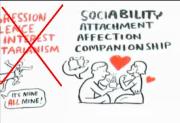
Together, we achieve lotsBe part of or create associations that promote energy descent, nature restoration, social justice… The Transition Town movement is getting momentum and induces a lot of change. In New Zealand, Transition Town Aotearoa networks and support communities, responding to the twin challenges of climate change and peak oil.

Also locally, write submissions and get involved politically. It may be worthwhile participating in Community Associations to bend them in a sustainable direction.

There are many global-change-friendly communities in the world, even some large ones like Whistler in Canada, Curitiba in Brazil or Nelson in New Zealand.

Individual level is the most reachable

How you spend your money is a powerful tool with which you can really make a difference. For example, you choose to support an industrial farmer using pesticides, polluting water, harming his animals etc when buying his produce at the supermarket OR you support the living of a friend at the local farmers market. Do you see how strong your choice is?

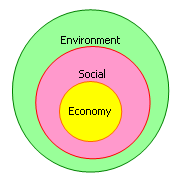
Changing requires a mind shift, a change in yourself. It requires you realize that you are a human,  part of the society, itself part of the environment. Economy is not an aim nor the ruler of all life, but the mere tool for societies to function.

From  to 
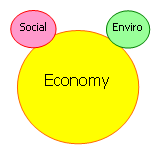
It requires that you realize that you ARE either contributing to the problem or you ARE part of the solution, from “what can I do anyway-I’d better keep going as usual” to “Wherever I am on this track, it is worthwhile for me, for the planet and for future generations, and I am going there”. And just start.

Think on how you eat (best is organic, local, vegetarian food), how you move (prefer bike or collective transports), how you heat your dwelling (reduce your energy consumption). And sieve them through the 4 questions above. Here is a Sustainability at home comprehensive  Checklist, courtesy of The Natural Step Canada.

We are all at a different stage on the path, and depending on circumstances one may have to go backwards. No judgement. It is not an excuse not to “keep aiming at” sustainability.

working together4

I hope that by now, terror and oblivion has been replaced hope and determination. The only problem left is “Are we early enough?” but better late than never...

Lots of actions and initiatives have already contributed to mitigate the issues, giving nature and beings more time to adapt to change. For example, the ozone layer depletion has started to reduce since 2009, thanks to the 1987 Montreal protocol.

Remember, you are not alone, we need many hands to go faster and also”the more the merrier“!

Here are some resources to give you information in specific domains and a lot of inspiration. Have a wonderful voyage!

More main resources

For positive news: Happyzine in NZ ; Guardian Green Living blog (Yes UK but quite worldwide) ; Tree Hugger with humour ; Celsias NZ, solid source but not always fun…

For news about New Zealand nature : Forest and Bird

Check out the resources from the Centre for Alternative Technologies in Wales and Terre Vivante in French

Here are Sustainable Initiatives and projects in NZ, mainly by the Centre for Sustainable Practice students.

Here is the American Earth Policy Institute Action plan B.

Lots of cool stuff on RSA Animate and TED talks


Agriculture, gardening, food and health

Organic New Zealand and Permaculture New Zealand

Information about Pesticides, in New Zealand and internationally, also What’s wrong with Pesticides?

Energy, transport, building

Rocky Mountain Institute, US based but lots of positive information about energy, transport and housing. See Amory Lovins inspiring TED talk here.

Renewable Energy World blog

The Future From black oil to a green future

Economics

Living Economy website in New Zealand

New Economics Foundation, Economics as if people and the planet mattered

Here a New Zealand online guide to eco-accommodation, organic cafes, food supplies, Māori cultural tourism, and environmental tourism activities.

Sustainable business network in New Zealand

Here are many more interesting links . It is also worthwhile “Liking” some organisations of your interest on Facebook and exploring their “Likes”. Focus on the good news and practical how-to aspects.

Please leave a comment if you find inaccuracies or to suggest too-good-to-miss links.

Leave a comment

Yellow Blue Park Project

Inspired by Terre Vivante where I worked as information manager for 7 years, I have created a concept of “Yellow Blue Park” ( Hint! I am not allowed to say green!!) where an existing public campground combines with a campus and a community social place, for the best use of space and facilities, to enhance interactions and to benefit from synergies.

We’re having a meeting to talk about the future of Wanaka Campground on Tuesday 12th March 8pm, in the rugby club rooms.

I will be there !


1 Comment

Slow travel

100_7128

Good clean fair travel

How to enjoy travels without much money and without impacting too much on the planet? We have Slow Food. Here is a Slow Travel concept.

No! I am not going to rant about these motor boats queuing at the petrol station in the morning and wasting it doing loops in the water; Nor am I going to name and shame people who fly for a 5-day discounted trip to a paradise international resort built on native land destroying coral… No.

Travelling and holidaying can use resources parsimoniously and be a meaningful experience, not just another consumption trap. One of the keys is to travel less far and less often but longer, and in combinaison with another purpose. Could be studying, volunteering,  working or running competitions…

Simple things

I enjoy no-travel-holidays, just staying home to make up for when I go to France. Enjoy my friends. Enjoy good books and rest. These walks I did not have time to walk yet. Catch up on sewing and repairs. Try new things, start the sourdough, patisseries, decorating the staircase, sun salutations, family games… I enjoy simple things.

20121231_235222Not far

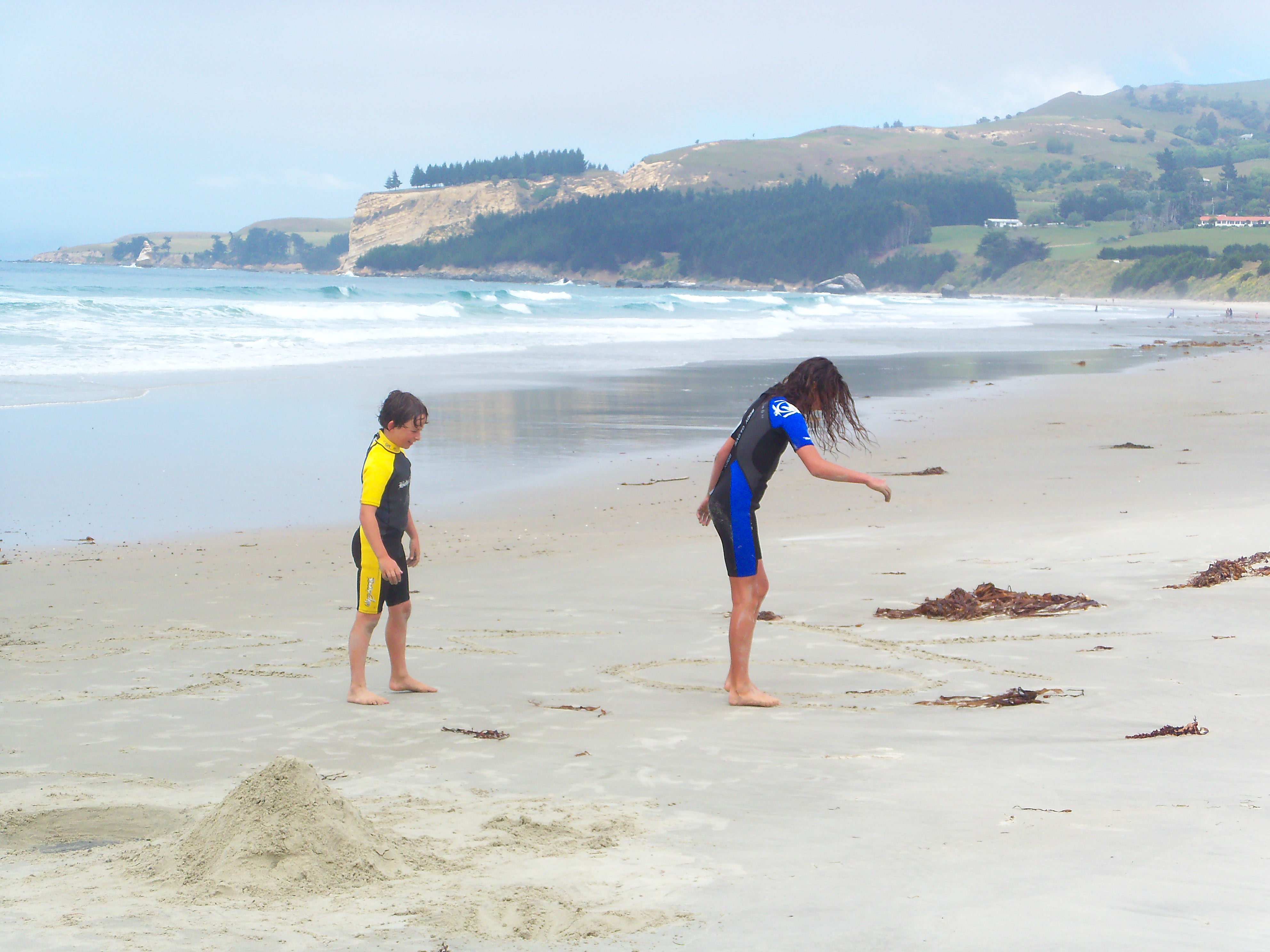
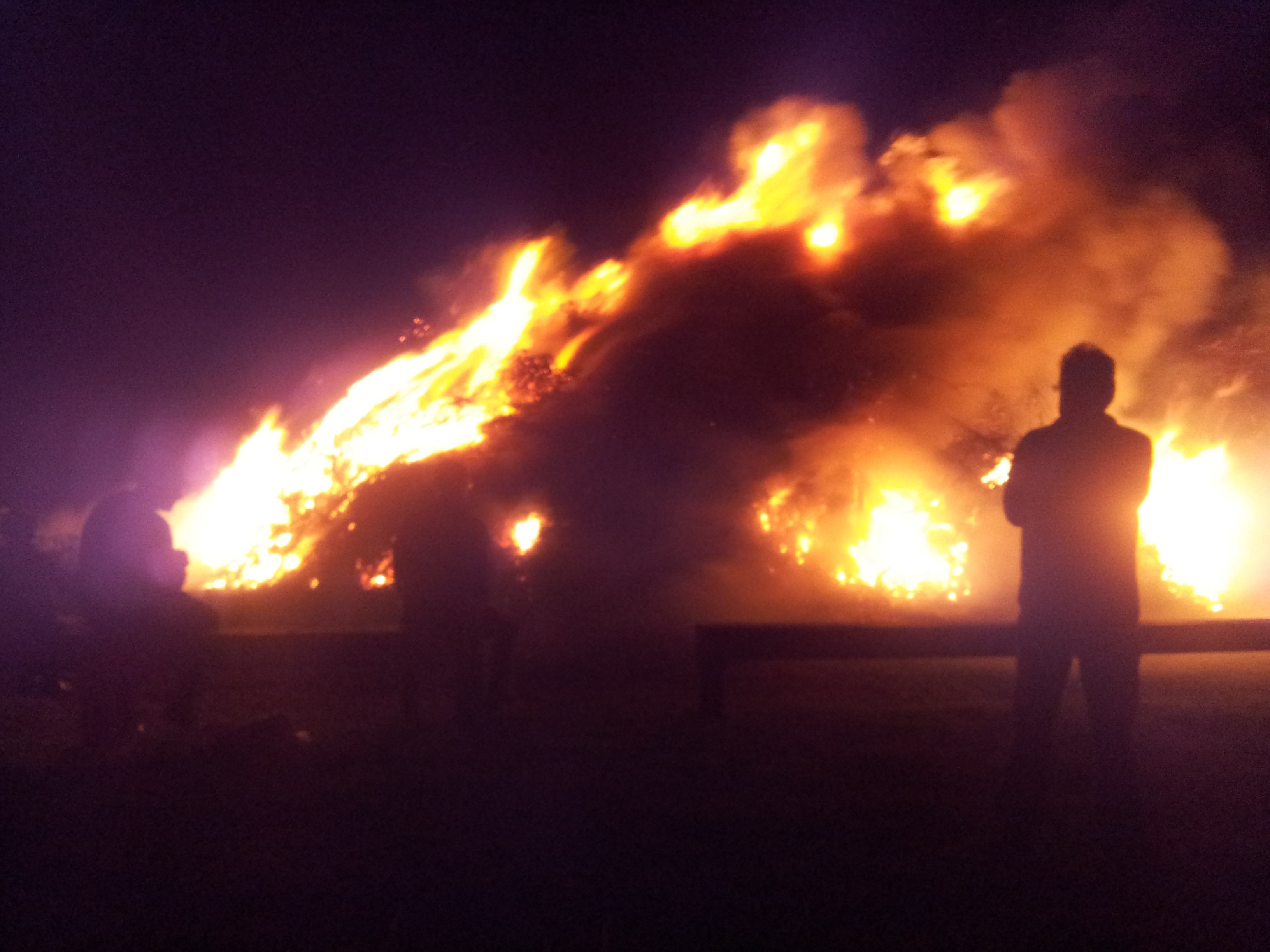
We love to drive to the sea with our tent and enjoy the beach and bonfire. We treasure tramping in the wilderness on a DOC track or walk – see also ideas on the interactive website NZ walks Info. Check the weather forecast on Metservice AND Metvuw.

Further…

When we do travel overseas, we have our tents or we  stay at locals accomodations, it’s cheaper and you know your money is going to feed the kids. It also provides a more genuine experience.

Ethical and environmental tourism

If you want to plan your travels, then think about the environmental and ethical impact of your choice. There are many travel agencies that really support communities and enhance biodiversity. Find some on Ethical Traveler, Tourism Concern,  or check if they are members of Leave No Trace, the International Ecotourism Society or other…

Carbon Off-setting

There are benefits in carbon off-setting and many companies will take your money to hopefully -check carefully- finance some carbon reduction programs. I personally can’t afford it and prefer keeping my daily carbon footprint as small as I can and avoid yet another monetarization of life.

Volunteering

A great cheap and meaningful way to go places and create friendships is to work in exchange of board in New Zealand and abroad:

When I will be wiser and free.. ?!

I may become peacekeeper for a few months through some of these organisations, Volunteer Service Abroad   (NZ) , Global Exchange Peace Brigades ,  Service International para La Paz,
Nonviolent Peaceforce or
Friend Peace Team (quaker)
 And Arbinger Institute will provide for most background issues.

If I was younger and free!…

I would go around the world cruise hiking  and stay at friendly people thanks to couch surfing . Read the advice from an experienced bunch on Matador Network.

Welcoming travelers is a way to travel –  proxy travel !

This year we met two awesome couples, traveling with not much at all, with a very low impact on the environment and maximum contact with the people:
  • Olivier and Nadege, traveling by bike, as light as possible, boarding on sailing boats, using a kite to drive long patches and going around the world in 7 years- planned…The nec plus ultra of Slow travel! Follow them on http://www.enrouteavecaile.com/

    100_7029

  • Adeline and Mark, arriving by chance at our place one evening, travelling in tandem http://letandemetlavie.fr/ .
What an overseas experience! To the four of them, we were very pleased to offer a home-so-far-away-from-home and wish you all the best.
Even with a family, Slow travel is possible. Raphaël, Sophie, Hugo et Adèle travelled one year (took a sabbatical leave), wwoofing, and meeting hundreds of people for an unforgettable experience… Nice to have met you all!

And the librarian in me can’t help mentioning books…

Travel books will take you place, for free and nearly zero-carbon:

  • a good fiction set in Africa, India, in a Pacific Island or wherever will probably transport you in another time/space. Sea Wall, by Marguerite Duras and White Tiger, by Aravind Adiga immediately spring to my mind.
  • A recount or a logbook that tell of a journey may make you feel that you actually walk next to the author. The first that I think of is Endurance: Shackleton’s Incredible Voyage, by Alfred Lansing and I was very pleased not to be with them! Another well written travel book with a mission is Three Cups of Tea, by Greg Mortenson.
  • an adventure story will take you there and beyond, depending how realist it wants to be. I walked and rode and walked for weeks reading The Hobbit, by J.R.R. Tolkien!

How do YOU make your travel good, clean and fair?

Please contribute to the slow travel concept by telling your experience in a comment. Thank you!


Leave a comment

Localising food tour coming to Wanaka

Flower

While Wanaka transition town people were starting to meet regularly to try and set up a transition town framework,  we were contacted by the Localising Food Tour Aotearoa team who would be in our part of the country in 5 weeks.

So the meetings changed to organising the Local Food event and here it comes, from 5th to 9th December.

Here is the Localising Food Tour Schedule and here is the website for bookings and more information about the workshops, presentations and facilitators.

I hope it will launch a local movement for more local food production, both as individuals and as a community, to build on the Farmers’ market.


Leave a comment

Cooperatives and social entreprises

BAU: Business as Unusual!

If we are to avoid Business As Usual competition and profit spiraling against resources and people, we can choose to make business differently. The choices include but are not limited to social enterprise, trust, cooperative, industrial and provident society…

I have searched about the various forms of these structures from the Community Economic Development network, the Office for the Voluntary and Community Sector and the New Zealand Cooperative association, and overseas from Social Traders in Australia and various dedicated government websites in Europe.

Social entreprise

Social enterprises mix social and/or environmental aims with a commercial orientation. Peter Holbrook, CEO of Social Enterprise UK, at a meeting on Thursday 26 April 2012 in Wellington (hosted by the Department of Internal Affairs), shared how social enterprise models will let communities stay ahead of the curve and have a valuable role to play through providing innovative approaches. Latest CED Bulletin announces the imminent creation of a social enterprise network in NZ.

Sources: http://www.ocvs.govt.nz/work-programme/building-capacity/social-enterprise.html  and http://www.ced.org.nz/?p=2081

Cooperatives

A cooperative “means an autonomous association of persons united voluntarily to meet their common economic, social and cultural needs and aspirations through a jointly owned and democratically controlled enterprise”. ILO Definition

2012 is International Year of Cooperatives, “Cooperatives are a reminder to the international community that it is possible to pursue both economic viability and social responsibility. ” United Nations Secretary-General Ban Ki-moon

In 2002, ILO passed a recommendation for governments to promote and support cooperatives, creating a legal framework that enables them to thrive, rather than limiting them in the informal economy.

Governance Options

Cooperative

Industrial and provident society

Social Enterprise

Definition an autonomous association of persons united voluntarily to meet their common economic, social and cultural needs and aspirations through a jointly owned and democratically controlled enterprise An industrial and provident society is an entity of a minimum of 7 members and the secretary for carrying on any industry, business or trade authorised by its rules with the exclusion of banking.
Names ending in Society Limited
Social enterprises are organisations that: a. Are led by an economic, social, cultural, or environmental mission consistent with a public or community benefit; b. Trade to fulfil their mission1; c. Derive a substantial portion of their income from trade2; and d. Reinvest the majority of their profit/surplus in the fulfilment of their mission.
Purpose Mutual support for members or the promotion of a specific purpose or social benefit. Improve the conditions of living or the social well being of members or be for community benefit. economic, social, cultural, or environmental mission consistent with a public or community benefit;
Economic aspects Members contribute to the capital. At least part of that capital is usually the common property of the cooperative. Benefits go to : developing their cooperative, setting up reserves, benefiting members in proportion to their transactions supporting other activities as approved by the membership. Usually consist of the owners of small businesses who, while continuing to operate independently, become part of this larger entity for mutual benefit.
They work (industrial) and receive benefits (provident) from the society for their future wellbeing.
Operationalised as 50% or more for ventures that are more than five years from start-up, 25% or more for ventures that are three to five years from start-up, and demonstrable intention to trade for ventures that are less than two years from start-up.Trade (exchange of goods and service)s, including:·monetary, non-monetary and alternative currency transactions, where these are sustained activities of an enterprise; contractual sales to governments, where there has been an open tender process ; and·trade within member-based organisations, where membership is open and voluntary or where membership serves a traditionally marginalised social group
Values self-help, self-responsibility, democracy, equality, equity and solidarity; as well as ethical values of honesty, openness, social responsibility and caring for others; To be defined by society To be defined by enterprise
Principles voluntary and open membership; democratic member control; member economic participation; autonomy and independence; education, training and information; cooperation among cooperatives; and concern for community. To be defined by society To be defined by enterprise
Advantages Mutual bond between transacting shareholders Power to Issue shares with a nominal value; and manage shares to ensure continuous active membership of company
Strong supporting national and international framework
A society becomes a separate legal entity once incorporated; A society will have a common seal (no longer applicable to companies); A society can lease, rent, buy and sell property, borrow money and enter contracts in its own name, generally under its common seal. No member of the society can have personal rights or interest in any of the assets of the society; A society will continue as a separate entity even though its membership changes; and Members will not be personally liable for the debts, contracts or other obligations of the society. Range of naturally occuring ‘types’ that emerge from common approaches, ideals and social purposes. 1. Income generation – Many nonprofit organizations see social enterprise as a way to reduce their dependence on charitable donations and grants through commercial activity 2. Employment – Many people see employment or engagement of marginalised groups as the principle motivation for social enterprise. 3. Service delivery – Social enterprise has the capacity to create or retain services needed in communities.
Legal New Zealand Co-operative Companies Act 1996 Industrial and Provident Societies Act 1908
Sources http://nz.coop/http://www.ilo.org/ilolex/cgi-lex/convde.pl?R193http://www.cecop.coop/What-is-a-cooperative http://www.nz.coop/docs/0403_MED_co-operative-organisations.pdf http://www.socialtraders.com.au/
http://www.ocvs.govt.nz/work-programme/building-capacity/social-enterprise.html

Sources:


Leave a comment

Trees trees trees

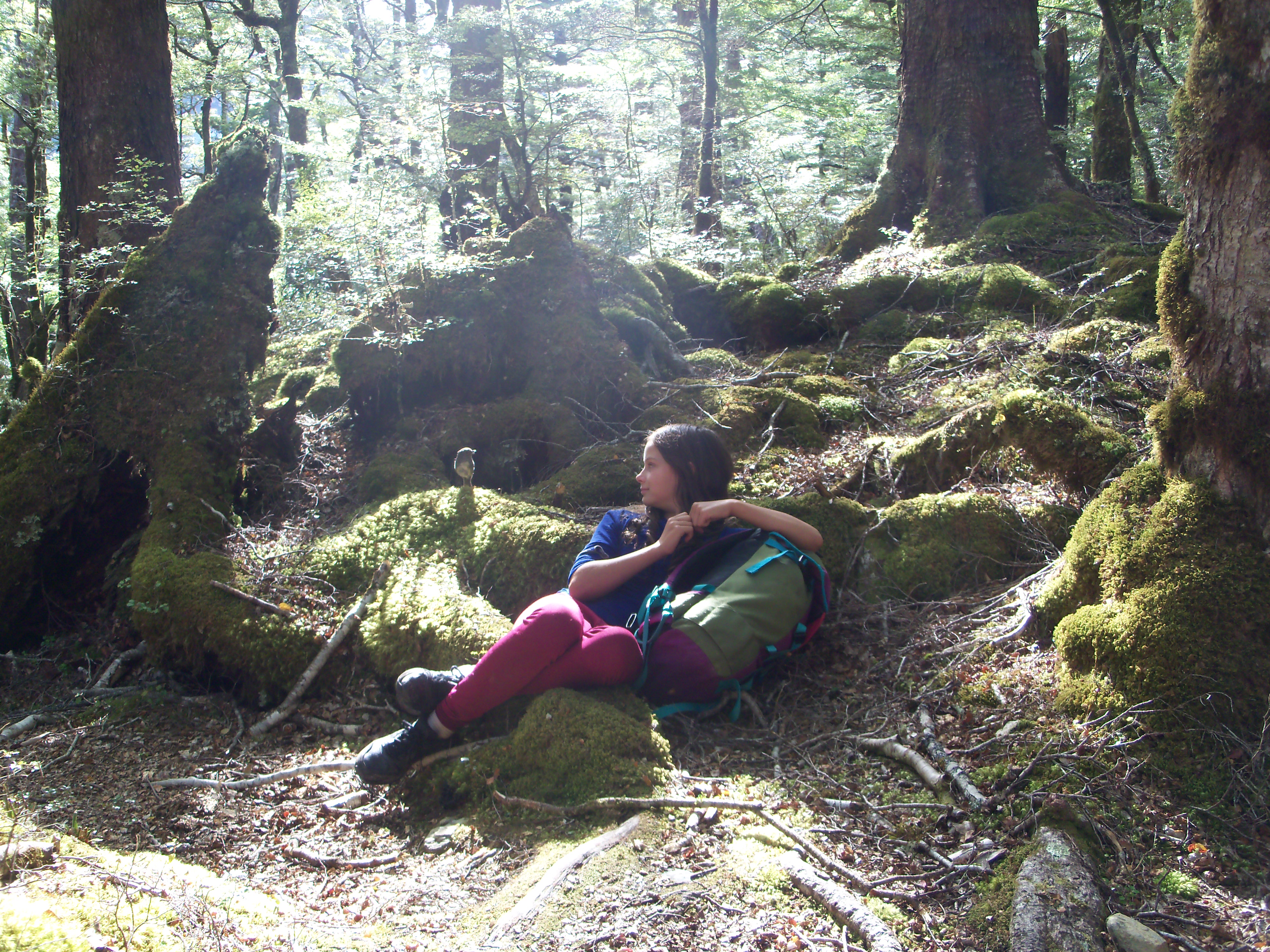
My favourite activity is to walk in a forest. I enjoy the softness of the forest floor, the smells, the noises, the atmosphere and hearing and spotting birds. It calms, regenerates and grounds me. But ever since I was a kid, I have always heard that forests are destroyed. When I check on the Internet to find how quickly, it is worse than I could imagine: 33 soccer fields per minute, as calculated in 1999 in a  FAO Study! It is estimated that only between 20 and 30% of the native forests remain worldwide. In New Zealand, Te Ara Encyclopedia states that 80% ot the New Zealand islands was covered in forests before human settlement. In 1997, natural forest covered just 24% of the land area, and planted forest covers 5% of land area, the FAO reports.

2011 was the International Year of forests to say loudly and clearly that it’s more than time to stop the destruction and start regenerating them. Why and how is summarised below.
Feel free to leave a comment to add or discuss a point.

Role and importance of forests

    • Forest ecosystems act as a sink of carbon. A fifth of greenhouse gases come from forest destruction was calculated in the  FAO Study .
    • Forests are vital in rain and water regulation. Trees are water column, and attract and retain water and humidity thus regulating water cycle. Haikai Tane from  the Living Water Foundation says for example “in Twizel, our two met stations during the hydro project days 1970-1985 recorded atmospheric humidity below 50% (MOSTLY 20-40%). Now with the arboreta of trees maturing, Twizel’s humidity rarely falls below 60% now… it’s a micro-meso-meteorological process… storing and recycling moisture through ecosystem performance...
    • They are hugely important ecosystems for biodiversity: they are the habitats of 2/3 of land animals. Vitally important for plants too which provide us for food and cure.
    • They usually have a high degree of endemism: in New Zealand for example, more than 80% of the approx 2300 native species in NZ forests occur nowhere else in the world (1), meaning that if we let them being destroyed, we loose these species and their genetic qualities all together.
    • When healthy, forests are an incredible resource for people who live near them (food, refuge, medicine, materials, firewood) and love them too.

Why are they destroyed?

  • For timber, sometimes just a few valuable trunks are taken (example the kauri in NZ), some is used for charcoal and wood chipping
  • For making space for farmland, particularly cattle farming and other exportation crops
  • Also burnt for hunting (example: the moa in NZ).
  • For mining and other uses. Here in the South Island forests were burnt to allow access for gold mining. Still today in many places forests are heavily damaged for mining and transport, oil rigging and dams. Example: open-cast mining in Denniston Plateau
  • For human settlements as we do not like to feel enclosed or they hide the view… and more and more humans need space.
  • Or they menace to change the landscape. That’s what happening currently in New Zealand with this wilding pine control frenzy!   They invade the pasture land, which is not natural in the first place… This is very controversial, sorry, and does not refer to the native forest indeed. But they grow so well, they would still be a useful resource (firewood… How much firewood do you use each year? Is it actually replaced by plantations?) and would help catch much needed rain too…

How can we stop it?

Support groups who protect them, for example:

Buy carefully:

    • paper with FSC label ,
    • wood products made from non exotic woods,
    • local or organic fair trade foods will ensure they have not been extracted from forests (unlike palm oil based food for example)

Campaign locally and globally (Avaaz, Greenpeace, for example) to protect forests.

And go and enjoy them, if National Parks are utilised, then they will not be as easily dismissed and nibbled. In some countries, eco-tourism is essential to keep National Parks doing their conservation work (example in Kenya).

Tree plantingAnd we can be restorative

Read the moving novella The Man who planted trees, by Jean Giono translated by Peter Doyle  http://www.pinetum.org/GionoUK.htm

The power of reforestation is fascinating. Wildlife comes back (example  QEII ), nature becomes abundant again. Watch for example this Oasis en tous lieux experience in Mali   or this amazing, complex and successful project of recreating rainforest  in Borneo, by biologist Willie Smits.

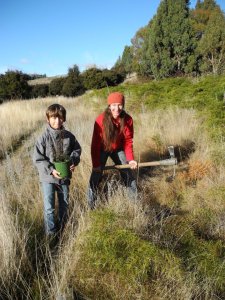
And locally, we can volunteer at Te Kakano nursery every Tuesday and Wednesday and there are Saturday planting days too. It is wonderful that a few passionate people managed to create a movement that allows us to regenerate native bush in our area. Thank you!

Or we can learn how to Grow Seedlings from the Wild and do it in our backyard.

Every tree counts and many trees recreate a forest…

Sources:

(1) New Zealand’s native trees, by John Dawson and Rob Lucas, Nelson: Craig Potton, 2011

http://www.fao.org/DOCREP/ARTICLE/WFC/XII/MS14-E.HTM

http://www.globalforestwatch.org/english/about/faqs.htm

http://www.wri.org/project/global-forest-watch


Leave a comment

Building resilience beyond bullying

I attended a very interesting meeting about bullying in Wanaka Primary School earlier this month. Not that I am worried that my kids are bullies or bullied. But just to know how I can, as a parent, prevent perhaps and help if it occurs. And it happens to be a much wider subject than it seems… These are my notes.

Build resilience in kids

Resilience is the capacity to cope with adversity. If children are strong inside, they will not remain affected. And they need to learn how to solve problems. As parents we can help by supporting our children’s self-esteem in general and by talking about the problems when they arise. We can help them say what they experienced, how they felt. Help them name these and going through solutions with them, so that they learn from what happened. And parents must address both bullies and bullied situations. We must tell kids to not go along bullies, to realise and take a stand.

Peer conflict versus bullying

The former is meanness, often one-off situations, with kids trying and not getting it right but soon realise and stop. It is quite normal even if it can still be very affecting. Kids may still need help to solve it, on both side of the conflict. When a kid says no one wants to play with him/her, is s/he bullied or is s/he the bully? We need to talk to find out and help find solutions.

Bullying is repeated, exerts an imbalance in power and the offender purposely wants to hurt and therefore will not stop. It can often escalate to violence or sex offense. For the victim, it MUST STOP. But so that it happens, victims MUST seek help, but unfortunately only 20% do. Specially when they get older. We, parents must keep the conversation open, not react. Do not threaten to confiscate the phone or computer access if they complain, or obviously they will not tell anymore. Instead, address the issue or seek help for it. For all cyberbullying issues, visit Netsafe.

Social relationships are acquired skills

We must tell our values, establish them, discuss them. And keep adapting with the children’s age. For example: No hurting –> Respect –> Welcoming…

At primary school, the first month is dedicated to establish rules and creating a safe classroom which is a requirement for good learning disposition. Children learn to talk and listen to each other, and they are taught the WITS strategy:

  • Walk away,
  • Ignore,
  • Tell someone,
  • Say what you want instead.

How to talk about an incident

Ask what happened? And listen to the several sides of the story. A good question is “If it has been filmed, what would I see on the video?”

School uses a restorative approach ( Or in New Zealand context, much more detailed ) that invites bullies to take responsibility and get help for it.

Through a framework of questions, bullies awareness is raised, they are invited to imagine how they could have behaved successfully, then they think about how to heal or repair, and what tools they need to manage this. This strategy is very successful and has a low recidivism rate.

It was emphasized that bullying issues are not only a school problem but a whole society problem and must be tackled by schools together with the parents and the whole community too.

Helping teenagers

The last intervenant of the evening was amazing in compassion and courage. She was dealing with repeating offenders who had therefore been thrown out of all educative systems and were on the jail doors. She did not mention it explicitly but I understood that these kids are mostly bullies who had not been helped on time, and at their age, it is called crime. Their life is a mess, a mixture of mental health, home stress, abuse, a vicious circle, often for a long time. They do not have the skills and do not cope so they use inappropriate strategies in life. They end up with no self-worth at all.

This woman’s job is to fix them! Here is how.

1- She helps them identify some goals. Whatever small goal will be a first step and she helps removing what is in the way of reaching that goal. When success is reached (however small), self-esteem starts to build-up, another goal is established and so on.

2- She believes in them until they believe in them themselves. She is motivated for them because they are not, she tells them so and accompany them all along until they can do it by themselves. She also find other people who will believe in them too.

3- She reduces all the stress possible. Their perception is their reality. She does not say “No. This is not a problem” or “Don’t worry” etc. Instead, she helps them go through the problem or deal with it, until they perceive it positively.

4- She keeps “her hand on the tiller” (I have learnt an expression that night ;) ), build skills to achieve goals, keep believing, set higher expectations until they believe in themselves and become good persons…

She’s helped set up several centres to care for these teenagers and saves more and more of them. A mission of love!

It was not after all only about bullying, it was a parenting course refresher. Talk talk, support and help to find solutions, set high expectations and they will deliver.

Building skills for resilience helps all life…

Thank you Wendy and all the speakers for sharing your knowledge in a very meaningful way.


2 Comments

Future Fiction

It is not Sci-Fi, yet it is fiction with a future focus. It is fiction that expresses what could happen with the global change our world is experiencing, in various ways and perspectives. The genre “eco-thriller” is on the rise and it is as exciting as crime, adventure or detective stories. Plus, it could turn out true!

Teenage reads

Carbon Diaries, Sacy Lloyd

2015. Britain governement implements a carbon card to ration it. You take a car? You use up some of your monthly allowance. You light up your fan? You use up more carbon points, and they disappear far quicker than you would expect. Laura is a normal urban teenager who loves music and tries to live a normal life. Everybody will adapt differently to this new situation. Then disaster strikes… Laura tells about it all in her diary, in a realistic and witty style. Award-winning series.

Empty, by Susan Weyn

In a town in the US, the coming prom is all that matters to these high school students. Being rich and popular or different… But when electricity runs out, and petrol stations close one after the other, nothing is easy anymore. And the coming cyclone transforms all life in survival mode… But solutions exists, if you can shift your mind to them…

On thin ice, by Jamie Bastedo

Set in a small Artic town nowadays and following the talented Ashley, this book opens to a rarely described culture, where reality and myths merge. Impacts of climate change are central to the plot although never sermonic. A rich, suspenseful, true-like novel. Multi-award winner.

More Adult reads

Solar, by Ian McEwan

Beard surfs the wave of fame he won with his physics Nobel price . When he “inherits” the plans for creating artificial photosynthesis power stations, he tries to save the world from climate change and save himself too… A thriller with some scientific data, a lot of travels and adventure, deep human understanding and some hilarious moments.One of my 5 favourite books ever!

Island of shattered dreams, by Chantal Spitz

Meet several generations of a family living on a remote atoll, their loves, their connection to their land, and their struggles when French engineers come to install a nuclear test plant on their island… This book opens to the Pacific Islanders ways of viewing the world, which is quite wide and profound, like the ocean that surrounds them. Beautiful, moving, unforgettable.

Forty Signs of Rain, by Kim Stanley Robinson

He is adviser to a member of Senate in Washington and looks after the kids while she works in the National Science Foundation. There she meets a monk, a high achiever climber surfer, etc… I enjoyed meeting these normal people in their daily life and how they manage, cope or struggle with what they know and what they want to achieve… before cataclysm hits… The sequel, Fifty degrees below is definitely on my To-Read list.

9780571290802Flight behaviour, by Barbara Kingsolver

It starts like a bored housewife book but as soon as she discovers these butterflies in the hill, it will be a roller coaster of questioning, emotions, meeting new people and science discovery. Barbara Kingsolver is an excellent writer conveying people thoughts and reactions in amazingly subtle ways giving this book as deep a meaning as you want it to.

Children reads

The Lorax, by Dr Seuss, “who speaks for the trees”… and more popular than ever before…
The Paperbag prince, by Colin Thompson, about this old man who lives happily in a bus on a dump;
George saves the world by lunchtime, by Jo Readman and Ley Roberts, to discover how everyday actions can affect the world around.

And many others

  • J. R. R. Tolkien, deep connection with nature in the Middle-earth underlying his books.
  • Carl Hiassen with lots of humour (Flush, Paradise Screwed…);
  • Ursula Le Guin creating a world of literate people in a subsistence age (the Earthsea series);
  • Margaret Mahy, denouncing coastal subdivisions in Kaitangata Twitch…

Do you know of any good one that I would add to my reading list?