
With an initial education in economics, I have a interest in the links between sustainability and economics. As well understood and skillfully demonstrated in the “Story of Stuff“, consumer society is unsustainable.
Capitalism and the environment
Why don’t we stop over-consuming then? Because consumerism is intrinsec to the predominent economic system, capitalism. Here is how it works.
Capitalism is driven by profit. Profit is the difference between the market price a good (or service) is sold and the price needed to make the good (or service). The price to make a product (or service) comes from its raw materials and its work force, part of the machines and the processes needed to create it.
 In agriculture, a fertile land will have high yields, with low production costs and create lots of produce. When demand for the produce grows, farming need to occur in less fertile lands, the work is harder to obtain the produce. The market price will rise so that this farmer can survive. Yet, for the fertile land farmer, the costs remain the same. Here are his profits. When the land fertility decreases, so do the profits.
 In manufacturing, the costs can be lowered by asking workers to work harder and pay them minimally. Of course this is limited to the survival of the workers and social unrest. Many strategies have been developped to keep this to a minimum. From offering workers house and food near the plant so that they work longer hours, to make them happy enough with a brainwashing television, to delocalisation of course. With social awareness and movements this has become a limit so profits stagnate…
The other way to lower costs is to get the cheapest inputs. This is the whole colonisation business. Arrive with arms and declare it’s your country now and you can just take whatever resources you want for free. Over time, things have to be a little less obvious, hardly. But today there are rich and poor nations.
 Nature has always been considered a reservoir of goods, the only cost of it is to extract it. Yet it is harder and harder to extract it, so again profits stagnate… Here also come the externalities issues, the process of not paying the whole cost of the products, for example by dumping waste in the air and rivers, or by letting the health system look after sick workers etc. These have been timorously regulated by governements in fear of delocalisation.
So we see how profits tend to decrease. To compensate for that, entrepreneurs need to find new ways of improving productivity (robotisation – inducing unemployment) and to invent new products (and sell them – consumption society). They need GROWTH. All is linked and inherent to the current economic system. And all in crisis…
From crisis to shift
 OK – I did simplify but basically, that’s how it works.
While the coming of the crisis was visible way back in the 1960’s, we can understand the interest of keeping the consumerism system going by any mean to become richer. And in many ways, many people did become richer- which does not mean happier. But many people also became poorer, and the environment pays its tribute! The resources are finite, and the planet has natural boundaries, some of which are exceeded.
What we have… What we need….
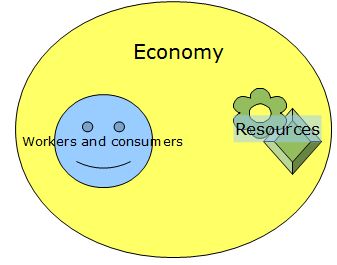
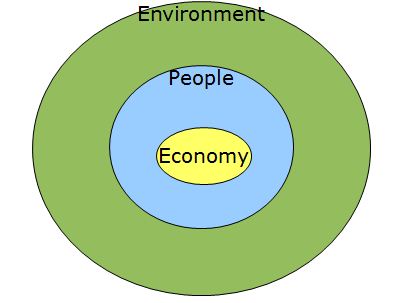
A major shift is required indeed, both in systems and mentalities…
Sustainable Economies
It is not new. In 1973, E. F. Shumacher published Small Is Beautiful: Economics As If People Mattered which promoted the use of local and appropriate technology to empower the people in a world hit by the energy crisis and globalisation. The ideas are developped today by the New Economist Institute and its large network.
The concept of sufficient economy was supported by the King of Thailand and based on buddhist ideas, with three key principles: moderation, wisdom and built-in resilience. It has been developped in the Thailand Human Development Report published in 1997 and adopted in the 10th National Development Plan as summarised below:
Here is an interesting article on “rethinking growth”, an interview of Herman Daly, ecological economist, published on Seed Magazine http://seedmagazine.com/content/article/rethinking_growth/
For the people, it is important to become active consumers. Do you really need to buy it? Choose where you spend your money wisely. Easy no? Concepts of frugality, simple living, intentional living, permaculture, the slow movement, alternative economics (and more – please suggest! ) are all different ways to deal with a common goal of moving out of the capitalism crisis.
Sustainable Practice in business is about finding innovative out-of-the-square-thinking ways of curving the line into a circle.
The line is: Take resources -> transform them into a product -> sell them -> products are used and dumped in landfill.
The circle is: take recycled resources -> process them with least waste -> use them -> recycle them
The example I preferred -so far- is Interfaceflor : from traditionnal carpet laying that goes to landfills in 10 years, they committed to Zero waste. Not only they choose non toxic materials, but they’ve arranged a way to separate materials after use so that they can be reshaped in new carpet. They lay squares of carpet so that used parts (entrance and ways) can be swaped with less used parts (corners) easily. Furthermore they found a way of recycling all their carpet: they ensure its maintenance overtime. Quite smart!
I believe taking sustainability seriously is a wonderful opportunity to create economic and social systems that work in the long term for everyone and within the natural environment. It does not mean revolution. It does not mean “go back to the candle” as sceptics say. And it does not mean recession, as many fear. If we are to cover all basics needs for our growing worldwide population, there is huge scope for growth, which does not have to be destructive. We need to be aware, smart and innovative, and share… A big shift indeed!
Knowledge, technology and tools exist and are taught in the Graduate diploma for Sustainable practice at Otago Polytech. I am studying towards it because I want to contribute to the shift.
Florence Micoud


