Regenerative Livestyle Blog


1 Comment

Urban Gardening

Why gardening ?

Because it is one of the solutions to:

  • the population problem (people feeding themselves),
  • the carbon footprint problem (no food kilometres),
  • the affordability of food (seeds and seedlings are cheaper than food, then can be harvested for the next year, or swapped…)

Because it contributes to:

  • community strenghtening (gardening together, intergenerations, between neighbours)
  • better health (fresh -full of vitamins, no pesticides residues, physical activity)
  • connecting to the Earth and its natural cycles
  • relax people, provides pleasure and satisfaction therefore taking care of the gardener too!

Because it tastes good, it looks nice, it is enjoyable, rewarding and nearly free!

Where?

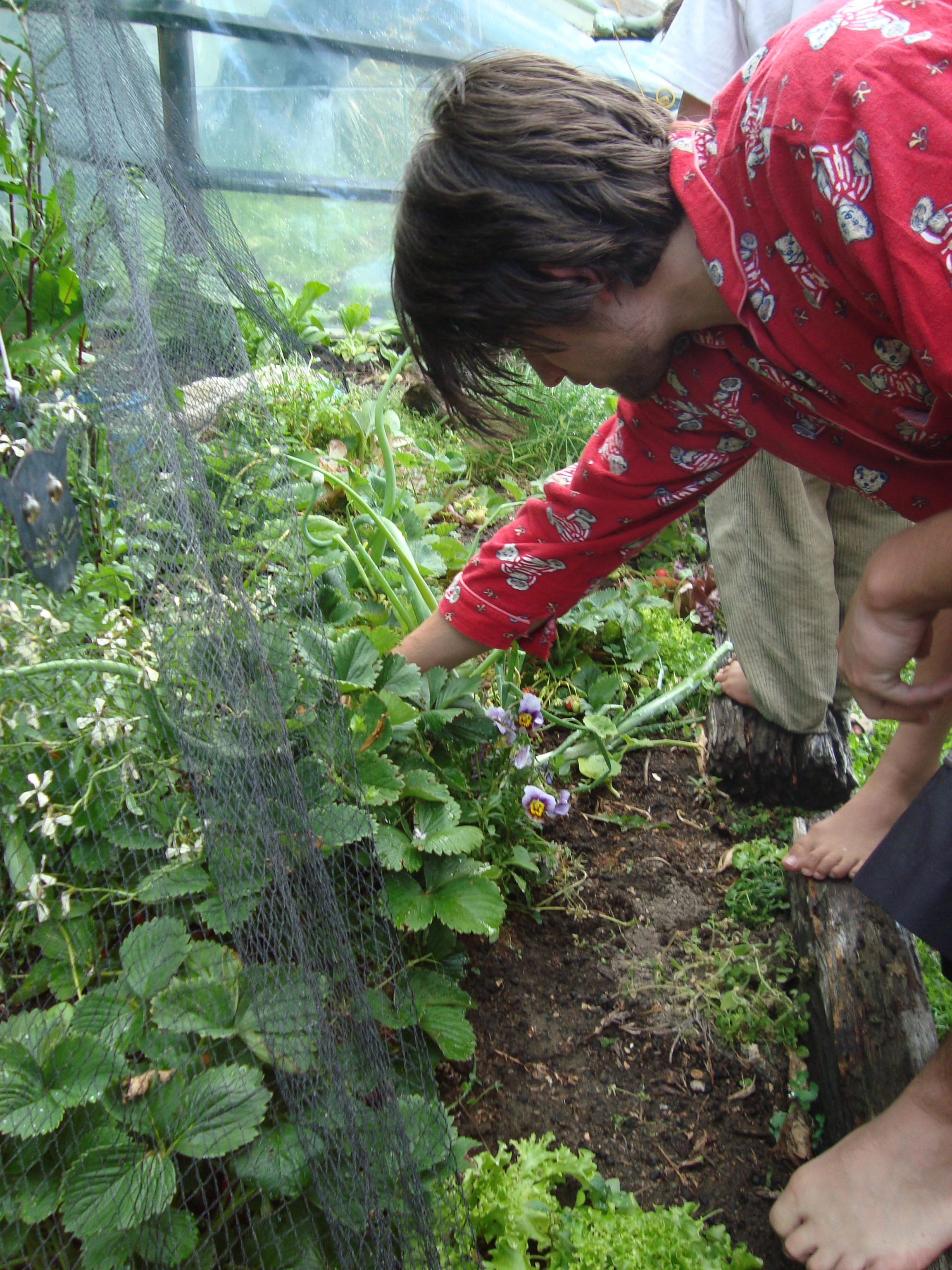
When owning a land, even small, it is easy to transform parts of it in vege patches, starting small, enriching the soil over the years with homemade compost.

Even when renting, most owners will allow the tenants to create raise-beds and are often happy for patches to be dug, as long as the land is restored when leaving, which is easy to do (just flatten it and saw lawn seeds). It is however more expensive as usually shorter term than above, compost usually have to be added initially and the improvement of the soil is left behind.

People living in a flat can grow on their balconies and windows… and roofs. They can advocate the creation of gardens on the shared property, in place of concreted yards or useless lawns. They can also look for some land they could use, perhaps in exchange of some work on the rest of the property. Many cities have available land that is used for gardening, family gardens or collective gardens or community gardens… Here is a list of New Zealand community gardens. If there aren’t any in your town, get some interested persons together and ask the local council for it.

If all fails, you can always start guerilla gardening, which consists in sowing and planting in public places without authorisation, even practising seed bombing. Very Naughty!

How?

– Start small, get some books from the library (Dewey 632) or buy from http://www.organicnz.org/bookclub/ or http://www.touchwoodbooks.co.nz/Home.htm

– Do not use any chemical fertiliser nor pesticides, although you will be told it is good for your plants, even compulsory! Or you will be deceived by “natural” labels. In fact, unless it shows the Biogro label, it is not organic. So how do you take care for your plants? Compost, green manure, companion planting, crop rotation, compost, mulch, choice of local varieties, soil preparation, comfrey, nasturtium, biodiversity, observation, patience, experience and compost are some of your key-words. Did I mention compost?!

– Talk “gardening” around you. You might be surprised how many people love gardening, and have seedlings and advice to give away.

Here in Upper-Clutha…

There is no community garden… yet. It is true that we are lucky in our town, as most people do have a little patch of land around the house where to grow some veges, and many people do. It is still time to start now, if you have not yet.

There is an Upper Clutha Herb Society whose focus is on Herbs rather than veges.

Free Compost workshops are happening soon (22nd Oct 2011 and 12th Nov, 9.30-12-30, at Wanaka Wastebusters) and there is a Bio-dynamic workshops series starting 30th October.

From Green Drinks, a small group is meeting quite regularly to visit each others garden and share seedlings and knowledge.

More is probably coming, with tomorrow a forum about the Future of Food and a growing interest and need for it.


Leave a comment

Pakeha perspective

Tena koutou e nga kaipanui haere mai nei ki tenei kupu ki te whiriwhiri i maori matauranga ratou ko kauneke tawhiro.

Ko Alps toku maunga
Ko Fure toku awa
Ko Boeing whitu wha whitu toku waka!
No Dauphine no France oku tupuna
Ko Gaulois toku iwi
No Wanaka ahau
Ko Florence toku ingoa.

 Greetings to you, readers, welcome to this letter that discusses maori culture and sustainability.

The Alps are my mountains
The Fure is my river
I arrived in New Zealand in Boeing 747
My ancestors are from Dauphine in France
My tribe is the Gauls.
I live in Wanaka and my name is Florence.

I chose to live in New Zealand with my family for its pristine landscapes and the warmth and welcoming of its people, which we experienced when we visited in 1998-99. We felt it was possible here to live a grassroot connected life, unlike in crowded and nuclearised France.

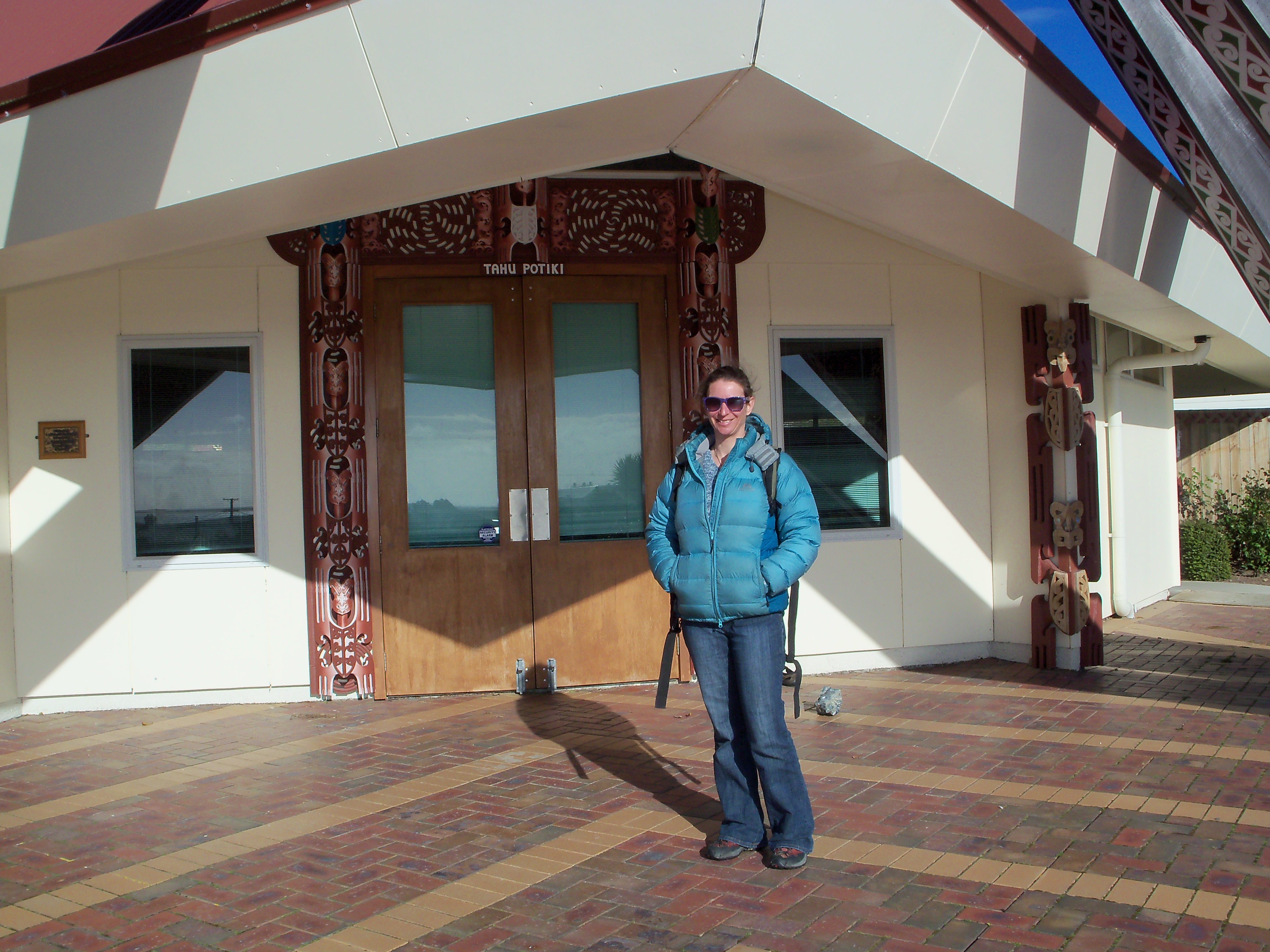
I can’t love a country and not its people. Therefore interested in Maori people and culture, I was fascinated by the unique case in colonisation history of “equality” between natives and colons, as signed in 1848 in the Treaty of Waitangi. I read lots of books about maori myths and legends, maori lore, history and tahunga. I joined and enjoyed a waiata a ringaringa local group and recently passed a certificate in Te Ara Reo Maori level 2, at Te Wananga o Aotearoa, where our great Tutor taught us maori perspective, so intricated in the language. I came to understand that the assets I initially admired in this country were linked to the Maori presence.

We became New Zealander in 2008. Pakehas. Proud to be. Pakeha is the word Maori gave to the first “fair-skinned” visitors. Pakeha is a word gifted by the Maori to the people who came to live here. It is a recognition that we are part of this land too. That we belong.

Caring for the land

Belonging to the land is a central notion for many indigenous people. Whanaungatanga. People do not possess the land but belong to it. Fundamental difference. It feels good to belong. It means I need to respect and take care of the place. Not to use it, consume it, exploit it… It is linked to the protection and conservation of resources. Kaitiakitanga. Hence the vast protected landscapes and forests. Tane-Mahuta, the first son, guardian of the forests, is still very strong. We can learn a lot from the maori knowledge and perception of the environment.

Caring for the people

Hospitality and welcoming also derive from Maori culture and has warmly diffused the whole country. Manaakitanga was Maori Language week theme this year and is widely acknowledged by tourists of the Rugby World Cup.

Maori have coded social structures, which I was lucky to experience on a marae. Communication skills korero, shared decision making, connectedness and support, transmission of knowledge and values, cooperation and participation, sense of belonging -again, are all essential skills to build a sustainable society.

New Zealanders welcoming habits, community sense and cool-she’ll-be-allright-attitude has much to do with maori culture and has changed the anglo-saxon immigrant into a Pakeha, a blessed citizen of Aotearoa.

Holistic approach

Most importantly, Maori have an holistic approach as they “never separate the sea from the land and the land from the air.”
Interestingly, the sustainability pages of Landcare Research are bathed in Maori culture. Not only sustainability could not be achieved in New Zealand without a deep inclusiveness of all people of New Zealand. But also Maori people behold the sustainability principles deeply and therefore mātauranga Māori is naturally at the core of landcare research sustainability.

All over the world, indigenous people have a great connection with living systems, as poetically detailed in the famous -if not authentic- Chief Seattle Speech. While humans deconnect from nature to live the “modern life”, understanding and respect of natural cycles also decrease. It is urgent to reverse the decline of the state of the environment by reconnecting with the world thanks to indigenous values.

Titi story

While on the marae in Bluff, we were offered muttonbird stories (also some to eat, yum). I was amazed to hear that birds numbers actually increase when the island is well looked after, following knowledge transmitted from generations. Not only they know when and how many birds they can catch to get the best harvests over the years. But also, muttonbirders restore nests and look after the trees the birds need to take off. That is sustainable management of the land, guardianship.

To thank our hosts on the Marae, we created a song. Like the muttonbirds who take off to migrate towards unknown lands, we have to listen to our destiny, open our minds to change, open our wings to fly into the unknown, and all this is possible thanks to the great nurture provided by the marae.

“Maori principles can help us deepen our appreciation of the environment, sound social structures and a connective view of sustainability”, as summarised in the Maori Perspective leaflet published on the Outlookforsomeday Sustainability Film challenge for young people website.

Tena koutou, tena koutou katoa.

Florence

—————————————–

Maori language resources

Learning a language is directly connected with learning a culture, because the way people express their ideas reflect their way of understanding the world. Knowing a culture is respecting and embracing it. Maori language is now widely taught in pre- and primary schools. There are 800 and a growing number of kohanga reo schools (maori language) and 3 maori tertiary education institutes. Give it a Go!

http://www.maorilanguage.net/
http://www.maorilanguage.info/
http://www.korero.maori.nz/
http://kupu.maori.nz/ One Maori word a day and much more
http://www.tetaurawhiri.govt.nz/ Maori Language commission

More Maori resources

Maori culture is becoming a strong and integrated part of New Zealand, thanks to great leaders (Apirana Ngata, Dame Whina Cooper), thanks to the Treaty of Waitangi, thanks to many Maori and Pakeha who know if they do not strenghten this culture, nobody will… And increasingly both Maori and Pakeha realise they enrich each other, and learn to live respectfully with each other … And all are proud of the Haka ;) New Zealand is one of the few countries worldwide who managed to maintain indigenous identity in a diverse society.

http://www.teara.govt.nz/en/maori Te Ara Encyclopedia of NZ about Maori history and culture
http://www.waitangi-tribunal.govt.nz/ deals with maori claims.
http://www.maoritelevision.com/Default.aspx


Leave a comment

Funnel vision!

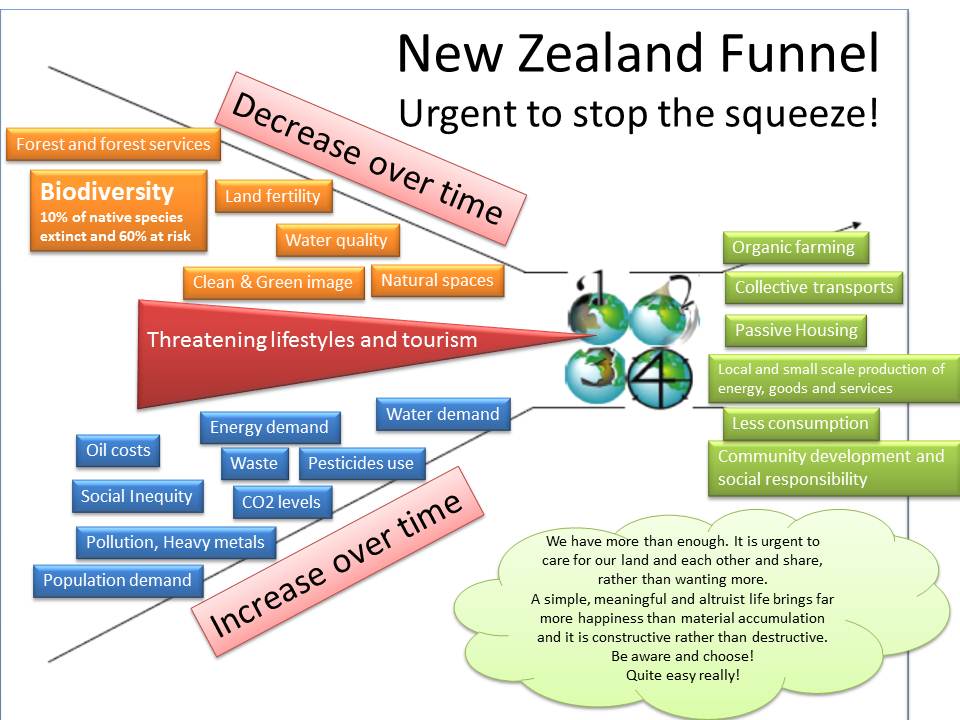
A funnel is a metaphore used by The Natural Step to illustrate the sustainability challenge. What is increasing over time? What is decreasing over time? Visualise how this squeeze is getting critical! What can be done to reverse the trends and possibly improve the situation?

Following the 4 Sustainability principles, symbolised by the 4 Earth icons, will create a sustainable situation.

Here is a video created by Whistler municipality,  that explains the funnel in 2 minutes.

I have “played” at creating funnels.

New Zealand funnel

Click to enlarge

I was amazed at how this tool make complex and interconnected issues look easy to solve.

Tourism funnel

One of my assignment is a sustainability study for a local guiding business. Here is a funnel that can be adapted to many tourism activities.

Click on the picture to enlarge

Libraries funnel

Well yes, I am librarian. Although it is not quite a sustainability subject, I gave the funnel metaphor a go with libraries squeeze. As you may be aware, many libraries are being closed in the US and in the UK. Libraries are threatened nearly everywhere, and are generally affected by budget reduction. It is all too common to hear that libraries (and books) are not useful anymore, as there is so much on the Internet nowadays.

Click to enlarge

Here again, solutions are quite obvious when the problems are laid in the funnel metaphor. Opportunities naturally arise from it.

For example, e-books are not a threat but the solution to cover customers needs with new books. They all want to read the same book at the same time? They can and the librarian does not have to purchase several copies that will clutter the shelves when the fashion is finished.

A lot of information is on the Internet? Good! Librarians do not need to buy every book on every subject in the world and will still be able to provide information about any query.

Transforming a library into a community place is a success criteria for libraries. People come for a variety of reasons and are exposed to a variety of experiences and knowledge (including reading).

Dematerialisation is quite visible, less books vs more access. It is also about replacing a product (book) by a service (advice on how to find the information). It is interesting to note that applying a sustainable practice tool to a different subject leads to solutions common in sustainable practice: dematerialisation and “service rather than product”.

From the tunnel vision metaphor to the funnel vision!

Try it with any issues that look like an unsolvable problem… and please share your experience below…


1 Comment

Footprinting…

I have just learned  that New Zealanders would need more than 4 planets if their lifestyle was experienced by all the people on Earth. Another way of saying it is that an average New Zealander lives on 7.7 hectares whereas it is estimated that there are only 1.8 “bioproductive” hectare per person.

I had a look on www.footprintnetwork.org to compare country trends…  The data is given on graphs in Global Hectares per Capita (GHC), between the 1960’s and 2005-2007 depending on the countries. It also shows the “biocapacity”. The data is a few years old, unfortunately.

NZ: 5 Global Hectares per capita in 2006
France: 5 GHC in 2006 (increase since the 60’s)
US : 8 GHC since 1980
China: 2 GHC (has rocketed since 2003)
Danemark: 8.5 GHC ! Champions!
Afghanistan: 0.5 GHC ! Real champions!
Japan : 4.5 GHC
Sweden : 6 GHC
Poor countries GHC varies between 1 and 2.

World average: One and a half planet in 2007.

Recent studies are greatly needed, because the trend has not globally improved since 2007 …

Hence the great value of Ella Lawton’s project: it is a 3-year programme to measure footprints related to built settlement types, then establish a vision of the theoretical ideal scale and form of built settlement, then put it in practice in rural and urban environment, and eventually enlarge and empower the rest of the country and beyond…

There are other initiatives in the world based on ecological footprint, like the One Planet Sutton, Foot Prints Wales but if you google “footprint US”, you find … a company that sells shoes, of course!

Environmental footprint is a great awareness tool

So I tried…

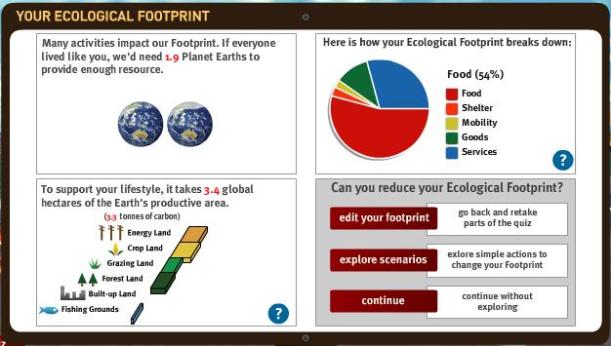
The footprint network quiz is interactive and easy to do. It concludes I use 1.9 planet and 3.4 bioproductive hectares! OMG!

I pledged to halve my meat consumption, to reach 1.6 planets and the only way I can yet improve to 1.5 is to pledge to buy less packaging, which “I do”.
It does not make a difference with this quiz if I travel to Europe every 4 years instead of 3.

It is well under the New Zealand average but far too much!

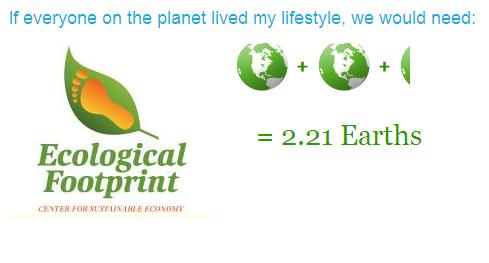
Worse! The Ecological Footprint Quiz by the Center of Sustainable Economy says that I need 2.21 Earths!

Oh, No!

I am reassured by the fact that questions are quite general and do not consider the fact that we have nearly no electrical appliances, for example.

So I tried more detailed calculators, and for them, I need my electricity bills, my vehicule logs, and bank account statements…

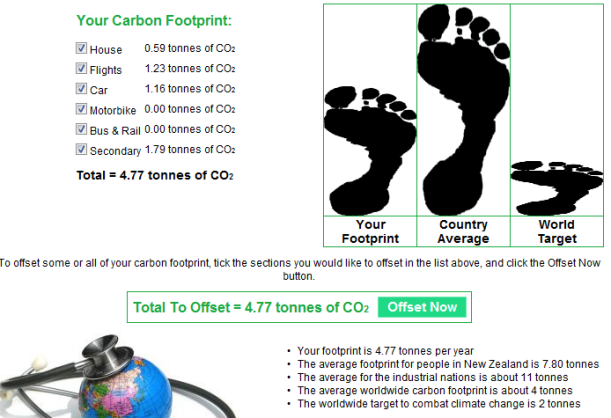
Here is the Carbon Footprint calculator result:

Although half the NZ average, I still feel I need to improve a lot. I “played” around with the questions. I would need to halve my electricity consumption ( which would be quite hard), fly only as far as Sydney, buy only local food (and no meat)  and get rid of my car to reach the world target. I am not there yet but I know what my goal is…

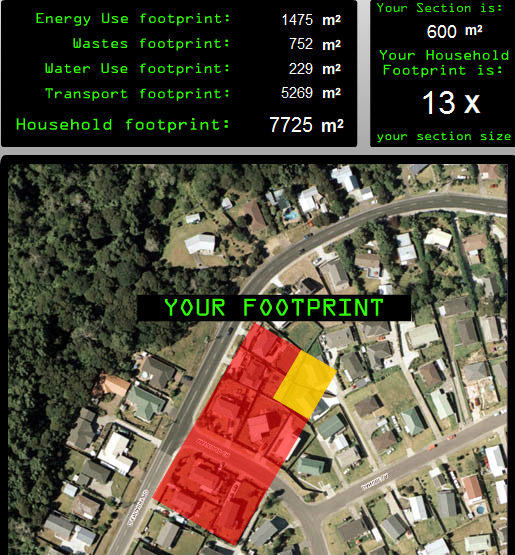
WA$TED is a NZ clever TV programme and book and website with a comprehensive household footprint calculator specifically designed for NZ. I am somewhat reassured, because it enables me to enter the exact number of lights and appliances etc, which are quite low and therefore I end up with a 3/4 hectare footprint. There is no international travel in this calculator so I would need to add about 1 ton of CO2 for travelling to France every 3 years, that is about 1 hectare and I am just within the available land for me. Just! This seems too light compared with other results.

I am not sure how CO2 tons convert in global hectares. The Ecological Footprint Standards 2009 from the footprint network says “A2.3 The assessment calculates the Footprint of carbon dioxide emissions (e.g., converts tonnes of carbon dioxide into global hectares) using the same methods as the National Footprint Accounts” but I was unable to find it. From various sources on the Internet, I estimated that 1 ton of CO2 is roughly equivalent to 1 hectare. In average, 1 hectare would be able to absorb about a ton of CO2 per year. This needs further research. Would my teacher know?

The most serious is the New Zealand Business Council for Sustainable Development emissions online calculator . It finds that I create 4.5 CO2 tons per year, which is fairly consistent with other results.

It slowly kicks in that although I thought my household was quite sustainable, it is actually twice bigger than what our Earth can make and take and therefore I MUST halve my own footprint. I should have done only the Wa$ted test and I would have felt quite content!

So now HOW do we reduce our carbon footprint?

The Centre for Sustainable Economy advises how to reduce our eco footprint. I feel I do a lot of this already…

In June 2011, an article in the Guardian explains HOW a household can greatly reduce its footprint. Seems easy.

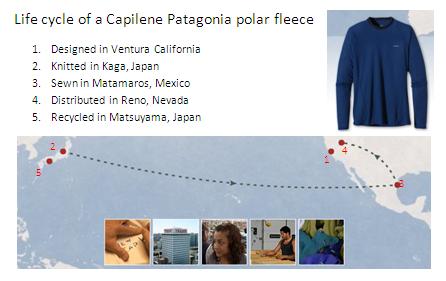
It is actually quite complex. Patagonia has designed an interactive tool to visualise the travels of several products. They are accompanied by interesting videos. For example this Capilene path:

It is amazing to see how many kilometers (therefore carbon) a simple jumper encapsulate, even one that is made by a company that cares. It just give a glimpse of what we need to think about when buying.


Leave a comment

Why go sustainable?

I watched this youtube from TED conference by Simon Sinek: “Start with Why: How Great Leaders Inspire Action”.
He explains that companies are successful at selling products when they advertise why they do them. People will buy a product because of why it is done. Decision making is done from the heart, from the belief. Companies who just say what they do, or how they do it do not get as much success.

Simon says… it is the same with ideas…
I thought I’d try to apply it to sustainability…

What?

So what is the problem? What is sustainability? A huge number of studies have gathered data measuring the ampleness of the issues, and created estimations and recommendations. They are essential for governments and international organisation to decide for actions.

Here are some excellent studies with compelling results. We cannot say that we do not know… But you need time to read!

Living Beyond Our Means from the Millenium Ecosystem Assessment website is a summary of the Millenium Ecosystem Assessement, a 3000 pages document, created by 1360 experts from 95 countries, reviewed by more than 2500 experts from 185 countries. Check out the 107 slides
presentation http://www.maweb.org/documents/document.752.aspx.ppt or my summary of the summary here.

– The Stern Review – The Economics of Climate Change  calculates that climate change will reduce global per-capita consumption of around 20% over the next 2 centuries, in the current trends. However, mitigating the impacts of climate change would only cost around 1% of annual global GDP by 2050 for a weak stabilisation of 550ppm Co2e. Policies to reduce emissions include carbon pricing, technology policy and removal to behavioural change.

– Check out the comprehensive IPCC website. For example the Report on Renewable Energy Sources and Climate Change Mitigation  or the latest assessment report summary (2007).

– For New Zealand, here is the “Climate Change Effects and Impacts Assessment: A Guidance Manual for Local Government in New Zealand

These are all very interesting researches that all prompt for urgent collective action, while giving governments and decisions-makers clues on how to do it best. Whether they decide to go for it or not is so far political.

But for many people anyway, although striking and obvious, these graphs and facts are boring and not engaging. The required actions seem beyond their means, whereas they actually have the political choice in their voting card…

Some people even deny that there is a link between climate change and extreme weather, but that won’t last!

How?

How can we become more sustainable?

It is important to give information (ex: how-to-do a garden), and to show examples of successful sustainable actions. But there are so many sources of information and so many topics that I do not attempt a list here. Giving tips on how to cut energy bills or recycle does help, but people may be overwhelmed by the number of things to know and do. They may not see connexions between seemingly different subjects. They will do it, then forget it. They miss the big picture. They need to know why…

Why?

So why go sustainable?

Why do I study sustainability? Why do I choose to buy local or fair trade, to bike or walk when I can, to make my own hand-made organic flour bread, to use eco-bulbs, to plant trees, to bring my old clothes to the recycling centre where I get not-so-old ones, to grow a pesticide-free vege garden, to live with a 6 years-old mobile phone, and so on…
Because I believe I can help changing the world in doing my part. I am convinced we can manage to curb these horrific Green House Gas curves (and others)  that threaten to over-heat our planet, if we all do our bit. I believe one day, all humans will be aware and respect the cycles of the nature we are within.

I also believe that the climate change is actually an opportunity for our human specie to grasp our problems as a whole and solve them altogether, from poverty and disparity, to pollutions and ecosystems destructions. Idealist? Yes, I am, because I trust humans. Each human trusts himself, why couldn’t I trust each human?

Therefore I am working towards raising this awareness, as well as spreading the information on the many solutions that do exist.

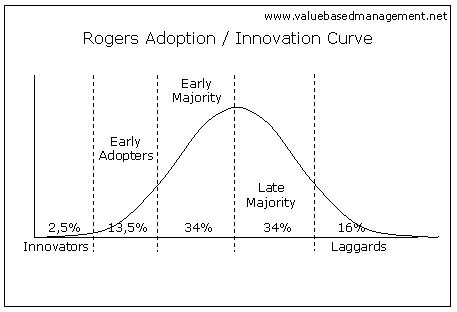
I know people will not all embark on the sustainability track now. As for products, ideas have an “adoption cycle”. I am humbly an innovator, carving this path for 25 years, despite mockery and derision. I think we are in New Zealand in the early “Early Adopters” phase. I believe this is the decade when we can make a change, and I am not alone. I study sustainability because I want to do professionally what I have been practising at home for long. The more I study, the more I realise we can make it.

Now, one of the most compelling action-prompting Youtube I’ve seen is “The most terrifying video” or the global climate change matrix where Greg Craven brilliantly shows that choosing to take no action is choosing Death! Boy, that is a pretty convincing reason why to go sustainable!

I have a vision of a happy, healthy, sharing era in a sustainable world. I do believe that a majority of people will soon realise that we are better off cooperating with each other and learning to use our resources wisely. Now is a good time  to shift your mindset and adopt the sustainability “innovation”.

“I have a dream” we will get there!

Does this post inspire action?


Leave a comment

Changing of perspective…

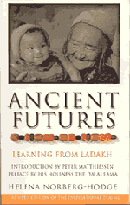
I have enjoyed reading the ”Future of Progress”, by Helena Norberg-Hodge which gives a totally different perspective on the world economic issues. This chapter is part of “The Future of Progress: Reflections on environment and development”, by Edward Goldsmith, Vandana Shiva, Sigmund Kvaloy, Martin Khor, Nicholas Hildyard, Gary Snyder and Helena Norberg-Hodge, a book which was the result of an international conference on environment and development organised near Stockholm by the International Society for Ecology and Culture and Friends of the Earth – Sweden, in 1995. It was made into a video which script can be read here.

The chapter demonstrates the impossibility and indesirability of economic growth in “South” countries.
Drawing a parallel between the crisis in the South (poverty, environmental degradation, ethnic friction, overpopulation and debt) and the crisis in the North (resource depletion, pollution, unemployment, and social breakdown), it argues that the economic growth is the cause of the problem and in no way a solution.
The solutions to both crises are on the one hand, strategies that counter destructive trends linked to the “techno-economic” model, and on the other hand, strategies that foster positive alternatives including:

  • Small-scale and local initiatives;
  • Appropriate technology: solar and small scale water power;
  • Education that integrates connections rather than narrow over-specialised learning; and
  • Synthetising traditional and post-industrial values, reviving traditions of cooperation, wisdom and local culture.

Simple and well demonstrated.

I am a long term “fan” of Helena as I met her in Terre Vivante in France when I was working there and had considered translating her book “Ancient futures”. Helena’s first book vividly describes the culture of one of the world most remote and harsh place of the world and how the 70’s development policies systematically destructured it.

Helena visited Ladakh in the 70’s and mastered the language. She became an international voice of Ladakhi people and by extension all traditional people of the world, revitalizing cultures and diversity, and promoting local communities worldwide.

I have also read “From the Ground Up: Rethinking Industrial Agriculture”, by Helena, Helena Norberg-Hodge, Peter Goering and John Page which analyses the roots of the environmental, social and economic crises facing modern industrial agriculture, while reviewing more sustainable options.
My partner and I tramped through the Zanskar valley in Ladakh in 1991 and we saw how people were happy and sharing whereas they had “nothing”. We witnessed how local people could cultivate this impossible landscape only with a local fine-tuned knowledge of cultivation. We listened to the stories of older children going to the town for school and leaving a gap of workforce while missing their traditional learning, which made them unable to come back living on the land…


Helena has since created a documentary “The Economics of Happiness” which she presents at TED and which I just bought to view and share. I’ll summarise it as soon as I see it.
I am very pleased she managed to create a world-wide awareness. It is great she managed to harness the power of social media for her quest.

All these resources can be purchased from http://www.localfutures.org/isec-online-shop


Leave a comment

Population popuLATION POPULATION

I invite you to read my  Population & Sustainability essay in PDF format.

I hope you will find it interesting. Feel free to leave comments below. Thank you.

 (Click here if you need to get Adobe reader to open the PDF)

Reflections…

While writing it, I have learnt that I need to choose a more precise subject for my learning journal entries. Such a LARGE subject as “Population and sustainability” required more than 30 hours work, and nearly a month to complete, while it is only a tiny part of my studies.

I had to revise my statistics. I enjoyed playing with the abundant data on the UN site and creating meaningful graphs. I had not been manipulating large numbers for a long time and it does stretch the mind !

I was keen to dig in depth of the subject and not only collate information but also to find connections and critically analyse what I read, to create an innovative interpretation on the subject.

In fact, the subject was disturbing to me because I did not quite comprehend it. It was like a needle  in my political point of views. I was amazed at my findings and even surprised I could actually conclude that the population issue is an opportunity!

When writing, the trickiest was to find appropriate words to name “rich” countries and “poor” countries. Helena Nobert-Hodge uses North and South but this does not apply well from a New Zealand perspective. Developed/developing is so biaised and wrong, I don’t like it but I did use it. Third World does not apply now that the bi-polar USA/USSR situation has disappeared. “Industrialised” does not mean rich… Over-consuming / surviving ? Nah! Capitalist or Occidental world or G10 perhaps  / then what are the other countries? Well there is not really such a divide but a whole range, so I have tried to name the countries, rather than making generalities.

Thank you, Alexis, for pre-reading and questioning as well as looking after the family while I study.


1 Comment

Economy & Sustainability

With an initial education in economics, I have a interest in the links between sustainability and economics. As well understood and skillfully demonstrated in the “Story of Stuff“,  consumer society is unsustainable.

Capitalism and the environment

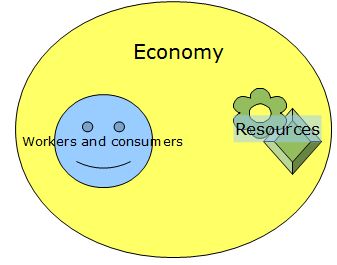
Why don’t we stop over-consuming then? Because consumerism is intrinsec to the predominent economic system, capitalism. Here is how it works.

Capitalism is driven by profit. Profit is the difference between the market price a good (or service) is sold and the price needed to make the good (or service). The price to make a product (or service) comes from its raw materials and its work force, part of the machines and the processes needed to create it.

In agriculture, a fertile land will have high yields, with low production costs and create lots of produce. When demand for the produce grows, farming need to occur in less fertile lands, the work is harder to obtain the produce. The market price will rise so that this farmer can survive. Yet, for the fertile land farmer, the costs remain the same. Here are his profits. When the land fertility decreases, so do the profits.

In manufacturing, the costs can be lowered by asking workers to work harder and pay them minimally. Of course this is limited to the survival of the workers and social unrest. Many strategies have been developped to keep this to a minimum. From offering workers house and food near the plant so that they work longer hours, to make them happy enough with a brainwashing television, to delocalisation of course. With social awareness and movements this has become a limit so profits stagnate…

The other way to lower costs is to get the cheapest inputs. This is the whole colonisation business. Arrive with arms and declare it’s your country now and you can just take whatever resources you want for free. Over time, things have to be a little less obvious, hardly. But today there are rich and poor nations.

Nature has always been considered a reservoir of goods, the only cost of it is to extract it. Yet it is harder and harder to extract it, so again profits stagnate… Here also come the externalities issues, the process of not paying the whole cost of the products, for example by dumping waste in the air and rivers, or by letting the health system look after sick workers etc. These have been timorously regulated by governements in fear of delocalisation.

So we see how profits tend to decrease. To compensate for that, entrepreneurs need to find new ways of improving productivity (robotisation – inducing unemployment) and to invent new products (and sell them – consumption society). They need GROWTH. All is linked and inherent to the current economic system. And all in crisis…

From crisis to shift

OK – I did simplify but basically, that’s how it works.

While the coming of the crisis was visible way back in the 1960’s, we can understand the interest of keeping the consumerism system going by any mean to become richer. And in many ways, many people did become richer- which does not mean happier. But many people also became poorer, and the environment pays its tribute! The resources are finite, and the planet has natural boundaries, some of which are exceeded.

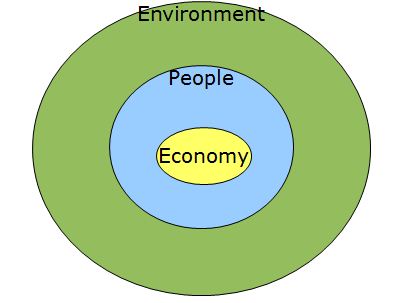
What we have…                  What we need….


 A major shift is required indeed, both in systems and mentalities…

Sustainable Economies

It is not new. In 1973, E. F. Shumacher published Small Is Beautiful: Economics As If People Mattered which promoted the use of local and appropriate technology to empower the people in a world hit by the energy crisis and globalisation. The ideas are developped today by the New Economist Institute and its large network.

The concept of sufficient economy was supported by the King of Thailand and based on buddhist ideas, with three key principles: moderation, wisdom and built-in resilience. It has been developped in the Thailand Human Development Report published in 1997 and  adopted in the 10th National Development Plan as summarised below:
 

Here is an interesting article on “rethinking growth”, an interview of Herman Daly, ecological economist, published on Seed Magazine http://seedmagazine.com/content/article/rethinking_growth/

For the people, it is important to become active consumers. Do you really need to buy it? Choose where you spend your money wisely. Easy no? Concepts of frugality, simple living, intentional living, permaculture, the slow movement, alternative economics (and more – please suggest! ) are all different ways to deal with a common goal of moving out of the capitalism crisis.

Sustainable Practice in business is about finding innovative out-of-the-square-thinking ways of curving the line into a circle.
The line is: Take resources -> transform them into a product -> sell them -> products are used and dumped in landfill.
The circle is: take recycled resources -> process them with least waste -> use them -> recycle them

The example I preferred -so far- is Interfaceflor : from traditionnal carpet laying that goes to landfills in 10 years, they committed to Zero waste. Not only they choose non toxic materials, but they’ve arranged a way to separate materials after use so that they can be reshaped in new carpet. They lay squares of carpet so that used parts (entrance and ways) can be swaped with less used parts (corners) easily. Furthermore they found a way of recycling all their carpet: they ensure its maintenance overtime. Quite smart!

 I believe taking sustainability seriously is a wonderful opportunity to create economic and social systems that work in the long term for everyone and within the natural environment. It does not mean revolution. It does not mean “go back to the candle” as sceptics say. And it does not mean recession, as many fear. If we are to cover all basics needs for our growing worldwide population, there is huge scope for growth, which does not have to be destructive. We need to be aware, smart and innovative, and share… A big shift indeed! 

Knowledge, technology and tools exist and are taught in the Graduate diploma for Sustainable practice at Otago Polytech. I am studying towards it because I want to contribute to the shift.

Florence Micoud


Leave a comment

Please stop aerial 1080 drops

We’ve just seen the DVD “Poisoning Paradise: Ecocide New Zealand”, by the Graf Boys www.thegrafboys.org

1080 pallets are dropped onto New Zealand bush by the Department of Conservation to kill possums, rats, stoats and other mammals who threaten our native birds. 1080 is a rodenticide and insecticide, and you will learn on the Pesticide info network, that it is definitely a nasty chemical with acute toxicity, it is a developmental or reproductive toxin, possibly carcinogenic and a likely hormone disruptor.

The documentary shows how 1080 baits kill birds as well as mammals. Of a horrible death, from some hours to two days of fits and convulsions… It kills insect and invertebrates. It kills fish and crayfish. It kills the animals who eat poisoned animals too. The food chain is polluted and the decomposers work stops. It ends up in native food, in our water, in cow’s milk. It may damage or kill us or our children.

I’ve understood that the 1080 programme was a trial but it keeps going without proper environmental toxicity study. I’ve understood there are monetary interests: Tull Chemical Company in Alabama is making business and the helicopter companies that drop the thing probably too. Well, they could find other ways of making money.

It is not a new issue and many arguments from both sides can be found on the Internet and You Tube. Meanwhile, we still have possums, less and less birds and we still spread poison in NZ nature. We do not have a 1080 problem but a invasive species problem and we should raise the discussion to tackling the problem collectively.

There is enough evidence that it is dangerous so it must stop  as a precautionary measure. There are alternatives which do no harm, mainly ground based bait station, i.e. trapping. I personally add here that possums could be hunted for an income, or  could be gathered and returned to their original habitats where they are so rare, or pieces of bush land could be allocated to people who look after them, which includes controlling the possums. Plenty of other solutions…

Please help stop New Zealand poisoning.

Florence