Regenerative Livestyle Blog


Leave a comment

Localising food tour coming to Wanaka

Flower

While Wanaka transition town people were starting to meet regularly to try and set up a transition town framework,  we were contacted by the Localising Food Tour Aotearoa team who would be in our part of the country in 5 weeks.

So the meetings changed to organising the Local Food event and here it comes, from 5th to 9th December.

Here is the Localising Food Tour Schedule and here is the website for bookings and more information about the workshops, presentations and facilitators.

I hope it will launch a local movement for more local food production, both as individuals and as a community, to build on the Farmers’ market.


Leave a comment

Cooperatives and social entreprises

BAU: Business as Unusual!

If we are to avoid Business As Usual competition and profit spiraling against resources and people, we can choose to make business differently. The choices include but are not limited to social enterprise, trust, cooperative, industrial and provident society…

I have searched about the various forms of these structures from the Community Economic Development network, the Office for the Voluntary and Community Sector and the New Zealand Cooperative association, and overseas from Social Traders in Australia and various dedicated government websites in Europe.

Social entreprise

Social enterprises mix social and/or environmental aims with a commercial orientation. Peter Holbrook, CEO of Social Enterprise UK, at a meeting on Thursday 26 April 2012 in Wellington (hosted by the Department of Internal Affairs), shared how social enterprise models will let communities stay ahead of the curve and have a valuable role to play through providing innovative approaches. Latest CED Bulletin announces the imminent creation of a social enterprise network in NZ.

Sources: http://www.ocvs.govt.nz/work-programme/building-capacity/social-enterprise.html  and http://www.ced.org.nz/?p=2081

Cooperatives

A cooperative “means an autonomous association of persons united voluntarily to meet their common economic, social and cultural needs and aspirations through a jointly owned and democratically controlled enterprise”. ILO Definition

2012 is International Year of Cooperatives, “Cooperatives are a reminder to the international community that it is possible to pursue both economic viability and social responsibility. ” United Nations Secretary-General Ban Ki-moon

In 2002, ILO passed a recommendation for governments to promote and support cooperatives, creating a legal framework that enables them to thrive, rather than limiting them in the informal economy.

Governance Options

Cooperative

Industrial and provident society

Social Enterprise

Definition an autonomous association of persons united voluntarily to meet their common economic, social and cultural needs and aspirations through a jointly owned and democratically controlled enterprise An industrial and provident society is an entity of a minimum of 7 members and the secretary for carrying on any industry, business or trade authorised by its rules with the exclusion of banking.
Names ending in Society Limited
Social enterprises are organisations that: a. Are led by an economic, social, cultural, or environmental mission consistent with a public or community benefit; b. Trade to fulfil their mission1; c. Derive a substantial portion of their income from trade2; and d. Reinvest the majority of their profit/surplus in the fulfilment of their mission.
Purpose Mutual support for members or the promotion of a specific purpose or social benefit. Improve the conditions of living or the social well being of members or be for community benefit. economic, social, cultural, or environmental mission consistent with a public or community benefit;
Economic aspects Members contribute to the capital. At least part of that capital is usually the common property of the cooperative. Benefits go to : developing their cooperative, setting up reserves, benefiting members in proportion to their transactions supporting other activities as approved by the membership. Usually consist of the owners of small businesses who, while continuing to operate independently, become part of this larger entity for mutual benefit.
They work (industrial) and receive benefits (provident) from the society for their future wellbeing.
Operationalised as 50% or more for ventures that are more than five years from start-up, 25% or more for ventures that are three to five years from start-up, and demonstrable intention to trade for ventures that are less than two years from start-up.Trade (exchange of goods and service)s, including:·monetary, non-monetary and alternative currency transactions, where these are sustained activities of an enterprise; contractual sales to governments, where there has been an open tender process ; and·trade within member-based organisations, where membership is open and voluntary or where membership serves a traditionally marginalised social group
Values self-help, self-responsibility, democracy, equality, equity and solidarity; as well as ethical values of honesty, openness, social responsibility and caring for others; To be defined by society To be defined by enterprise
Principles voluntary and open membership; democratic member control; member economic participation; autonomy and independence; education, training and information; cooperation among cooperatives; and concern for community. To be defined by society To be defined by enterprise
Advantages Mutual bond between transacting shareholders Power to Issue shares with a nominal value; and manage shares to ensure continuous active membership of company
Strong supporting national and international framework
A society becomes a separate legal entity once incorporated; A society will have a common seal (no longer applicable to companies); A society can lease, rent, buy and sell property, borrow money and enter contracts in its own name, generally under its common seal. No member of the society can have personal rights or interest in any of the assets of the society; A society will continue as a separate entity even though its membership changes; and Members will not be personally liable for the debts, contracts or other obligations of the society. Range of naturally occuring ‘types’ that emerge from common approaches, ideals and social purposes. 1. Income generation – Many nonprofit organizations see social enterprise as a way to reduce their dependence on charitable donations and grants through commercial activity 2. Employment – Many people see employment or engagement of marginalised groups as the principle motivation for social enterprise. 3. Service delivery – Social enterprise has the capacity to create or retain services needed in communities.
Legal New Zealand Co-operative Companies Act 1996 Industrial and Provident Societies Act 1908
Sources http://nz.coop/http://www.ilo.org/ilolex/cgi-lex/convde.pl?R193http://www.cecop.coop/What-is-a-cooperative http://www.nz.coop/docs/0403_MED_co-operative-organisations.pdf http://www.socialtraders.com.au/
http://www.ocvs.govt.nz/work-programme/building-capacity/social-enterprise.html

Sources:


Leave a comment

Funnel vision!

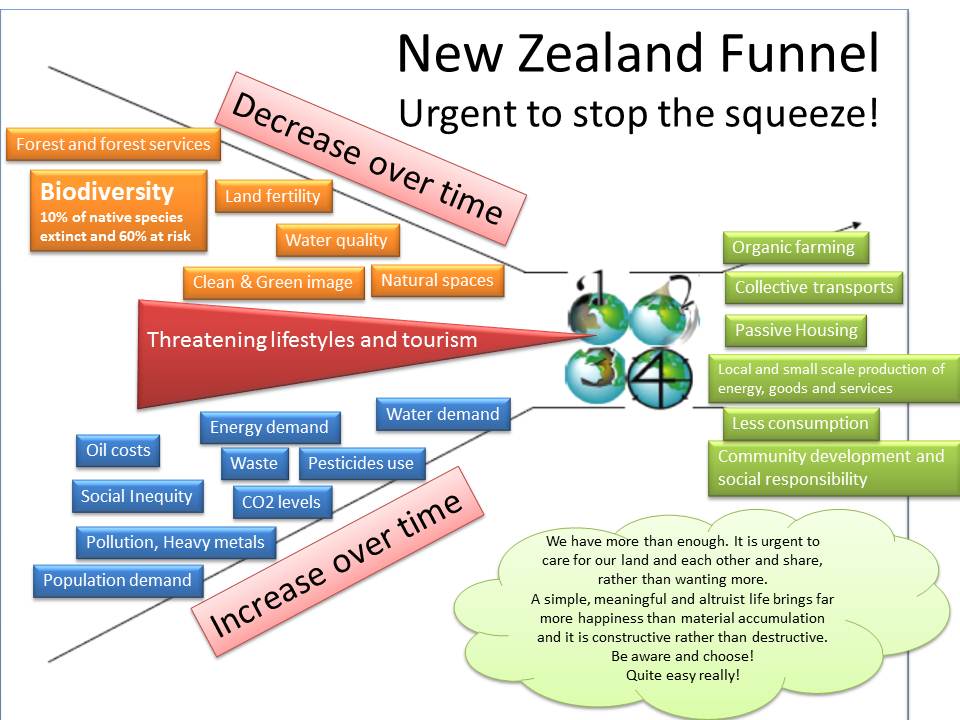
A funnel is a metaphore used by The Natural Step to illustrate the sustainability challenge. What is increasing over time? What is decreasing over time? Visualise how this squeeze is getting critical! What can be done to reverse the trends and possibly improve the situation?

Following the 4 Sustainability principles, symbolised by the 4 Earth icons, will create a sustainable situation.

Here is a video created by Whistler municipality,  that explains the funnel in 2 minutes.

I have “played” at creating funnels.

New Zealand funnel

Click to enlarge

I was amazed at how this tool make complex and interconnected issues look easy to solve.

Tourism funnel

One of my assignment is a sustainability study for a local guiding business. Here is a funnel that can be adapted to many tourism activities.

Click on the picture to enlarge

Libraries funnel

Well yes, I am librarian. Although it is not quite a sustainability subject, I gave the funnel metaphor a go with libraries squeeze. As you may be aware, many libraries are being closed in the US and in the UK. Libraries are threatened nearly everywhere, and are generally affected by budget reduction. It is all too common to hear that libraries (and books) are not useful anymore, as there is so much on the Internet nowadays.

Click to enlarge

Here again, solutions are quite obvious when the problems are laid in the funnel metaphor. Opportunities naturally arise from it.

For example, e-books are not a threat but the solution to cover customers needs with new books. They all want to read the same book at the same time? They can and the librarian does not have to purchase several copies that will clutter the shelves when the fashion is finished.

A lot of information is on the Internet? Good! Librarians do not need to buy every book on every subject in the world and will still be able to provide information about any query.

Transforming a library into a community place is a success criteria for libraries. People come for a variety of reasons and are exposed to a variety of experiences and knowledge (including reading).

Dematerialisation is quite visible, less books vs more access. It is also about replacing a product (book) by a service (advice on how to find the information). It is interesting to note that applying a sustainable practice tool to a different subject leads to solutions common in sustainable practice: dematerialisation and “service rather than product”.

From the tunnel vision metaphor to the funnel vision!

Try it with any issues that look like an unsolvable problem… and please share your experience below…


1 Comment

Footprinting…

I have just learned  that New Zealanders would need more than 4 planets if their lifestyle was experienced by all the people on Earth. Another way of saying it is that an average New Zealander lives on 7.7 hectares whereas it is estimated that there are only 1.8 “bioproductive” hectare per person.

I had a look on www.footprintnetwork.org to compare country trends…  The data is given on graphs in Global Hectares per Capita (GHC), between the 1960’s and 2005-2007 depending on the countries. It also shows the “biocapacity”. The data is a few years old, unfortunately.

NZ: 5 Global Hectares per capita in 2006
France: 5 GHC in 2006 (increase since the 60’s)
US : 8 GHC since 1980
China: 2 GHC (has rocketed since 2003)
Danemark: 8.5 GHC ! Champions!
Afghanistan: 0.5 GHC ! Real champions!
Japan : 4.5 GHC
Sweden : 6 GHC
Poor countries GHC varies between 1 and 2.

World average: One and a half planet in 2007.

Recent studies are greatly needed, because the trend has not globally improved since 2007 …

Hence the great value of Ella Lawton’s project: it is a 3-year programme to measure footprints related to built settlement types, then establish a vision of the theoretical ideal scale and form of built settlement, then put it in practice in rural and urban environment, and eventually enlarge and empower the rest of the country and beyond…

There are other initiatives in the world based on ecological footprint, like the One Planet Sutton, Foot Prints Wales but if you google “footprint US”, you find … a company that sells shoes, of course!

Environmental footprint is a great awareness tool

So I tried…

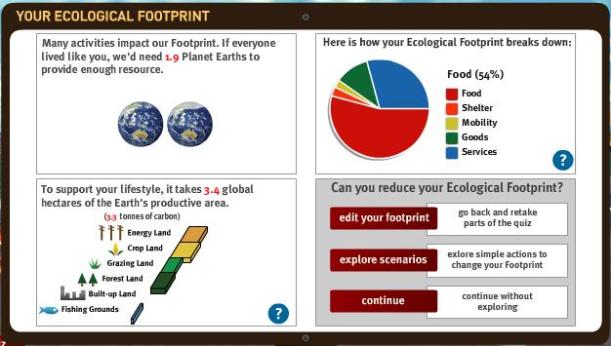
The footprint network quiz is interactive and easy to do. It concludes I use 1.9 planet and 3.4 bioproductive hectares! OMG!

I pledged to halve my meat consumption, to reach 1.6 planets and the only way I can yet improve to 1.5 is to pledge to buy less packaging, which “I do”.
It does not make a difference with this quiz if I travel to Europe every 4 years instead of 3.

It is well under the New Zealand average but far too much!

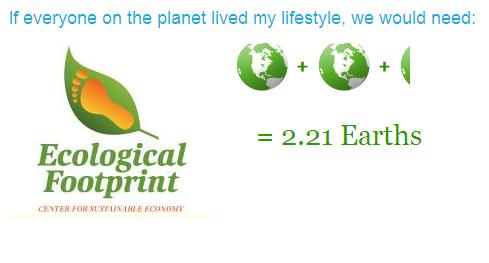
Worse! The Ecological Footprint Quiz by the Center of Sustainable Economy says that I need 2.21 Earths!

Oh, No!

I am reassured by the fact that questions are quite general and do not consider the fact that we have nearly no electrical appliances, for example.

So I tried more detailed calculators, and for them, I need my electricity bills, my vehicule logs, and bank account statements…

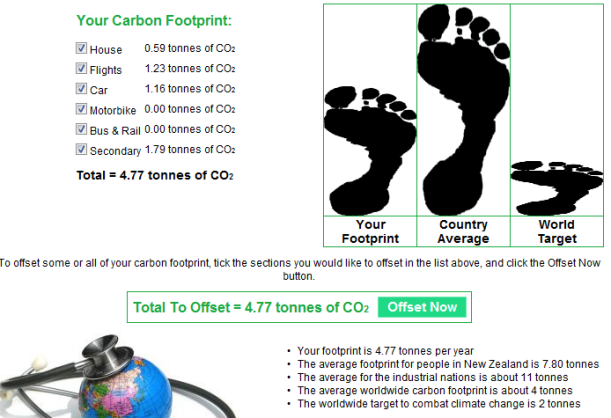
Here is the Carbon Footprint calculator result:

Although half the NZ average, I still feel I need to improve a lot. I “played” around with the questions. I would need to halve my electricity consumption ( which would be quite hard), fly only as far as Sydney, buy only local food (and no meat)  and get rid of my car to reach the world target. I am not there yet but I know what my goal is…

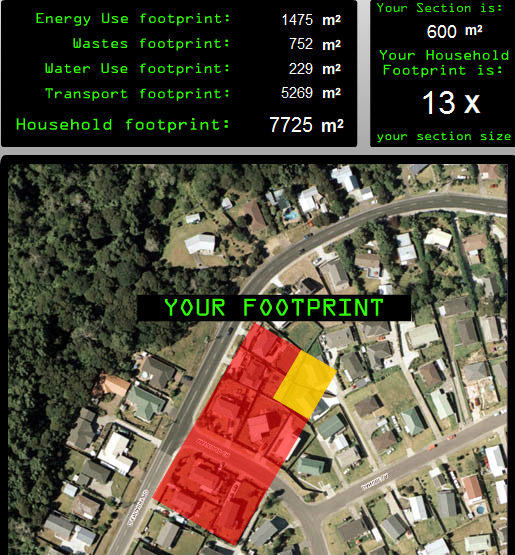
WA$TED is a NZ clever TV programme and book and website with a comprehensive household footprint calculator specifically designed for NZ. I am somewhat reassured, because it enables me to enter the exact number of lights and appliances etc, which are quite low and therefore I end up with a 3/4 hectare footprint. There is no international travel in this calculator so I would need to add about 1 ton of CO2 for travelling to France every 3 years, that is about 1 hectare and I am just within the available land for me. Just! This seems too light compared with other results.

I am not sure how CO2 tons convert in global hectares. The Ecological Footprint Standards 2009 from the footprint network says “A2.3 The assessment calculates the Footprint of carbon dioxide emissions (e.g., converts tonnes of carbon dioxide into global hectares) using the same methods as the National Footprint Accounts” but I was unable to find it. From various sources on the Internet, I estimated that 1 ton of CO2 is roughly equivalent to 1 hectare. In average, 1 hectare would be able to absorb about a ton of CO2 per year. This needs further research. Would my teacher know?

The most serious is the New Zealand Business Council for Sustainable Development emissions online calculator . It finds that I create 4.5 CO2 tons per year, which is fairly consistent with other results.

It slowly kicks in that although I thought my household was quite sustainable, it is actually twice bigger than what our Earth can make and take and therefore I MUST halve my own footprint. I should have done only the Wa$ted test and I would have felt quite content!

So now HOW do we reduce our carbon footprint?

The Centre for Sustainable Economy advises how to reduce our eco footprint. I feel I do a lot of this already…

In June 2011, an article in the Guardian explains HOW a household can greatly reduce its footprint. Seems easy.

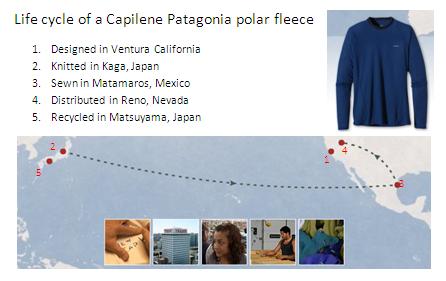
It is actually quite complex. Patagonia has designed an interactive tool to visualise the travels of several products. They are accompanied by interesting videos. For example this Capilene path:

It is amazing to see how many kilometers (therefore carbon) a simple jumper encapsulate, even one that is made by a company that cares. It just give a glimpse of what we need to think about when buying.


Leave a comment

Changing of perspective…

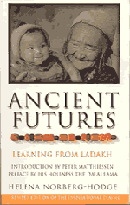
I have enjoyed reading the ”Future of Progress”, by Helena Norberg-Hodge which gives a totally different perspective on the world economic issues. This chapter is part of “The Future of Progress: Reflections on environment and development”, by Edward Goldsmith, Vandana Shiva, Sigmund Kvaloy, Martin Khor, Nicholas Hildyard, Gary Snyder and Helena Norberg-Hodge, a book which was the result of an international conference on environment and development organised near Stockholm by the International Society for Ecology and Culture and Friends of the Earth – Sweden, in 1995. It was made into a video which script can be read here.

The chapter demonstrates the impossibility and indesirability of economic growth in “South” countries.
Drawing a parallel between the crisis in the South (poverty, environmental degradation, ethnic friction, overpopulation and debt) and the crisis in the North (resource depletion, pollution, unemployment, and social breakdown), it argues that the economic growth is the cause of the problem and in no way a solution.
The solutions to both crises are on the one hand, strategies that counter destructive trends linked to the “techno-economic” model, and on the other hand, strategies that foster positive alternatives including:

  • Small-scale and local initiatives;
  • Appropriate technology: solar and small scale water power;
  • Education that integrates connections rather than narrow over-specialised learning; and
  • Synthetising traditional and post-industrial values, reviving traditions of cooperation, wisdom and local culture.

Simple and well demonstrated.

I am a long term “fan” of Helena as I met her in Terre Vivante in France when I was working there and had considered translating her book “Ancient futures”. Helena’s first book vividly describes the culture of one of the world most remote and harsh place of the world and how the 70’s development policies systematically destructured it.

Helena visited Ladakh in the 70’s and mastered the language. She became an international voice of Ladakhi people and by extension all traditional people of the world, revitalizing cultures and diversity, and promoting local communities worldwide.

I have also read “From the Ground Up: Rethinking Industrial Agriculture”, by Helena, Helena Norberg-Hodge, Peter Goering and John Page which analyses the roots of the environmental, social and economic crises facing modern industrial agriculture, while reviewing more sustainable options.
My partner and I tramped through the Zanskar valley in Ladakh in 1991 and we saw how people were happy and sharing whereas they had “nothing”. We witnessed how local people could cultivate this impossible landscape only with a local fine-tuned knowledge of cultivation. We listened to the stories of older children going to the town for school and leaving a gap of workforce while missing their traditional learning, which made them unable to come back living on the land…


Helena has since created a documentary “The Economics of Happiness” which she presents at TED and which I just bought to view and share. I’ll summarise it as soon as I see it.
I am very pleased she managed to create a world-wide awareness. It is great she managed to harness the power of social media for her quest.

All these resources can be purchased from http://www.localfutures.org/isec-online-shop


Leave a comment

Population popuLATION POPULATION

I invite you to read my  Population & Sustainability essay in PDF format.

I hope you will find it interesting. Feel free to leave comments below. Thank you.

 (Click here if you need to get Adobe reader to open the PDF)

Reflections…

While writing it, I have learnt that I need to choose a more precise subject for my learning journal entries. Such a LARGE subject as “Population and sustainability” required more than 30 hours work, and nearly a month to complete, while it is only a tiny part of my studies.

I had to revise my statistics. I enjoyed playing with the abundant data on the UN site and creating meaningful graphs. I had not been manipulating large numbers for a long time and it does stretch the mind !

I was keen to dig in depth of the subject and not only collate information but also to find connections and critically analyse what I read, to create an innovative interpretation on the subject.

In fact, the subject was disturbing to me because I did not quite comprehend it. It was like a needle  in my political point of views. I was amazed at my findings and even surprised I could actually conclude that the population issue is an opportunity!

When writing, the trickiest was to find appropriate words to name “rich” countries and “poor” countries. Helena Nobert-Hodge uses North and South but this does not apply well from a New Zealand perspective. Developed/developing is so biaised and wrong, I don’t like it but I did use it. Third World does not apply now that the bi-polar USA/USSR situation has disappeared. “Industrialised” does not mean rich… Over-consuming / surviving ? Nah! Capitalist or Occidental world or G10 perhaps  / then what are the other countries? Well there is not really such a divide but a whole range, so I have tried to name the countries, rather than making generalities.

Thank you, Alexis, for pre-reading and questioning as well as looking after the family while I study.


1 Comment

Economy & Sustainability

With an initial education in economics, I have a interest in the links between sustainability and economics. As well understood and skillfully demonstrated in the “Story of Stuff“,  consumer society is unsustainable.

Capitalism and the environment

Why don’t we stop over-consuming then? Because consumerism is intrinsec to the predominent economic system, capitalism. Here is how it works.

Capitalism is driven by profit. Profit is the difference between the market price a good (or service) is sold and the price needed to make the good (or service). The price to make a product (or service) comes from its raw materials and its work force, part of the machines and the processes needed to create it.
In agriculture, a fertile land will have high yields, with low production costs and create lots of produce. When demand for the produce grows, farming need to occur in less fertile lands, the work is harder to obtain the produce. The market price will rise so that this farmer can survive. Yet, for the fertile land farmer, the costs remain the same. Here are his profits. When the land fertility decreases, so do the profits.

In manufacturing, the costs can be lowered by asking workers to work harder and pay them minimally. Of course this is limited to the survival of the workers and social unrest. Many strategies have been developped to keep this to a minimum. From offering workers house and food near the plant so that they work longer hours, to make them happy enough with a brainwashing television, to delocalisation of course. With social awareness and movements this has become a limit so profits stagnate…

The other way to lower costs is to get the cheapest inputs. This is the whole colonisation business. Arrive with arms and declare it’s your country now and you can just take whatever resources you want for free. Over time, things have to be a little less obvious, hardly. But today there are rich and poor nations.

Nature has always been considered a reservoir of goods, the only cost of it is to extract it. Yet it is harder and harder to extract it, so again profits stagnate… Here also come the externalities issues, the process of not paying the whole cost of the products, for example by dumping waste in the air and rivers, or by letting the health system look after sick workers etc. These have been timorously regulated by governements in fear of delocalisation.

So we see how profits tend to decrease. To compensate for that, entrepreneurs need to find new ways of improving productivity (robotisation – inducing unemployment) and to invent new products (and sell them – consumption society). They need GROWTH. All is linked and inherent to the current economic system. And all in crisis…

From crisis to shift

OK – I did simplify but basically, that’s how it works.

While the coming of the crisis was visible way back in the 1960’s, we can understand the interest of keeping the consumerism system going by any mean to become richer. And in many ways, many people did become richer- which does not mean happier. But many people also became poorer, and the environment pays its tribute! The resources are finite, and the planet has natural boundaries, some of which are exceeded.

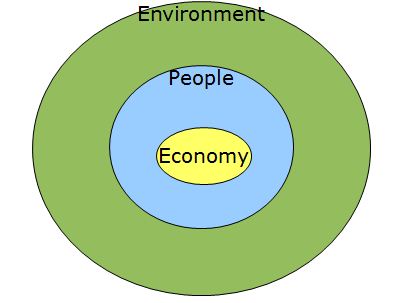
What we have…                  What we need….
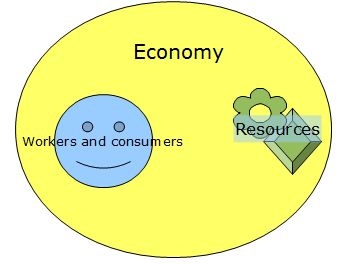
   

 A major shift is required indeed, both in systems and mentalities…

Sustainable Economies

It is not new. In 1973, E. F. Shumacher published Small Is Beautiful: Economics As If People Mattered which promoted the use of local and appropriate technology to empower the people in a world hit by the energy crisis and globalisation. The ideas are developped today by the New Economist Institute and its large network.

The concept of sufficient economy was supported by the King of Thailand and based on buddhist ideas, with three key principles: moderation, wisdom and built-in resilience. It has been developped in the Thailand Human Development Report published in 1997 and  adopted in the 10th National Development Plan as summarised below:
 

Here is an interesting article on “rethinking growth”, an interview of Herman Daly, ecological economist, published on Seed Magazine http://seedmagazine.com/content/article/rethinking_growth/

For the people, it is important to become active consumers. Do you really need to buy it? Choose where you spend your money wisely. Easy no? Concepts of frugality, simple living, intentional living, permaculture, the slow movement, alternative economics (and more – please suggest! ) are all different ways to deal with a common goal of moving out of the capitalism crisis.

Sustainable Practice in business is about finding innovative out-of-the-square-thinking ways of curving the line into a circle.
The line is: Take resources -> transform them into a product -> sell them -> products are used and dumped in landfill.
The circle is: take recycled resources -> process them with least waste -> use them -> recycle them

The example I preferred -so far- is Interfaceflor : from traditionnal carpet laying that goes to landfills in 10 years, they committed to Zero waste. Not only they choose non toxic materials, but they’ve arranged a way to separate materials after use so that they can be reshaped in new carpet. They lay squares of carpet so that used parts (entrance and ways) can be swaped with less used parts (corners) easily. Furthermore they found a way of recycling all their carpet: they ensure its maintenance overtime. Quite smart!

 I believe taking sustainability seriously is a wonderful opportunity to create economic and social systems that work in the long term for everyone and within the natural environment. It does not mean revolution. It does not mean “go back to the candle” as sceptics say. And it does not mean recession, as many fear. If we are to cover all basics needs for our growing worldwide population, there is huge scope for growth, which does not have to be destructive. We need to be aware, smart and innovative, and share… A big shift indeed! 

Knowledge, technology and tools exist and are taught in the Graduate diploma for Sustainable practice at Otago Polytech. I am studying towards it because I want to contribute to the shift.

Florence Micoud